


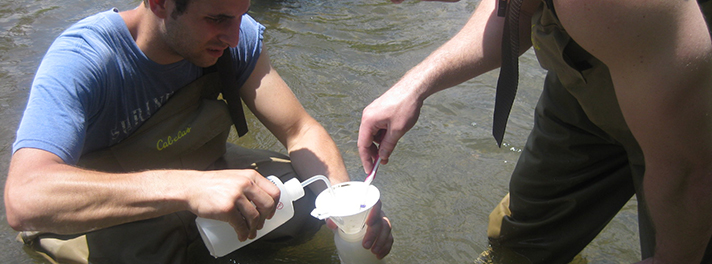
The interdisciplinary Environmental Management minor prepares students to apply the principles of environmental science and engineering to contemporary environmental problems in natural resource, industrial, and public policy contexts. The minor is particularly suitable for students interested in professional careers in business, natural resources management, and environmental policy and planning. The Environmental Management minor strives to develop graduates who can apply science and technology to a broad range of practical environmental problems in a variety of professional settings. These settings are addressed by three tracks within the minor.
Industrial Environmental Management
Many students completing the Environmental Management minor pursue careers in industrial environmental management. In this role they often work within industry to help ensure that their firm or clients are in compliance with environmental and occupational safety and health regulations, as well as to help move beyond compliance to become increasingly "green" corporate citizens. They may also work within the regulatory agencies which oversee the performance of industry with respect to environmental laws and regulations.
Natural Resources
Students interested in the management of natural resources will often find themselves working with governmental or private land management organizations which seek to preserve and/or conserve the natural resources associated with particular land or water parcels. They may also be engaged in the gathering and analysis of data describing the condition of flora, fauna, and abiotic elements of ecosystems ranging in size from small ponds to the entire Earth. Finally, they may engage in careers as environmental educators, teaching students of all ages about the intricacies of our planetary ecosystems and the interactions of humans with them.
Environmental Policy
Students with interests in environmental policy and regulation often pursue careers in government or non-profit advocacy work. In this role they may help influence or implement environmental policies, and often work with multiple stakeholders in the policymaking process. The environmental policy concentration is designed to supplement the minor's coursework in environmental science with classes focused on specific areas of environmental policymaking or expertise, such as economics, risk analysis, communication, and social dynamics.
Coordinator
 |
Dr. Steve Frysinger Integ. Science and Technology ISAT 309 MSC 4102 office phone: +1 540 568 2710 e-mail: frysinsp@jmu.edu |
Links


