

JMU Advances to Gold Level Virginia Pollinator-Smart Solar Site Certification
Environmental Stewardship


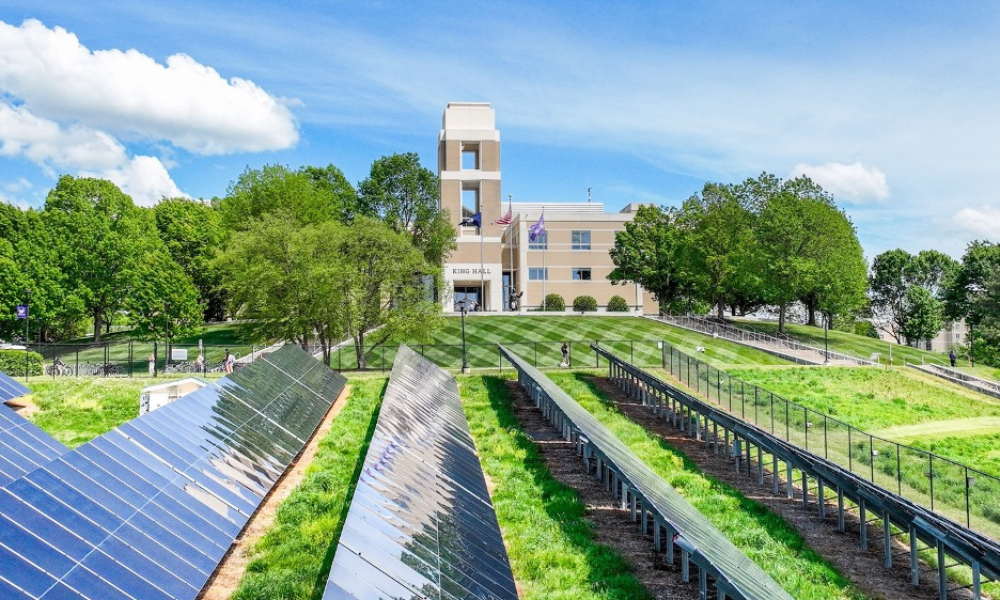
SUMMARY: James Madison University, the only university in the Commonwealth to earn a Virginia Pollinator-Smart Program Certification, advanced to gold-level certification for the JMU Pollinator-Smart Meadow and Solar Array, located adjacent to King Hall.
James Madison University, the only university in the Commonwealth to earn a Virginia Pollinator-Smart Program Certification, achieved gold-level certification for the two-year reassessment of the JMU Pollinator-Smart Meadow and Solar Array, located adjacent to King Hall.
The Virginia Pollinator-Smart Program, designed by the Virginia Department of Conservation and Recreation (DCR) and the Department of Environmental Quality (DEQ), is an “ecologically-responsible program to encourage pollinator-friendly solar energy developments throughout the Commonwealth of Virginia.” Scorecard criteria included providing benefits to the environment and the solar site owner/operator in a number of key areas over time, including: pollinator services, biodiversity and habitat enhancement, carbon sequestration, erosion and sediment control, and reduced vegetation maintenance. Recertification is required every two years. JMU’s Pollinator-Smart Meadow and Solar Array earned more than the 100 points on the Virginia Pollinator-Smart scorecard to garner the gold-level status.
In 2023, JMU received the standard certification. History of the meadow and details on certification can be found in a previous news story. JMU’s ascent to gold-level certification was in part due to the increasing coverage of native pollinator-smart plants in the panel area by 50% and the open zone area by 25% in the time between the initial application and renewal. Ali Sloop, Stormwater Compliance Specialist at JMU, coordinated the application for the Pollinator-Smart certification, commented, " The long-term vegetative management plan for the pollinator-smart solar facility involved a targeted and intensive plan for the control of invasive species in the first couple years as the native meadow species became established. This has been the main contributor to the increase in our scorecard. The native pollinator species are able to thrive without non-native and invasive species competing for resources and the quality of pollinator habitat in this space has benefited."
Public Engagement and Research is an important category on scorecard. Amy Goodall, Professor Emeritus, explained, “The East Campus Hillside is part of an ongoing project to investigate the temporal and spatial patterns in butterfly diversity and abundance across Harrisonburg. The project currently involves analysis of the observation data collected by more than 300 JMU undergraduate students over the last decade.”
The recognition is one of several environmental stewardship recognitions for Academic Year ‘25-’26. JMU was identified as a Top Performer in the Research Category of the Sustainable Campus Index and selected for inclusion in the in The Princeton Review’s 2026 Guide to Green Colleges.


