

How Jacqueline Rodebaugh ('14) is Inspiring the Next Generation of Thinkers
English



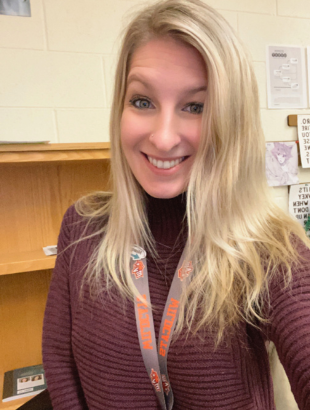
Jacqueline Rodebaugh, a 2014 Alumna, credits her time at JMU as an English major and American Studies minor with improving and shaping her skills as a teacher and writer. As a current teacher at Osbourn High School in Stafford County, Rodebaugh attributes the intersection of these two areas of study with improving her writing and analytical skills. She now applies these to her classroom, shaping the minds of the next generation.
Rodebaugh emphasizes that this intersection of study in particular is ideal for those looking to strengthen their awareness of historical and global affairs, as well as improving their writing.
“I think if you are akin to English, like it's your niche, it's the best way to help you grow as a writer.” Rodebaugh explains, “ It opens up a lot more avenues for your writing to go. It also gives you a basis of history. I think that's the most important part. “
Rodebaugh recalls taking AMST 200, the introductory course for the American Studies minor, which fulfils a general education requirement. “I do remember just really liking the course,” she says. “I thought it was really interesting diving into American history and getting to link it with literature. I've always been super interested in history and English.”
Rodebaugh also reflects on her time in a course with Dr. Federico, she felt as though her teaching style was an immersive and inclusive space for students to be involved.
“She actually was the one that awarded me the certificate of achievement, which was pretty cool. I actually still have the journal that she gave me as a present. It's worn and torn, let me tell you what. But I really thought that she just had such a good way of teaching that you felt okay speaking your mind even if you weren't sure if you were correct. Kind of have a safe space to spitball ideas. I really enjoyed that.”
The sense of safety and freedom that Dr. Federico fostered, is one Rodebaugh now strives to create in her own classroom. Rodebaugh currently teaches Honors English, AP Seminar, and Teachers for Tomorrow.
Teachers for Tomorrow is a program that gives students an introduction to teaching as a career, they also get dual enrollment credit for college. This program is offered to juniors and seniors across Stafford County.
“They spend the first two quarters with me learning every aspect of teaching, whether it be professionalism, learning styles of children,” she explains. “ And then by the second half of the year they're actually going to be able to student teach.”
After completing their practicum experience, students use the skills they have learned in order to teach a class.
“We just did something quarter one, where we went through different time periods in the past of how education was and the shift and the influences,” she says. “ They were able to take on a particular time period and present it to the class and learn the long-lasting influence it has on the educational system. ”
These strengths and skills in history and English not only transfer to Teachers for Tomorrow, but also into Rodebaugh’s more traditional classes. AP Seminar is a course where students research global issues and attempt to find plausible solutions.
Students work together to make research questions about a large-scale global issue. They do this over the course of the year as opposed to a more traditional classroom format. They analyze these issues through multiple lenses such as social, political, and economic.
“It’s kind of building on these skills all year,” she says. “It’s pretty cool.”
Rodebaugh’s Honors English class also examines a variety of texts from various points in history. This ranges from Letters from Birmingham Jail to Shakespeare.
“You can pull from something that occurred in history,” she explains, “and teach those annotation skills and rhetorical appeals.”
The intersection of literature and history are intertwined with the coursework in Rodebaugh’s classroom. Not only are these skills applicable to a classroom setting, but they influence civic engagement and understanding and are applicable to several different career paths.
“You can dissect particular time periods, and you can analyze and apply it to really what you need it for,” she says. “So I recommend for others, if it is something you even think you might be interested in, especially on the history side, do it, because it could lead to a lot of good.”
For Rodebaugh, pairing English and American studies has proven valuable in terms of the ways in which it influences a deeper understanding of the world, improves writing, and allows for strengthening of analytical skills.
According to Rodebaugh, “the most important part” is the foundation of history. When students are able to understand the connection between literature and its historical context, they become more thoughtful and informed thinkers.
And for Jacqueline Rodebaugh, that connection continues to shape her classroom every day.


