

Future Educators Ignite Science and Curiosity in Fifth-Grade Campus Experience
College of Education


On a Thursday afternoon in late April, the halls of the Union were ringing with the laughter and excited voices of 100 fifth graders from Smithland Elementary School, invited to campus by the College of Education to participate in a COE student-run, science-based field trip. The initiative, led by four cross-disciplinary faculty in the Early, Elementary, and Reading Education department, was part of a reciprocal partnership with the Harrisonburg City School district in which fifth grade students were invited to engage in standards-aligned science activities and gain exposure to JMU’s campus while 29 junior elementary education majors tried out course-aligned instructional practices with the diverse elementary students.
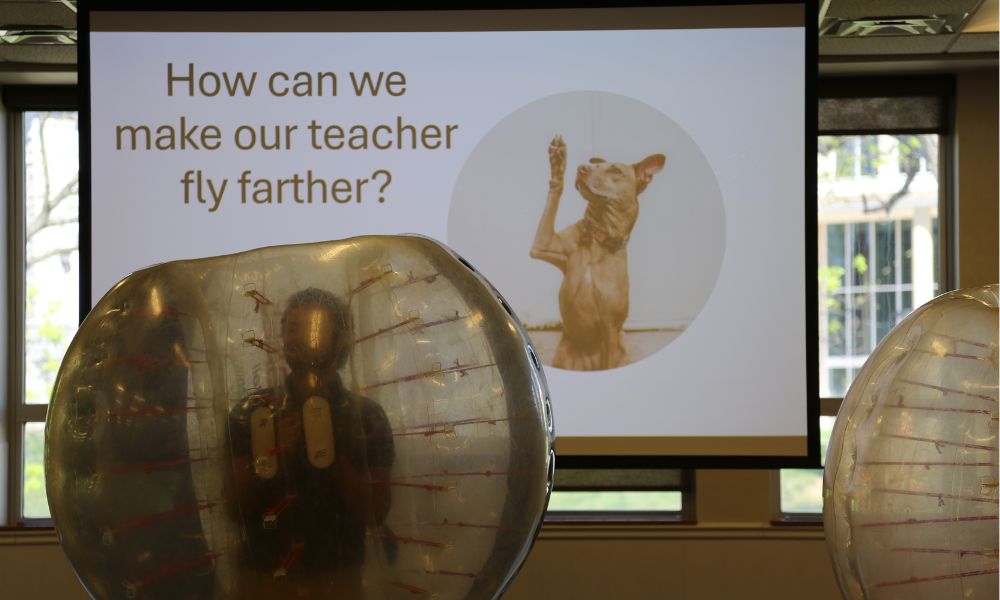
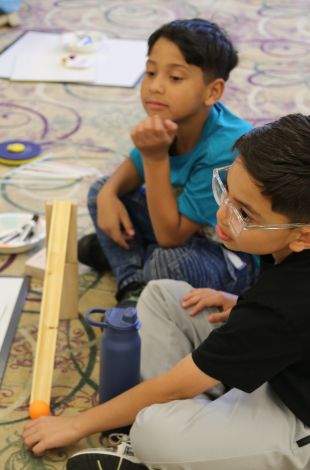
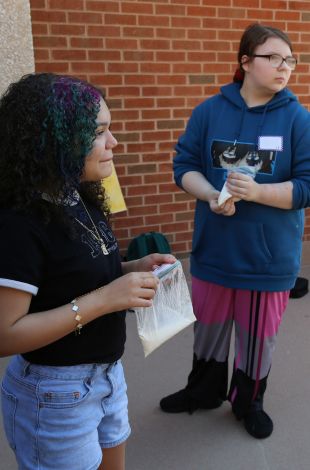
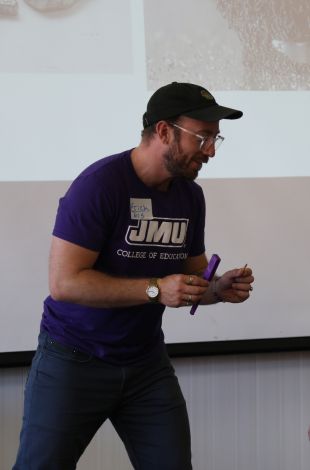 The fifth-grade students cycled through four science-based stations run by the elementary education students. In these stations, fifth graders explored grade-level science concepts like energy transfer and collision, mixtures and solutions, phase changes, and the rock cycle, through engaging and hands-on experiences that had students making ice cream, using magnets to investigate just what is in the cereal we eat every day, diving into the complex vocabulary of the rock cycle, and designing (and testing!) solutions for how to make their teachers fly farther in the game of KnockerBall. Though science was the overarching focus of the field trip, cross-disciplinary colleagues Liz Ochoa (literacy), Eric Imbrescia (math), Erich Sneller (science), and Alexis Rutt (science) worked together to create cross-disciplinary stations that allowed their elementary education students to also try out literacy strategies and math strategies, for a true cross-curricular opportunity.
 The collaboration was initiated by Dr. Alexis Rutt, assistant professor of science education in the College of Education’s Early, Elementary, and Reading Education department, as a way to fill a gap in her elementary education students’ learning while strengthening ties to the local school community. “With the heavy focus on math and literacy in elementary schools,” Dr. Rutt explained, “many of our students are not seeing science taught frequently in their practicum classrooms. This field trip gave our students an opportunity to try out the reform-oriented science instruction they are learning in class with real students, while also giving the elementary students an opportunity to participate in grade-level learning on a college campus with college students.”
The reciprocity of learning opportunities was a cornerstone of the project for the planning team. Thanks to a generous High Impact Activity grant from the College of Education, and funding support from JMU’s Work-Based Learning Experience program, the team was able to offer the experience to Smithland Elementary students completely free of charge.
 For Meredith Hagy, junior elementary education major, the field trip was a valuable learning experience for both her and her students. She explained, “Right off the bat, students were interested and engaged, which taught me how valuable it is to make science instruction interactive and hands-on for students. I think the 5th graders really enjoyed getting to step foot on a college campus and meet the College of Education students like myself and establish meaningful connections. I think this is something they will remember for a very long time.”
Riley Harrington, also a junior elementary education major, agreed, highlighting how the experience provided new instructional opportunities. She explained, “This field trip stood out to me because it brought student engagement and time management to life in a way I hadn’t experienced before. I really hope JMU keeps offering it; it was genuinely one of a kind.”


