

Students contribute to NSF-funded drought research
News


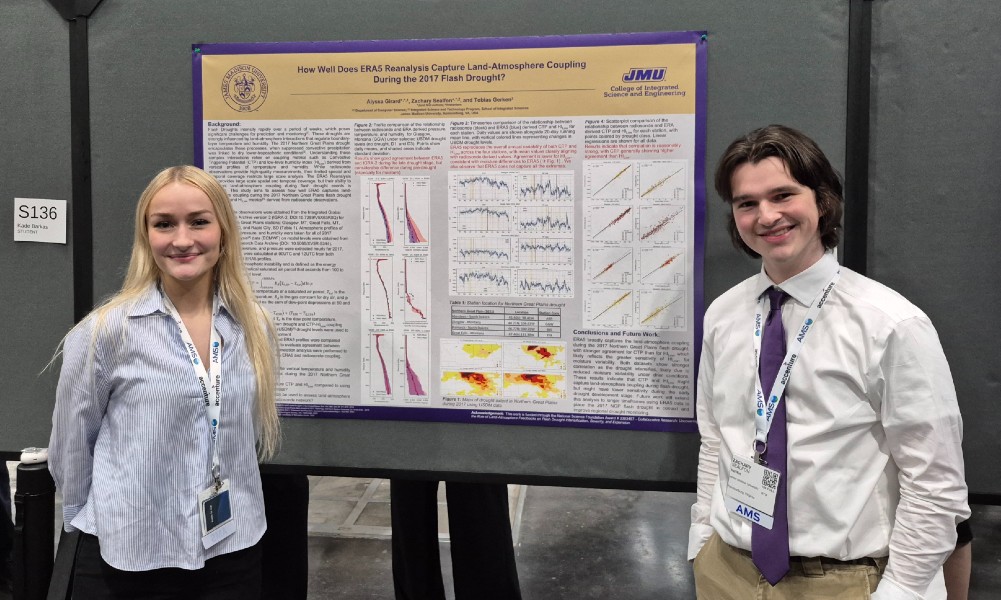
SUMMARY: Alyssa Girard (Computer Science) and Zac Sealfon (Integrated Science and Technology) contributed to NSF-funded drought research and presented their findings at the American Meteorological Society Annual Meeting, one of the country's largest weather and climate conferences.
Most undergraduate students don't expect to contribute to federally funded climate research, analyze data using a national supercomputer or present their findings at one of the largest weather and climate conferences in the country.
For Alyssa Girard (‘26), a Computer Science major, and Zac Sealfon, an Integrated Science and Technology major, that opportunity came through a National Science Foundation-funded research project. The project, led by ISAT professor Dr. Tobias Gerken, examines how interactions between the land and atmosphere contribute to the rapid development of flash droughts.
"Flash droughts are unlike traditional droughts. They develop very quickly and can intensify in a matter of weeks," Gerken said. "They are especially difficult to predict and manage and can lead to crop losses in agriculture, damage to ecosystems and also increase the risk of wildfires."
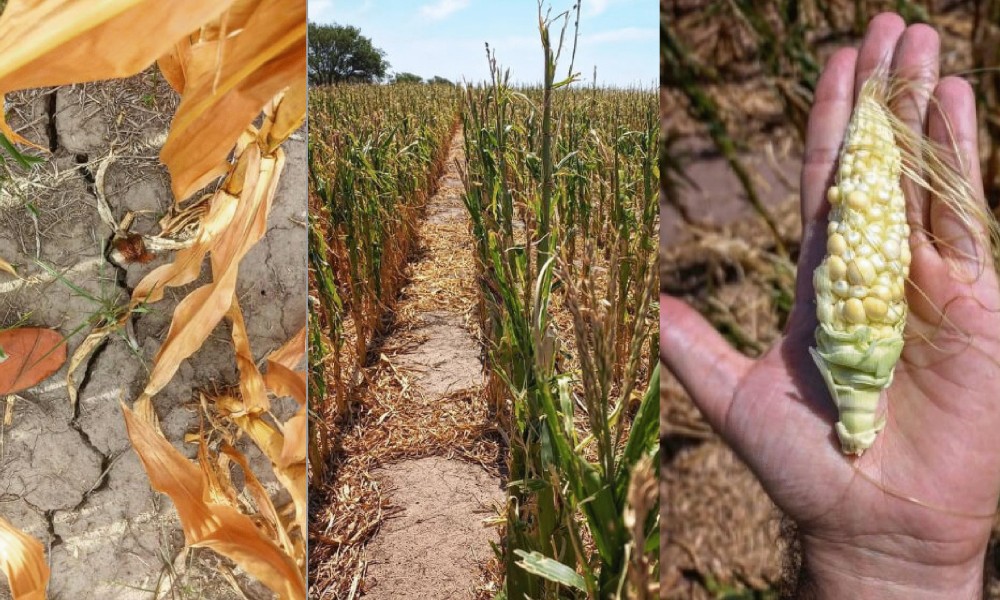
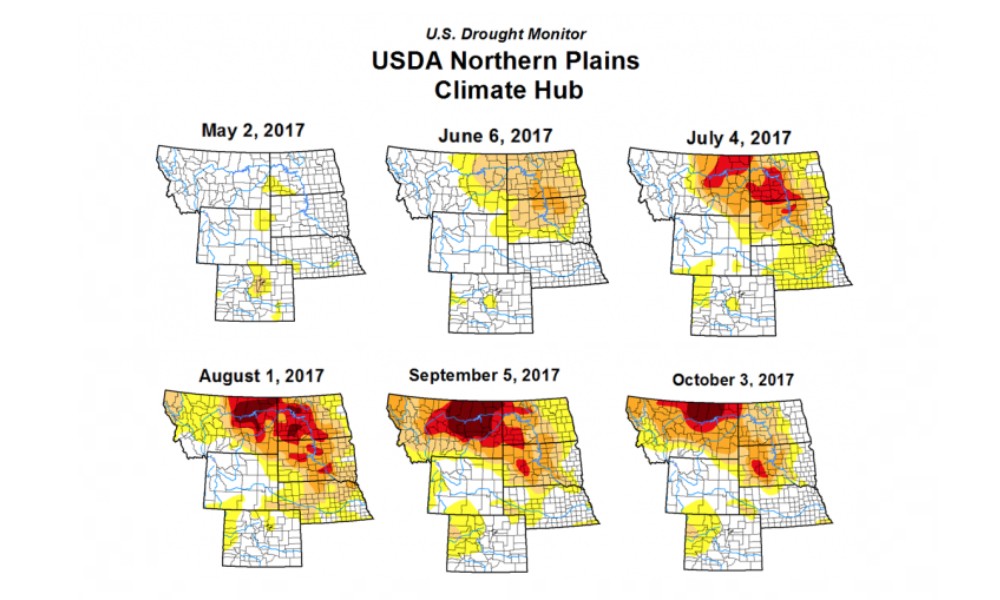
Using the 2017 Northern Great Plains flash drought as a case study, the students investigated whether atmospheric model data accurately captured land-atmosphere interactions observed during the drought.
To determine whether model data could be used to study flash droughts more broadly, Girard and Sealfon compared weather balloon data with reanalysis data — weather model data used to provide a best estimate of atmospheric conditions in places where direct observations are missing. Using Python, they analyzed temperature and moisture data from both sources to determine how closely the model data matched the weather balloon observations.
“Weather balloons are launched twice daily at about 70 locations in the U.S. This sounds like a lot, but that leaves a lot of places and times, where we don’t have measurements within the atmosphere. To fill the gap, scientists run atmospheric models, that provide a best estimate,” Gerken explained.
Because the datasets were too large to process or store on a personal computer, the students ran their analysis on Derecho, one of the National Center for Atmospheric Research’s high-performance computers located in Wyoming. “It was so cool to have access to such powerful computing, and it made our research efforts take far less time than it would have otherwise," Girard said.
Girard’s coursework in Computer Science prepared her to contribute to the project. "I have an extensive coding background to help me, as well as my data analytics minor," she said. "This research helped me develop my Python skills further, and I used Jupyter notebooks for the first time."
The project also introduced her to an entirely new area of research. "I am passionate about the environment and how the Earth works in general, so I was incredibly interested in researching droughts," Girard said.
As a result of their analysis, the students found that the atmospheric model data generally captured the same land-atmosphere interactions observed during the 2017 drought event. The findings provide confidence that the data can be used in future studies examining flash droughts across larger geographic regions.
"Alyssa and Zac have really been instrumental in our research," Gerken said.
Girard and Sealfon’s work culminated in a poster presentation at the American Meteorological Society Annual Meeting in Houston, Texas — one of the largest gatherings of weather, climate and atmospheric science professionals in the United States. They shared their findings with researchers, meteorologists and industry professionals from across the country.
"The AMS conference was incredible," Girard said. "Being able to fly to Houston, attend the conference and present was something I'll never forget. It was great to be able to show people what we'd worked so hard on."
In addition to presenting their findings, the students attended conference sessions, explored emerging research in weather and climate science and connected with organizations, graduate programs and potential employers. The conference exhibition included representatives from NASA, NOAA and private weather technology companies.
Gerken believes opportunities like these demonstrate the value of undergraduate research.
For Girard and Sealfon, the experience offered much more than a research project. It provided an opportunity to contribute to nationally significant scientific research, work with advanced computing resources and share their findings with professionals in their field — all before graduation.


