

Engineering a better way to relieve back pain
JMU News


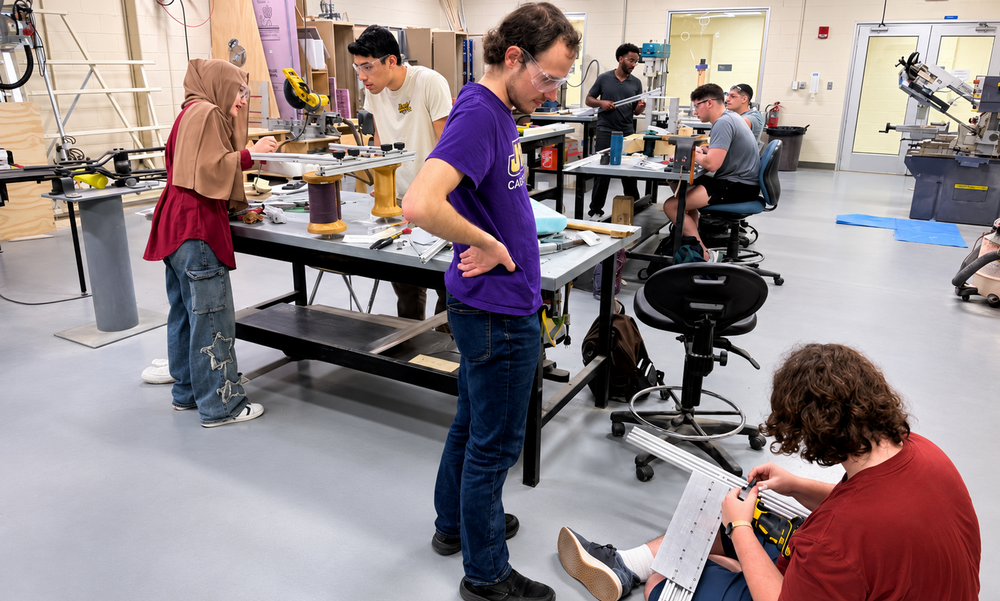
SUMMARY: JMU Engineering students designed two biomedical devices to make lower back pain relief more practical and accessible.
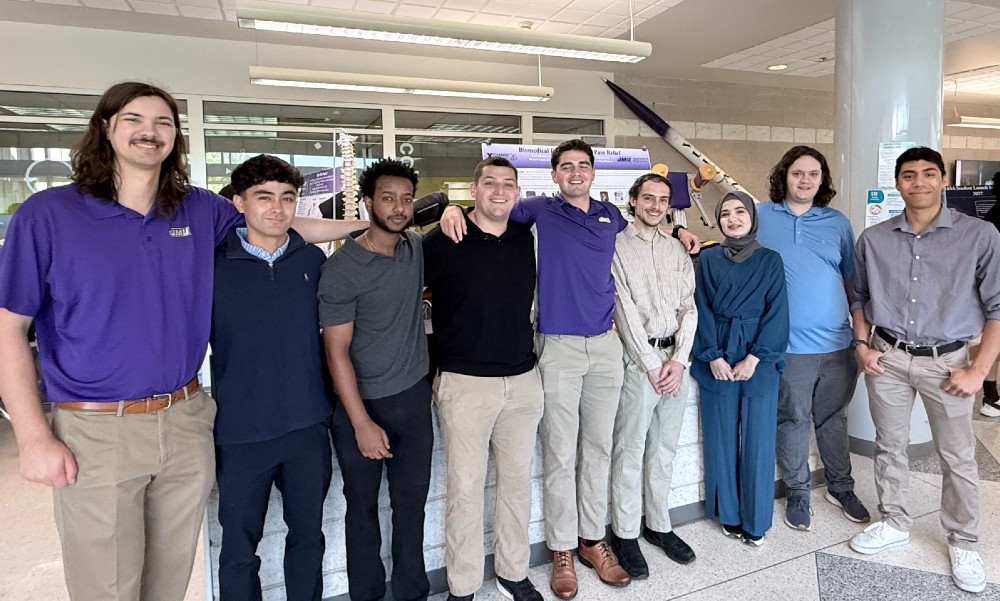
Two JMU Engineering teams, led by Marvin Fuentes ('26) and Aidan Fuller ('26), took on the same challenge: how to relieve lower back pain without relying on bulky, expensive equipment. As part of their capstone project, the students designed and prototyped biomedical devices to make back pain treatment more practical and accessible.
“I wanted the students to work on something that addresses a real human need and shows how engineering can make a meaningful difference,” said Dr. Karim Altaii, engineering professor and project advisor.
Altaii, who has suffered from back pain for nearly 15 years, tried numerous devices before finding relief with an inversion table. Altaii said the table has limits. “Many people cannot tolerate being inverted and the devices are expensive, bulky or in clinics,” Altaii said. “I wanted something portable that offered traction without being inverted.”
That challenge became the foundation for the capstone project.
Because the project focused on a biomedical device, students worked closely with Dr. Nando Vivsalingam, head of neurology at Sentara, and Dr. Sarah Gosselin, a physical therapist, strength and conditioning specialist and owner of SG Performance LLC.
Both teams focused on relieving pressure on the spine, but each took a different approach.
A pneumatic approach
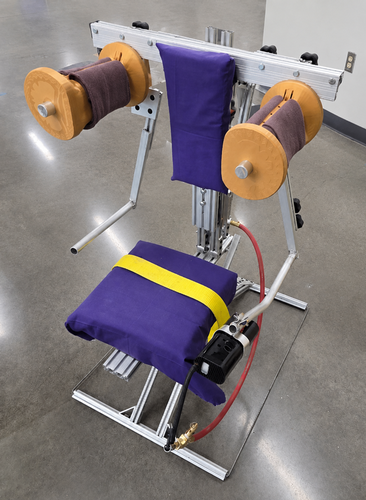 Fuentes’ team drew inspiration from traction tables. They developed a pneumatic system powered by compressed air pistons rather than traditional weights. The chair-like device applies traction while maintaining a lighter and more portable frame.
The team went through several rounds of prototyping and redesign before reaching its final concept. Their first prototype, made from wood, demonstrated the concept. The second version, made from steel, was too heavy to remain portable. They switched to aluminum, which created another obstacle.
“Our teammate only had experience with steel welding,” Fuentes said. “But with help from our advisor, we found aluminum that was standardized and able to be connected with bolts.”
To ensure the device was both safe and effective, the team relied heavily on calculations to determine the appropriate amount of force needed for traction. “To provide enough traction, you want a weight between 25 and 50 percent of the person’s body weight in force,” Fuentes said. “This ensures safety and that the back is adequately stretched.”
Fully mechanical design
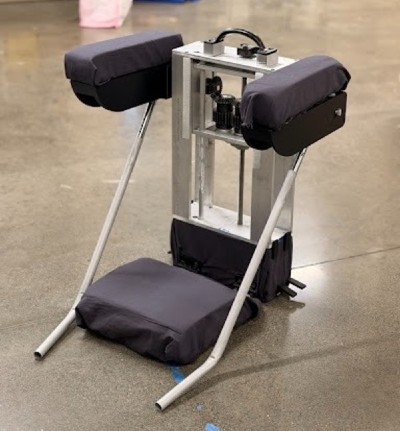 Fuller's team looked to inversion tables as a starting point and pursued a fully mechanical approach. Their design relied on a crank system and gears climbing a corkscrew mechanism to lift armrests positioned beneath the user’s arms, stretching the spine without the use of electronics or compressed air.
Each student created an individual concept before combining the strongest elements into a single design. “We all made our own designs we felt fulfilled the requirements,” Fuller said. “Then we came back and compared our designs to mash them together.”
The process involved constant redesign and refinement. Fuller compared the experience to working in a startup environment, where students were building something entirely new while balancing time constraints and design limitations.
“We were sent back to the drawing board three times,” Fuller said. “That set us back and delayed us from building our design.” Eventually, the team's persistence paid off.
The team also faced limitations in testing. “We can’t test it on people, only on our professor,” Fuller said. “If it works with him, then we know it’s effective.”
Engineering with a human focus
Students had to consider structural stability, material selection, durability and ease of use while designing for a wide range of users.
“One of the main challenges is designing a device that is effective, safe and comfortable at the same time,” Altaii said. “The device must provide the right amount of traction force without causing discomfort or introducing any safety concerns.”
Beyond the technical aspects, Altaii said the project gave students the opportunity to apply concepts from mechanics, biomechanics, materials and engineering design in a real-world setting.
“They’re learning how to move from idea to a working prototype through iterative design, testing and refinement,” he said. “They’re developing teamwork, communication and problem-solving skills.”
The students said seeing their ideas come to life was one of the most rewarding parts of the experience. “The best part was the freedom — being given a problem and designing a solution from scratch,” Fuentes said. “It helps to stretch our brains and give our all toward the design process.”
“The best thing for me was finally seeing it being built,” Fuller said. “Seeing the people around us getting excited for us, as we are for them.”
“They’re not simply building a device,” Altaii said. “They’re working on a solution that could improve someone’s quality of life."


