

IA students study economics and national security in Sweden
Two weeks. Three credits. A global perspective.
News


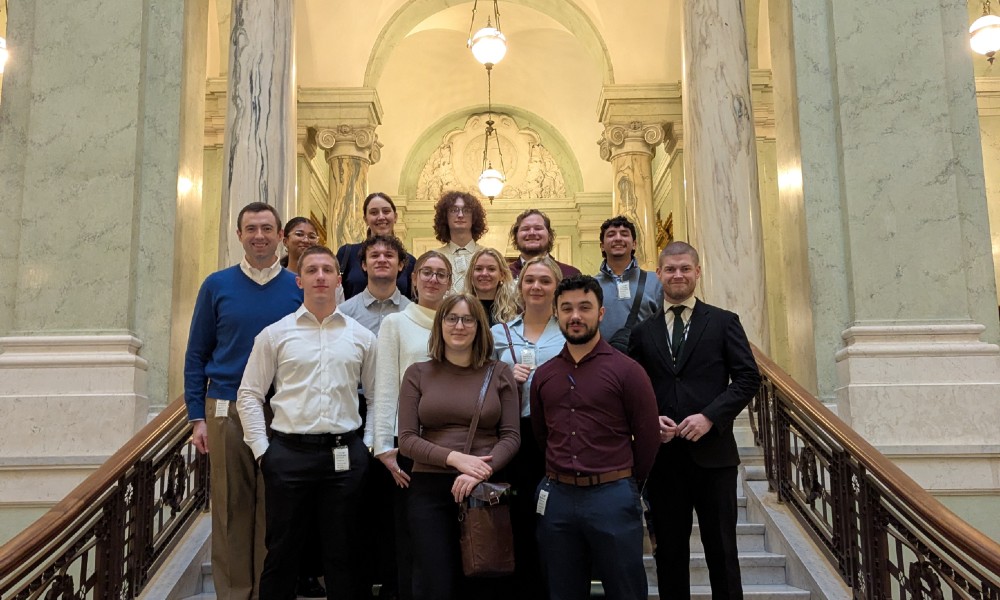
SUMMARY: While many students spent winter break at home, 12 students in JMU’s Intelligence Analysis program studied economics and national security in Stockholm, Sweden, examining how intelligence analysis operates beyond the United States.
The two-week session, held Jan. 4–17 and led by John Robinson, professor of intelligence analysis, condensed a three-credit course into daily lectures and structured site visits across the Swedish capital.
The Sweden program marked the first IA study abroad experience in about a decade. Robinson said the IA course sequence and cohort model make semester-long study abroad difficult without delaying graduation.
The curriculum is very prescribed,” said Olivia Scanlon, an IA major and program ambassador. “You can’t really miss anything, so we had to find a way to make it work between semesters.”
As part of her ambassador role, Scanlon helped initiate the winter program, identifying a location and brief academic window that would not interfere with required coursework or summer internships.
Robinson reached out to his dissertation chair, Dan Klein, professor of economics at George Mason University, who connected him with Charlotta Stern, professor of sociology at Stockholm University and CEO of the Ratio Institute. Stern connected Robinson with leaders at Ratio, a Swedish labor market research organization that studies how labor policies and demographic shifts shape Sweden’s economy.
Sweden’s recent entry into NATO and the Nordic region’s evolving security environment provided timely context for IA students studying national security and international affairs.
“Sweden is an ideal setting for examining intelligence analysis outside the U.S. context,” Robinson said.
“The Nordic region right now is a very lively region for international affairs,” Robinson added.
The Ratio Institute hosted the group, providing classroom space and connecting students with guest speakers in economics and policy. “They gave us space to hold daily seminars and connected us with scholars we otherwise wouldn’t have met,” Robinson said.
Students also visited the Swedish Parliament, known as the Riksdag, where they met with two Members of Parliament to discuss economics and national security policy.
Scanlon said one of the most impactful aspects of the program was hearing from a different guest speaker each morning. “It was really cool to hear from nine different people working in academia or within the European Union and learn about their specific experiences,” she said.
Beyond daily lectures and site visits, the program’s condensed format reshaped how students engaged with the material. Robinson acknowledged the intensity of fitting three credits into two weeks but described it as a worthwhile trade-off.

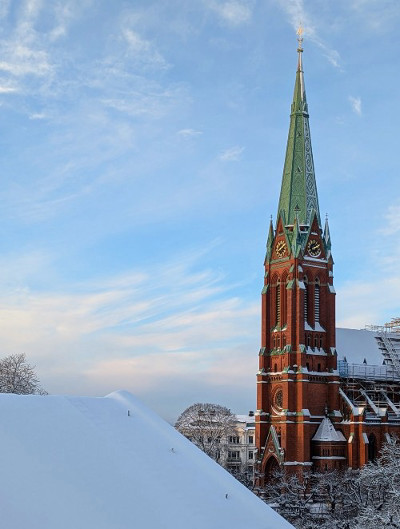
IA student, Joseph Fernandez, looks out over the Stadsgården harbor in Stockholm.
“Everything we’re doing is potentially class-related, and then we just get breaks from that,” Robinson said. “It changes the nature of the academic experience.”
Scanlon recalled visiting the Nobel Prize Museum and connecting exhibits on humanitarian law and disability protections to an international humanitarian law course she had taken during the previous semester. “I sent my professor pictures of what I was seeing,” she said. “I was in another country, and it all connected to his lectures.”
The immersive nature of the program also fostered strong bonds among participants. Students shared meals, participated in snowball fights and spent nearly all their time together, creating what many described as a family-like dynamic.
“It becomes a communal activity,” Robinson said. “We’re all in this together, and we rely on each other.”
“Taking a traditional class and turning it into a two-week experience can be incredibly beneficial,” Scanlon said. “I learned so much both inside and outside the classroom and met people I would not have met otherwise.”
For IA students, the Sweden program provided professional exposure, global context and a deeper understanding of how intelligence analysis intersects with economics and policymaking abroad – lessons that will continue shaping their coursework and future careers.
For Robinson, the Sweden program is a model he hopes to continue building.
“It’s a good deal of work,” he said, “but it’s wholly worth it.”


