

Student-led research explores how music affects learning for students with ADHD
College of Health and Behavioral Studies


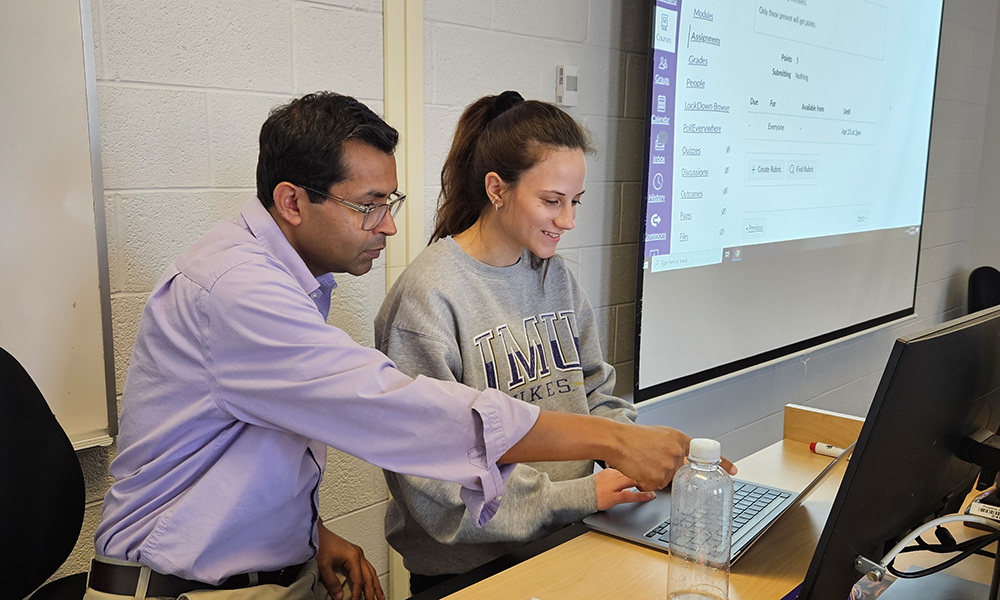
When James Madison University (JMU) student Madalynn Nofplot (’26) approached Health Sciences professor Raihan Khan with an idea about listening to music and attention-deficit/hyperactivity disorder (ADHD), neither expected the results would challenge some common assumptions about studying and concentration.
What began as Nofplot's Honors Capstone grew into a published study in Psychiatry International with co-authors Dr. Md Towfiqul Alam, Dr. Sojib Bin Zaman, Dr. Catherine Zeman. It examines how listening to music relates to academic performance among college students with and without ADHD. Along the way, it also became an example of the hands-on research opportunities available to JMU students.
"We are student-centric at JMU," said Khan. "We emphasize teaching and mentoring students in our research."
The project began with a simple observation. Nofplot noticed that many students regularly listen to music while studying and wondered whether the habit affects students with ADHD differently than their peers.
“My mother, she sent me a playlist one day…and it was music to help you study or music that will help you focus,” Nofplot recalled. “I wondered if this playlist was actually curated based on a scientific study or a specific reasoning.”
"She told me, 'Dr. Khan, I have this idea,'" Khan said. "She thought a lot of students are listening to music, and she wanted to know how it helps, especially students with ADHD."
As Nofplot's faculty mentor, Khan guided her through the three-semester Honors Capstone process. Together, they refined the research question, reviewed existing literature, and designed a survey for students. After securing Institutional Review Board approval, they collected data from JMU students.
"The main question was very simple," Khan said. "If a student with ADHD listens to music when they are studying, does it help improve their GPA?"
The researchers distributed online surveys and advertised participation through flyers across campus. More than 600 students responded, and 541 responses were included in the final analysis.
The survey asked students about their music-listening habits, preferred genres, ADHD status and self-reported GPA. Khan and Nofplot also explored whether factors such as academic level and college affiliation influenced the relationship between music listening and academic performance.
Their findings revealed that the relationship between music and academic success is far more complicated than many might expect.
"It's interesting because I didn't know that this is what we would find," Khan said. "And that is actually very normal. If you knew what you were going to find, you would not need to do the study."
The team examined a wide range of genres, including classical, rock, pop, rap, country, EDM, jazz and others. Although classical music is often associated with concentration and productivity, the researchers found no significant relationship between listening to classical music and higher grades.
The findings became even more complex when the researchers compared different student populations. Undergraduate students with ADHD who listened to music reported lower GPAs overall. However, among graduate students with ADHD, the results suggested that music could provide more academic benefits.
The study also found that some genres appeared to be associated with different academic outcomes. Students who reported listening to rap, for example, reported higher GPAs than students who listened to classical music.
“Some genres in the survey did not have many responses. We could have seen different results about some genres if we had more responses. Therefore, this type of study needs to be repeated at JMU and other institutions to have a better understanding,” Khan explained.
“The results were very sporadic; it was very interesting,” Nofplot added.
For Khan, one of the most important takeaways is that there is no universal formula for successful studying. Instead, students should develop study habits that work best for their individual needs.
Beyond its findings, the project demonstrates the value of undergraduate research and faculty mentorship at JMU. Khan considers student involvement as a central part of his research program and says every research project he has conducted at JMU has included student researchers.
"I personally always benefited from mentoring students in all the research studies that I have done at JMU," he said. Khan's commitment stems in part from his own experience as a student researcher.
"When I was a student, I was somebody else's research assistant," he said. "So, I give it back now."
In addition to mentoring Honors Capstone students, Khan regularly works with students through JMU's First Year Research Experience program and other undergraduate research opportunities. Many students continue working with him for multiple semesters, gaining valuable experience. For students considering research, Khan believes the benefits extend far beyond a single project.
"This is a great opportunity if they can get to work with a faculty member," he said.
Academic Unit Head and Health Sciences Professor Jeff Herrick also believes student-faculty research collaboration is essential to students' professional development, stating, “It (research) provides students with tangible life skills and professional skills such as working in a team, collaboration, time management, accountability, struggle and success. For students, when they participate in research with faculty, it’s always a very memorable moment for them...it ends up being one of the key outliers in their resume when they look for their first work or graduate school. It often comes up in those interviews, and it gives them something tangible to talk about that usually translates to the job and the profession.”
For Nofplot, what began as a question about music and ADHD evolved into a published study and a deeper understanding of the research process. For Khan, the project represents exactly what undergraduate research at JMU is designed to accomplish: empowering students to ask meaningful questions, pursue evidence-based answers and contribute new knowledge to their fields.
As the study shows, research does not always confirm expectations. Sometimes, the most valuable discoveries are the ones no one anticipated.


