

Douglass Day’s Debut for Dukes
News


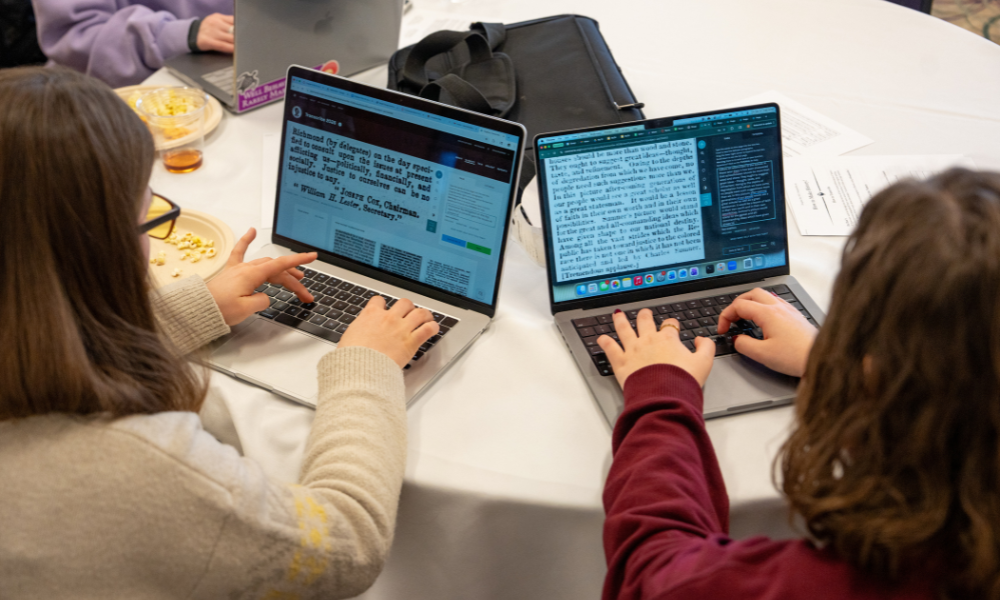
SUMMARY: JMU faculty and students celebrated Douglass Day by joining others across the country to transcribe documents connected to Black history.
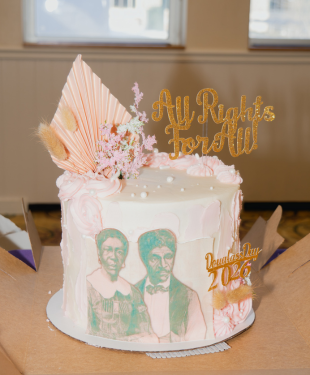
For the first time in its history, JMU faculty and students came together in the Union Ballroom to celebrate Douglass Day — a yearly national event aimed at digitizing Black history.
Facilitated by the University of California, Santa Barbara’s English department, the annual Valentine’s Day event kicked off with a livestreamed welcome ceremony, where event facilitators explained the purpose of Douglass Day: for students and community members across the country to transcribe documents connected to Black history.
“We like to always think about Douglass Day as one of the starting points for Black History Month,” English professor Courtney Murray Ross said, who spearheaded bringing Douglass Day to JMU. “This is about its ninth or tenth year [of the national event], and I've been involved since Douglass Day in 2020 — so I'm very excited to finally bring it to James Madison.”
In addition to bringing Douglass Day to JMU, Murray Ross was also one of the six team members who helped plan and facilitate the national event — in part due to the “formative” experience she had when she participated in Douglass Day as a graduate student. She said it seems like the attendees at JMU’s Douglass Day were excited to participate in Black history.
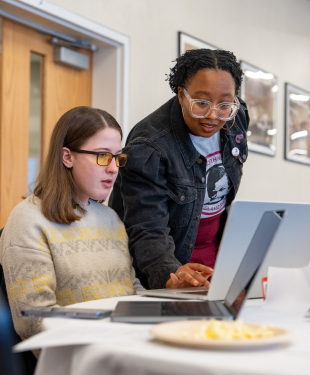
Students were given eighty minutes, broken up into sections by four live broadcast events, to transcribe a plethora of historical documents from across the country. Justice Studies major Kat Kalb (’28) attended the event to receive extra credit for her social justice class paired with a passion for learning about and participating in history.
“I enjoy history, so I think it's fun to broaden your horizons and learn more about people in our history,” Kalb said. “This is the first event I've seen [for Douglass Day], but I'm sure there is going to be more.”
Out of the 3,417 documents needing to be transcribed nationally, participants were able to transcribe 2,478, according to @DouglassDayOrg on Instagram. For each of these documents, participants were also asked to list the names found on the page — and 1,880 of these pages were combed through for names.
Transcribing these documents will allow them to be more accessible for individuals conducting research or simply looking for information, Murray Ross said.
“I hope that we can continue to grow [Douglass Day] as long as I'm here — and as long as JMU is excited to have Douglass Day, they will have it every year, Murray Ross said. “I’m very excited to keep it going, and I hope to see more people as we keep going forward.


