

The American Experience
JMU’s distinctive General Education courses spotlight learning across a broad set of students
Nation and World


By Dr. John Scherpereel, professor of political science, coordinator of the American and Global Perspectives area of JMU’s General Education Program
In 2020, the Virginia General Assembly established the Virginia American Revolution 250 Commission and charged it with “commemorating the 250th anniversary of the American Revolution, the Revolutionary War and the independence of the United States.”
Despite that call’s tight historical parameters, VA250 eventually unveiled a tagline that expands well beyond the revolutionary era. That tagline — “America. Made in Virginia.” — directs attention to the country’s origins and its contemporary realities. In many ways, yes, America was made in Virginia. But America is still being made in Virginia. And an important part of Virginia is made at JMU, whose mission is to prepare students to be educated and enlightened citizens who lead productive and meaningful lives.
JMU’s General Education Program is a key means through which the university pursues its mission and contributes to America’s ongoing construction. Since the late 1990s, JMU has required all undergraduate students to pass a course where they reflect on American history and principles, think deeply about contemporary political and social dynamics, and grapple with their personal civic responsibilities.
Students take one of three courses to satisfy this requirement — U.S. History (HIST 225), Justice and American Society (JUST 225), or U.S. Government (POSC 225). Regardless of which option they choose, they engage with primary sources. They evaluate domestic processes using qualitative and quantitative data. They grapple with the complexity of American engagement in world affairs. They seek to understand the practical implications of abstract principles like “freedom,” “equality” and “justice,” and they analyze patterns of inclusion and exclusion over the course of the country’s history.
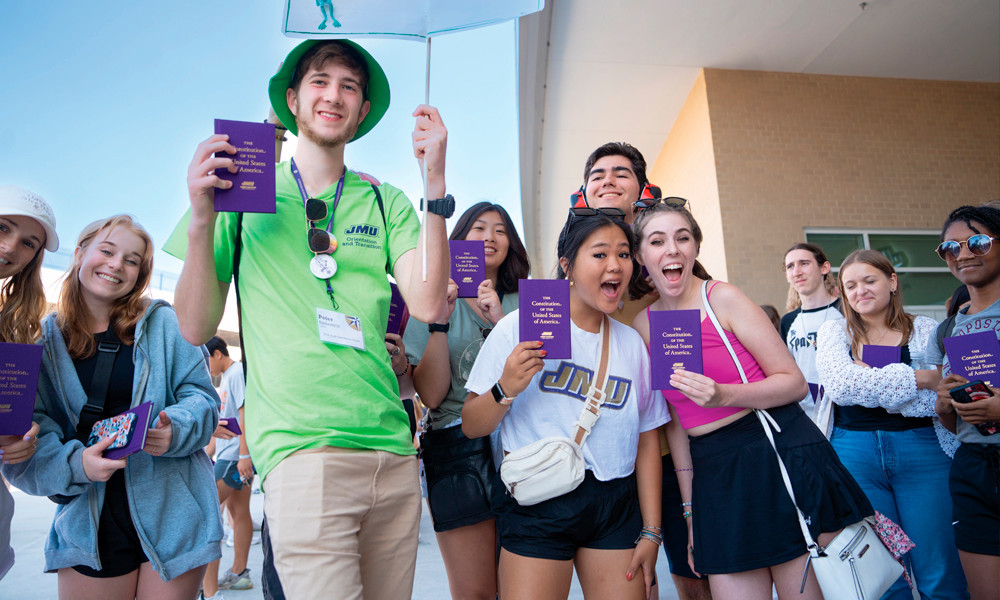
The institutional effort involved in pursuing these outcomes is significant. In the 2024-25 academic year, for example, the university offered more than 100 sections of HIST 225, JUST 225 and POSC 225, meaning just over 4,000 JMU students were enrolled in one of the three courses. Investments beyond the traditional classroom are also significant. General Education collaborates with various internal partners — colleges, departments, the James Madison Center for Civic Engagement and more — to support co-curricular initiatives and activities like the distribution of pocket U.S. Constitutions, field trips, speakers and more. This supports knowledge of and engagement with the process of making America.
Faculty in American Experience courses employ a wide range of pedagogies to promote the common outcomes.
Instructors have integrated role-playing simulations into their classrooms. Political Science major Joel Hensley (’08)— who is teaching POSC 225 and serving as a Rockingham County, Virginia, supervisor — remembers taking International Relations with Dr. Jonathan Keller during his undergraduate studies. Keller designed a semester-long, foreign policy decision-making simulation, which, at that point, required papers, pencils and physical message boards. In the intervening years, Keller had collaborated on the development of a software package, Statecraft, which opened up further instructional possibilities.
The educational impact — and the pure fun — of Keller’s simulation stuck with Hensley, whose educational journey has now come full circle. Hensley is leading his set of POSC 225 students on a semester-long Statecraft simulation of American politics and policy. He divides the students into teams, such as the White House, House Democrats, House Republicans, Senate Democrats, Senate Republicans and various news outlets, each of which pursues different political and policy goals, such as elections and preventing a terrorist attack. Students compete for a finite set of game points, so that players with overlapping goals, such as House Democrats and Senate Democrats, still have incentives to compete.
Hensley finds that the gamification resonates with today’s students, much as it did for him. But the big payoff is educational: Students see political processes from the perspective of the players they are representing, and come to a new appreciation for how the rules of the game structure strategic interactions and political outcomes.
The list of innovative pedagogies goes well beyond role-playing simulations. In her JUST 225 class, for example, Dr. Melissa Švigelj, assistant professor of justice studies, teaches students about the social and political roles of zines — self-published, modest-circulation magazines that various political and social campaigns have used since the 1930s. Then, Švigelj has students publish their own zines that focus on Supreme Court cases. The projects students submit must present both sides of a case and integrate primary sources — for example, transcripts of oral arguments as well as excerpts from decisions or materials that parties and their supporters used to advocate for their causes.
In the same class, Švigelj partners with an educational technologist in JMU Libraries. Her students learn the basics of Tinkercad, a free 3D-modeling program, and print 3D prototypes that relate to contemporary issues and themes. For example, recent prototypes have drawn attention to food insecurity, oceanic pollution, global warming and human trafficking.
Like Švigelj and Hensley, professor of political science Dr. Kathleen Ferraiolo designs assignments that draw on the interests that diverse sets of general education students bring to the classroom. The fact that all students must fulfill the American Experience requirement means there is always a broad cross section of majors and minors in her POSC 225 class. Students with interests in media and communication may be instinctively attracted to the podcasts Ferraiolo assigns on the decline of local newspapers. Her guided considerations about the implications of “small-press death” for the vitality of American democracy, though, engage all students and encourage critical thought about the nature of the public sphere in the past, present and future.
Ferraiolo and her colleague, Dr. Martin Cohen — both recipients of JMU’s highest award for general education teaching — also spend time covering matters mathematical, scientific and technological. They require students to assess the sampling quality of different polls. They discuss the ways that geographic information system-enabled redistricting software enables decision-makers to draw precise gerrymandered districts. They ask students to consider ways that artificial intelligence might threaten and/or enhance democratic quality and affect social/institutional trust.
Professors Dr. Abraham Goldberg (political science) and Dr. Rebecca Brannon (history) are also careful to bring students, regardless of their interests, backgrounds and majors, into conversations in innovative and perennial ways. For example, both professors use classroom-polling software to assess content mastery. And Goldberg takes advantage of the fact that Virginia’s electoral calendar (elections every year) is more crowded than the calendars of other states. He devotes each fall’s “post-election Wednesday” to a systematic debrief. He answers students’ election-related questions, but he also facilitates conversations about the results. In a social environment where citizens tend to digest elections within like-minded groups and in online echo chambers, the opportunity to reflect in diverse groups is increasingly rare and increasingly valuable.
The construction of America is an active and ever-evolving process. Through intentionally designed, creatively delivered courses that require active reflection from multiple angles and dovetail with broader university efforts, JMU is preparing students to be educated and enlightened citizens who continue to make America.



