

From the classroom to the Constitution
National Teacher of the Year Phil Bigler (’74, ’76M) reflects on education, history and the enduring legacy of James Madison
Education


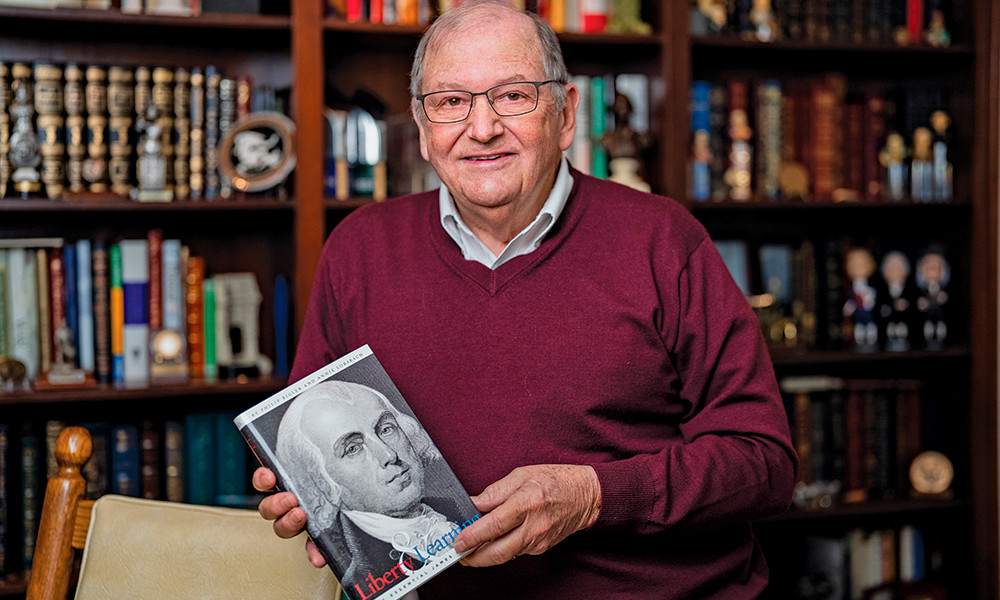
SUMMARY: Phil Bigler (’74, ’76M) is a retired educator, historian, researcher and author. The 1998 National Teacher of the Year, he returned to JMU in 2001 to lead the new James Madison Center for Liberty and Learning. Bigler is the author of 11 books on history and education.
Madison magazine: Can you talk about your Madison Experience and how it helped launch your career?
Phil Bigler: I actually transferred here in my junior year. I started at Virginia Tech, and I was kind of a lone ranger as a history major down there. The summer before I transferred in, I got a telephone call. My mom answered, and she called up to me: “There’s a professor on the phone.” I said, “A professor?” I went downstairs and picked up the phone, and a voice on the other end said, “Hello, this is Dr. Ray Dingledine, chairman of the history department. I want to welcome you to Madison College.” Wow. All of a sudden, I realized, this is going to be a different kind of place.
The history department at Madison was just spectacular. I got to know a lot of the professors … [including] Dr. Clive Hallman, who was a colonial history professor, and Dr. Lee Congdon, who was my great intellectual mentor and remains a friend to this day. Because it was a small school at that time, there were a lot of opportunities, and the faculty was very interested in teaching and getting to know you and to help you. After I graduated, I had the opportunity to come back as a graduate student the following year, and I actually had an office in Jackson Hall and got to teach some classes. It was such a great experience. It changed my life.
Madison: You went on to become an award-winning high-school teacher. You also taught here at Madison and served as a teacher trainer for a time. As part of your educational philosophy, you wrote: “As a profession, teaching remains one of the truly noble occupations, and we are engaged in a daily struggle against ignorance. It’s our fundamental responsibility to show our students the importance of knowledge and the need to be well-versed in history, literature, foreign languages, mathematics, art, science and all of the other disciplines that represent the cumulative efforts of human civilization over the last 10,000 years.” That’s a pretty big charge. Are teachers living up to that responsibility?
Bigler: I think the teachers who focus on their students and student learning are the most successful. Madison turns out outstanding teachers. I had a really great experience working with some of our preservice teachers here, and we ran a program called the Teachers of Promise, which was designed to bring in some of the most talented preservice teachers from all over the commonwealth for a conference to meet with and be encouraged by award-winning educators. We need to support our new teachers.
I think we also need to emphasize the importance of subject knowledge. I still say that the most important thing that we can do is to get kids interested in reading and books. I fear that not only students, but teachers as well, are not spending enough time reading serious material. … Kids today, they’re bombarded with information. When I started teaching, we had no materials. We had just a textbook and whatever else we could create and develop, but were pretty much on our own. Today, it’s the reverse. There is so much material out there. You have to be able to sort out what’s accurate and relevant. … You also have to switch things up. The worst thing a teacher can do is to get stagnant and teach the same course over and over in the same way. I believe that kids need to be active learners. I used a lot of historical simulations in my classroom and, again, I got kids to think for themselves.
Another thing I’ve always said about being a teacher is you have to be optimistic. If you’re not, you’re in the wrong profession. You have to have faith, and you have to reach each kid individually. I still believe that teaching is one of the most noble professions there is, and I think the ones who are dedicated to it … are the ones who open the doors to lifelong learning and exploration.
Madison: You stepped away from teaching for three years in the 1980s to serve as the historian at Arlington National Cemetery, which became the subject of a book on the history of the site, In Honored Glory: Arlington National Cemetery, The Final Post. Why should every American visit there?
Bigler: It’s the nation’s burial ground and a record of American history. We have dead from the American Revolution all the way to the present there. It’s notable as the site of the Tomb of the Unknown Soldier, as well as the graves of John and Robert Kennedy. There are over 400,000 servicemen and women interred at Arlington, and every one of these headstones represents an individual life — a past to be remembered, a story waiting to be told. Both of my parents are buried there. My in-laws are also buried there. So, it’s a very special place to my wife and me. … What’s hard for me now is that some of my former students are buried there. Toward the end of my teaching career, I thought we were done with wars. But sure enough, after 9/11, a couple of my students went into the military and were killed in either Iraq or Afghanistan in the war on terrorism. And so, it became a place where I learned some important lessons. One was that life is short, and we don’t know how much time we’ve got, and we need to make the best of it. It’s also a reminder that there are real-world, human consequences to decisions and policy. We all need to be aware of that.
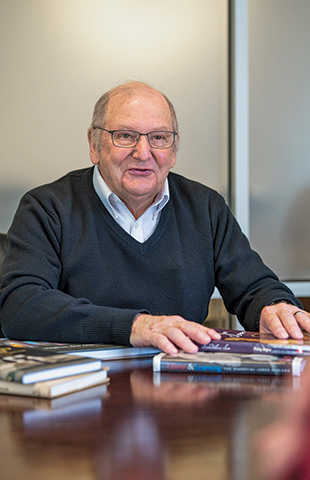
Madison: You wrote another book, Hostile Fire: The Life and Death of First Lieutenant Sharon Lane, about a young military nurse who was killed while serving in Vietnam. Where did the inspiration for that book come from?
Bigler: I had written a book called Washington in Focus, which was basically a photographic history of Washington, D.C. At that time, the most recent monument was the Vietnam Memorial. I had gone down there and looked around, and I saw that there were eight women whose names were on the wall of the memorial. I never even thought about it, and I felt really guilty about that. I initially thought I was going to write this story of all eight nurses, but after doing some research, I found out that I really needed to focus on one, Sharon Lane, who was the only nurse killed as a result of enemy action. She was only in Vietnam for six weeks, and she wrote something like 14 or 15 letters from Chu Lai. Those letters became the basis for the book. I was still teaching at the time, and I contacted her mother, who lived in Canton, Ohio. Once a month, I would finish teaching at McLean High School [in Northern Virginia] on Friday; drive to Canton, Ohio, that night; spend the next couple days in Canton; and drive back and teach a class on Monday. … It was a fascinating project, because it shows how the world has changed.
Madison: This year we’re celebrating the nation’s semiquincentennial. In the future, when historians look back on the first 250 years of the American republic, what do you think will stand out to them?
Bigler: I think the idea that the individual citizen is important. That was radical thinking in 1776. And it carried over to our Constitution, which starts out “We the people …” If you think about [James] Madison, he lived from 1751 to 1836. He’s born under King George II of England at a time when being a member of the British Empire was considered to be a great privilege. He dies under Andrew Jackson, the populist president. During that period, he witnessed the development of America, from a group of colonies to a republic, and he saw the ideas of individual liberty and freedom that he had advocated for take root. Madison and others also warned — I think very significantly — that it will take an educated populace to retain the republic. And so hopefully we’ll be able to continue that.
Madison: Why is it important that this institution is named for James Madison?
Bigler: Madison is called the “forgotten founder,” because he’s always in the shadow of Thomas Jefferson. But it was Jefferson who said that Madison was the smartest man he knew. He’s a great exemplar for students. He was a believer in education and the advancement of knowledge. He was the scholar president and a man who believed in the importance of an educated citizenry to help preserve the ideals that had been won in the [American] Revolution. He’s also responsible for two of our three founding documents: the Constitution and the Bill of Rights. And because he was with George Mason in Richmond [in June 1776] when the legislature adopted the Virginia Declaration of Rights — which became the basis for the Declaration of Independence — you could argue that Madison’s largely responsible for all three of our founding documents. And yet, most people don’t know much about him anymore. You go to Washington, D.C., and you see the Washington Monument, the Jefferson Memorial. The only thing [in the District] named for Madison is one of the buildings of the Library of Congress.
So again, in many ways, this is an opportunity for the university to celebrate a man of great wisdom. Jefferson was brilliant, but he was also an idealist. He didn’t understand human nature the way Madison did. Madison believed that human nature basically doesn’t change. People will act in their own best interest. The genius of Madison is that he tried to create a government that allowed for this fact to maximize human potential but, at the same time, not allow for chaos and anarchy.



