

I Dream a World
Monday, October 19, 2026
7:30pm
Forbes Concert Hall
Please silence all electronic devices.
Unauthorized videotaping or any other recording of this production is strictly prohibited in adherence with Federal copyright laws.
Program
UCSA: University Chorus Soprano/Alto Ensemble
Jo-Anne van der Vat-Chromy, director
Elizabeth Williams, collaborative pianist
Awakening - Christi Jones (b. 1960)
"Oh, Had I Jubal's Lyre" from Joshua - G.F. Handel (1685-1759)
White Winter Hymnal - Robin Pecknold/arr. A. Billingsley
Kendra Liverman, undergraduate conducting intern
Somewhere Over the Rainbow - Music: Harold Arlen/lyrics: E.Y. "Yip" Harburg/arr. Celtic Woman
Savannah Whitley, undergraduate conducting intern
What Happens When a Woman Takes Power? - Alexandra Olsavsky
UCSA: University Chorus Tenor/Bass Ensemble
W. Bryce Hayes, director
Linlin Uta, collaborative pianist
Bound for the Promised Land - Early American Hymn/arr. E. Crocker
Dies Irae (Day of Wrath) - Z. Randall Stroope (b. 1953)
When Dawn Shines - Mishaal Surti
Brian Garmendia, undergraduate conducting intern
"Loving-Kindness" from Awakening - Stephen Paulus (1949-2014)
Wild Mountain Thyme - Traditional Scottish/arr. Karen Marrolli
Dr. Annie Savage, fiddle
Combined University Choruses
I Dream a World - André J. Thomas (b. 1952)
Based on the inspirational poem by civil rights advocate, writer, composer, and diplomat James Weldon Johnson (1871-1938), Christi Jones sets Awakening with beautiful cluster chords over a driving syncopation that highlight the vibrant symbolism of the poem itself.
I dreamed that I was a rose that grew beside a lonely way,
Close by a path none ever chose, and there I lingered day by day.
Beneath the sunshine and the shower, I grew and waited there apart.
Gathering perfume hour by hour, and storing it within my heart.
Yet, never knew, just why I waited there and grew.
I dreamed that you were a bee, that one day gaily flew along,
You came across the hedge to me, and sang a soft, love-burdened song.
You brushed my petals with a kiss, I woke to gladness with a start,
And yielded up to you in bliss, the treasured fragrance of my heart;
And then I knew that I had waited there for you.
Originally set in the oratorio Joshua as a solo aria for virtuosic sopranos, "Oh, Had I Jubal's Lyre" remains one of the landmark arias and now choral settings by the celebrated composer G.F. Handel. Born in 1685 in Halle, Germany, Handel composed many oratorios with biblical contexts, not the least of which is his globally celebrated Messiah. Based on the biblical story of Joshua, in the oratorio the line appears in a scene celebrating the Israelites' passage into Canaan. In the biblical story reference in "Oh, Had I Jubal's Lyre," Miriam is a key figure in the Exodus narrative. She is described as a Hebrew woman who served as a singer and timbrellist (timbrel—a small, frame-like musical instrument with a single string or set of strings, often used in religious or ceremonial music) during the Israelites' escape from Egypt. When the Israelites crossed the Red Sea, Miriam led a song of praise and celebration, standing at the edge of the water to lead the people in worship. This moment is recorded in Exodus 15, where Miriam is called "the prophetess" and her song is part of the worship that follows God's deliverance. Jubal is mentioned in Genesis 4:21 as "the father of all who play the harp and flute." He is the first musician named in the Bible, a descendant of Cain, and is credited with the invention or foundational role in the development of stringed and wind instruments. The name "Jubal" is thought to be related to the Hebrew word "yobel," meaning "ram's horn" or "trumpet," linking him to both music and sound. While little else is known about Jubal, his role marks music as an early and enduring part of human culture. The pairing of Jubal and Miriam reflects the contrast between the invention of music and the prophetic use of music in worship. As such this verse symbolizes longing for the musical gifts of the past—Jubal's lyre representing the earliest forms of musical art, and Miriam's voice representing the prophetic, celebratory song of God's deliverance. At this point in the oratorio the character Achsah (UCSA!?!?!) expresses her joy and gratitude to her father for having been granted permission to marry Orthniel and evokes strong metaphoric symbols to express her gratitude! The ornamental nature of this composition, expressing gratitude, laughter, and thanks, teaches so much about vocal technique and melismatic patterns!
Oh, had I Jubal's lyre, or Miriam's tuneful voice!
To sounds like his, I would aspire; in songs like hers, Rejoice!
My humble strains but faintly show how much to heaven and thee I owe.
Written by Robin Pecknold of the Seattle-based Indie folk band Fleet Foxes, White Winter Hymnal is the first song of their 2008 album by the same title. Says Pecknold, "... It's lyrically fairly meaningless I guess, but it's not really meant to mean something! As an introduction to the record, we thought it would be nice to start it with a simple jam that's focused on singing—on the record it starts with a tongue-in-cheek harmony thing that we hoped would make people laugh or something but I think it just confuses them! This is my favorite song to play live, though singing it live is sometimes difficult because the lyrics are so vague. Weird how that works!" This song was later covered by Pentatonix, who added the vibrant body percussion.
Over the Rainbow, the timeless ballad by Harold Arlen, with lyrics by Yip Harburg, was written for the 1939 film The Wizard of Oz and sung by Judy Garland, who made it her signature song. In the film, Garland's Dorothy Gale sings it about five minutes into the story, after failing to convince her family and farmhands to listen to her about a dispute with Miss Gulch. Aunt Em advises her to "find yourself a place where you won't get into any trouble," prompting Dorothy to walk away and muse to her dog, Toto, about a place "far, far away... behind the moon, beyond the rain." Garland herself described it as "symbolic of everybody's dreams and wishes," and it has since become a symbol of hope and imagination. UCSA's presentation of this three-part arrangement by the Irish Vocal Ensemble, Celtic Woman, whose "fresh fusion of traditional Irish music and contemporary songcraft" delights audiences around the world, features lush, jazzy, close harmonies that are just wonderful to sing!
What Happens When a Woman Takes Power? is both a musical and social statement—a rhythmic anthem that invites listeners to imagine the possibilities when women lead. This three-part SSA choral work with body percussion blends strong musical energy with bold questions about leadership and agency. Composer Alexandra Olsavsky is a Chicago-based vocalist and founding member of the vocal trio Artemisia, whose mission is to "harness the power of the female voice to tell stories through the vocal traditions of the world," and who often commissions and performs works by living female composers. The three-part SSA treble writing creates a percussive, communal feel, with call-and-response and call-and-answer phrasing that encourages active participation. The lyrics pose questions about leadership, autonomy, and standing "on her own two feet," reframing the traditional, "What happens when..." format into a statement of agency. The body percussion (claps, snaps, stomps) is integral, not decorative, and is designed to be perofrmed by the entire ensemble, in unison, in two, and in three parts!
Bound for the Promised Land, also known as "On Jordan's Stormy Banks," was included in a book, The Southern Harmony, and Musical Companion compiled by William "Singin' Billy" Walker and printed in Philadelphia, Pennsylvania, in 1835. The book contained 335 songs, went through several editions, and became possibly the most popular southern tunebook in the 19th century. In 1867, Walker claimed that over 600,000 copies had been sold. William Walker was born in 1809 in South Carolina and grew up near Spartanburg. He became a Baptist song leader and shape note "singing master."
Dies Irae is a Latin poem on the subject of the Last Judgement. Attributed to a Franciscan monk named Tomaso de Celante (1190-circa 1255), the complete poem contains 18 rhymed stanzas. (An unknown author later added the "Pie Jesu" couplet and the "Amen.") Little did this Franciscan know that his colorful poem would provide a springboard for some of the most dramatic works ever written. The Dies Irae text is often included in settings of the Requiem, set by many composers over the centuries.
Dies irae, dies illa/Day of wrath, day that will
Solvet saeclum in favilla,/Dissolve the world into burning coals,
Teste David cum Sibylla./As David prophesied with the Sibyl.
Quantus tremor est futurus,/How great trembling there will be,
Quando iudex est venturus/When the judge comes
Cuncta stricte discussurus./To strictly sentence all.
Pie Jesu Domine,/Merciful Lord Jesus
Dona eis requiem./Grant them rest.
When Dawn Shines is a heartfelt piece of rememberance that shares a message of hope and inspiration. With text by Canadian poet Justin Zadorsky, the music is written by Mishaal Surti, a South Asian-Canadian educator, choral conductor, singer, and performer based in Toronto, Canada.
When dawn shines, worry not your minds.
For, when the sun shines bright,
at last I shall master this fight.
Quiet now your hearts, and please no tears.
Now is the ending of my part,
as the light throws down all fears.
Tonight you watch in mournful sadness
but, when the sun shines,
my spirit will renew its gladness;
when dawn shines.
"Loving-Kindness" is a serene, contemplative choral work for unaccompanied male voices (TTBB) composed by the renowned American composer Stephen Paulus (1949-2014). He sets an evocative excerpt from the Digha Nikaya ("Long Discourses"), a foundational collection of Buddhist moral teachings. The text instructs the individual to cast away worldly hindrances, quiet the mind, and intentionally radiate an all-pervading, boundless compassion. Musically, Paulus captures this spiritual excerise through gentle, reflective harmonies and fluid melodies. The texture of the piece mirrors the expansion described in the text: beginning in a state of quiet introspection, the music gradually opens up to simulate a sublime, love-filled thought enveloping the world—above, below, around, and in every direction. The result is a deeply moving auditory meditation on unity, peace, and universal benevolence.
Wild Mountain Thyme (also known as "Purple Heather" or "Will Ye Go, Lassie, Go?" is a beloved folk song traditionally associated with Scotland and Ireland. While its modern roots trace back to a mid-20th-century recording by the McPeake family, the lyrics are adapted from "The Braes o' Balquhidder" by the 19th-century Scottish poet Robert Tannahill. The text captures the romances of a changing season, inviting a loved one out into the hills to pluck wild mountain thyme amidst the blooming heather. Originally composed for the Santa Fe Men's Camerata in New Mexico, this unique arrangement by Karen Marrolli infuses the familiar, lyrical ballad with an unexepectedly buoyant energy. Marrolli structuralizes the piece around the clever intertwining of two distinct Scottish musical heritages: while the tenor-bass chorus sings the sweeping melody of "Wild Mountain Thyme," the violin weaves in a lively counterpoint using the traditional Scottish reel "Whiskey Before Breakfast." Accompanied by a dancing, driving piano line, these two tunes overlap to mirror the playful, joyful spirit of springtime courtship. The result is a spirited, multi-layered celebration of love, nature, and Celtic musical tradition.
Originally commissioned for the 50th Anniversary of the North Carolina Symphony Independent Colleges Association (NCSICA) and dedicated to the victims of the September 11, 2001, André J. Thomas's original composition, I Dream a World, serves as a gentle yet profound musical prayer for peace. Rather than a soaring, aggressive anthem, Thomas approaches Hughes' iconic poem with a "gentle flow," creating an atmosphere of quiet introspection and contemplation. The text, written by Langston Hughes (1901-1967), outlines a visionary future defined by universal brotherhood, love, equality, and the complete absence of greed and racial scorn. Musically, Thomas pairs these declarations with lyrical vocal lines. This texture mirrors the poem's balance between an acknowledgement of worldly "wretchedness" and an unyielding, pearl-like hope for mankind. Thomas's setting provides a moment of healing, demonstarting how communal singing can amplify an enduring plea for a better world.
Of such I dream, of such I dream.
I dream a world where man
And peace its paths adorn.
Sweet freedom's way,
Where greed no longer saps the soul
Nor avarice blights our day.
A world I dream where black or white,
Whatever race you be,
And every man is free,
Of such I dream.
And joy, like a pearl,
Attends the needs of all mankind
Of such I dream.
I dream a world.
UCSA: University Chorus Soprano/Alto Ensemble
Dr. Jo-Anne van der Vat-Chromy, conductor
Elizabeth Williams, collaborative pianist
Kendra Liverman, ensemble manager, undergraduate conducting intern
Savannah Whitley, ensemble manager, undergraduate conducting intern
Morgan Carney, Jessica Spindler, Natalie Wigginton, ensemble managers
Members: Arianna Adams, Laura Adams, Jocelyn Arias, Gabriella Barrios, Claire Brown, Kenya Brown, Morgan Carney, Janet Colón-Montalvo, Will Correll, Becca Davis, Alma Diaz, Liz Dixon, Pearl Dolce, Brooklyn Dye, Sienna English, Cara Ethington, Emma Fischer, Carol Ghatas, Natalie Goodwin, Reese Hageman, Elena Handy, Cozette Humen, Danis Jones, Gray Jones, Rachel Lambert, Mia Lapointe, Cambria Layton, Kendra Liverman, Sophia Marsh, Eddy Olex, Adelaide Page, Lucy Pisaniello, Gracie Rollins, Addison Romich, Erika Rounds, Sophia Shelton, Lotus Shields, Hailey Smith, Claire Spanberger, Jessica Spindler, Jaila Strebeck, Saycia Szakonyi, Lily Taveras, Glennes Ware, Taryn Wheeler, Savannah Whitley, Natalie Wigginton
UCSA: University Chorus Tenor/Bass Ensemble
Dr. W. Bryce Hayes, conductor
Dr. Linlin Uta, collaborative pianist
Brian Garmendia, undergraduate conducting intern
Members: JT Ball, Connor Beebe, Xander Bennett, Martin Billiups, Garrison Cornwell, Nyles Deloatch, Jonah Eggert, Mark Fortune, Joshua Grimes, Drew Hanning, Noah Hindley, Habib Kamara, Kevin Landry, Alex Lee, Jordan Matson, Trent Oliver, Alejandro Rios, Bruce Russell, Lucas Samuel, Andy Santiago, James Smith, Logan Steele, Kenneth Thach, Jonah Tonn, Matt Underwood, Brian Garmendia, Jose Velazquez Disla, Mark Visvalingam, Trey Whitcomb, Aiden Williams, Jake Williams, Christian Wilson
JMU Choral Area:
Dr. Jo-Anne van der Vat-Chromy: Director of Choral Activities, Co-Coordinator of the Ensemble Area, Professor of Choirs, Conducting, and Choral Music Education.
Dr. W. Bryce Hayes: Associate Director of Choral Activities, Professor of Choirs and Choral Music Education.
Colin Cossi: DMA Choral Conducting Graduate Student
Joseph Brown: DMA Choral Conducting Graduate Student
Sarah Damon: Choral Librarian
Emma Leudesdorff: Poster & t-shirt design
JMU Choral Collaborative Pianists:
Adam Shenk: The Madison Singers
Elizabeth Williams: Treble Chamber Choir, UCSA
Dr. Linlin Uta: UCTB
JMU Voice Area
Dr. Sonya Baker, soprano/Voice area Coordinator
Dr. Kirsten Blair, soprano
Dr. Bridgid Eversole, soprano
Professor Pascale Spinney, soprano
Professor Brenda Witmer, soprano
Professor Michael Hadary, baritone
Professor David Newman, baritone
Dr. Jo-Anne van der Vat-Chromy, Director of Choral Activities
Dr. W. Bryce Hayes, Associate Director of Choral Activities
Professor Joshua Borths, Director of Opera Theatre
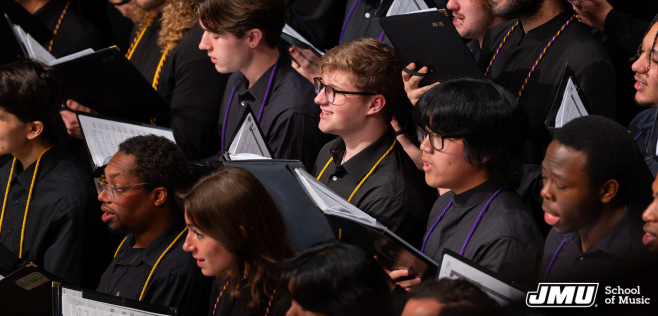
The James Madison University Chorus is split into two different ensembles that perform separately and together throughout the academic year:
The James Madison University Chorus: Soprano/Alto Ensemble (UCSA), under the direction of Dr. Jo-Anne van der Vat-Chromy, is the non-auditioned ensemble component of the JMU University Chorus for soprano and alto voices. Numbering from 40-60 voices, the UCSA performs music of various styles and genres as appropriate to the needs and levels of the group and is appropriate for the beginning to intermediate collegiate singer who desires voice building and musical training.
The James Madison University Chorus: Tenor/Bass Ensemble (UCTB), under the direction of Dr. Bryce Hayes, is a non-auditioned ensemble open to all tenor and bass voices at JMU. It is offered especially to non-music majors and music majors alike, focusing on vocal pedagogy, musical training, and high-quality singing, while tapping into Tenor/Bass literature. Modeled after the Harvard and Yale Glee Club tradition, this 30-40-voice ensemble performs both on and off-campus, presenting concerts at churches and retirement communities throughout the local area.
These two ensembles join forces each semester to present SATB concert music and often collaborate with the JMU Chamber Orchestra for spring semester choral masterworks.
Thanks for our generous Friends of the Arts & Design scholarship donors whose support allows our students to continue to create, perform, and inspire.
Arts & Design Hero ($5,000+)
- Patricia Gould & Hasan Karsiloglu
- Ann & Mark Siciliano
- Richard & Sue Orem
- Joshua & Trish Weinstein
Arts & Design Champion ($1,500-$4,999)
- Beth Chandler Cahill & Jim Cahill
- Jonathan Fox
- Rubén Graciani & Matt Pardo
- Marilou Johnson
- Matthew & Sarah Von Schuch
Arts & Design Advocate ($500-$1,499)
- John & Susan Allemeier
- Jerry Benson & Martha Ross
- Nancy Davis
- Patrick & Stephanie Driscoll
- Holly Haney & Bob Kolvoord
- Quillon Hall & Karin Tollefson-Hall
- Gina & Tom Holden
- Thomas McKenzie
Arts & Design Ally ($250-$499)
- Sue Agranoff
- Ellen & George Aschenbrenner
- Charles Boepple
- Reginald Bryson & Souha Khawam
- Eric & Jess Guinivan
- MiKyoung Lee
- Amy & Sean Myers-Payne
- James & Virginia Newman
- Rebekah Noonan
- Cyndia & Dexter Taylor
- Heather & Theodore Tseng
- Bethany & Scott Vriesman
- Connie & Hugh Westfall
- Cecelia Wolf
- Diane & Leonard Young
Dear Patron,
Thank you for attending this School of Music performance; we appreciate your support! The JMU School of Music educates the most talented students from around the world to shape the fabric of society. We are ecstatic to showcase the talent and hard work of our students and faculty.
Scholarship contributions help young musicians blossom into mature artists. With your support, we will be able to offer our talented students more financial help in pursuing their goals. If you are interested in supporting our students' passion and dedication, please consider contributing to the Music Scholarship Fund at James Madison University by clicking the button below.