

Fandango
Tuesday, September 29, 2026
7:30pm*
Forbes Concert Hall
Please silence all electronic devices.
Unauthorized videotaping or any other recording of this production is strictly prohibited in adherence with Federal copyright laws.
*Pre-concert discussion will take place at 6:30pm in the Lobby of the Forbes Concert Hall.
Program
Magnolia Star - Steve Danyew (b. 1983)
(Orchestral Premiere)
Idyll, Op. 44 - Samuel Coleridge-Taylor (1875-1912)
Noelle Singleton, graduate conductor
Variations in B Minor - Samuel Coleridge-Taylor/orch. Sam Suggs
Dr. Sam Suggs, double bass
---Intermission---
Overture to La Princesse Jaune - Camille Saint-Saëns (1835-1921)
Dalton Guin, graduate conductor
Capriccio Espagnol, Op. 34 - Rimsky-Korsakov (1844-1908)
I. Alborada
II. Variazioni
III. Alborada
IV. Scena e canto gitano
V. Fandango asturiano
Magnolia Star - Steve Danyew (b. 1983)
Magnolia Star was a train that ran from New Orleans to Chicago with the famous Panama Limited in the mid-20th century. This work evokes train travel with driving rhythms and train-like sonorities, and also uses the blues scale.
- Program Note from Publisher
When I was playing saxophone in my middle school jazz band, we started every rehearsal the same way –- with an improvisation exercise that our director created. It was a simple yet brilliant exercise for teaching beginning improvisation and allowing everyone in the band a chance to “solo.” As a warm-up at the opening of each rehearsal, the whole band played the blues scale ascending, resting for one measure, descending, and resting for another measure. During the measures of rest, each member of the band took turns improvising a solo. Looking back, this exercise not only got the band swinging together from the start of rehearsal, but it made improvisation, a daunting musical task to many, seem within everyone’s abilities.
This experience was my introduction to the blues scale, and I have long wanted to write a piece inspired by this group of pitches. In Magnolia Star, I explore various ways to use these pitches in harmonies, melodies, and timbres, creating a diverse set of ideas that will go beyond sounds that we typically associate with the blues scale. I didn’t want to create a “blues” piece, but rather a piece in my own musical voice that uses and pays homage to the blues scale. Nearly all of the pitches used in Magnolia Star fit into the concert C blues scale. It is interesting to note that embedded within the C blues scale are both a C minor triad, an E-flat minor triad, and an E-flat major triad. I explore the alternation of these tonal areas right from the start of the piece, and continue to employ them in different ways throughout the entire work.
Another influence was trains and the American railroad. The railroad not only provides some intriguing sonic ideas, with driving rhythms and train-like sonorities, but it was also an integral part of the growth of jazz and blues in America. In the late 19th century, the Illinois Central Railroad constructed rail lines that stretched from New Orleans and the “Delta South” all the way north to Chicago. Many Southern musicians traveled north via the railroad, bringing “delta blues” and other idioms to northern parts of the country. The railroad was also the inspiration for countless blues songs by a wide variety of artists. Simply put, the railroad was crucial to the dissemination of jazz and blues in the early 20th century. Magnolia Star was an Illinois Central train that ran from New Orleans to Chicago with the famous Panama Limited in the mid-20th century.
- Program Note by Steve Danyew
Idyll - Samuel Coleridge-Taylor (1875-1912)
English composer Samuel Coleridge-Taylor (1875–1912) was born in London to a British mother and a father from Sierra Leone. He entered the Royal College of Music as a violin student at the age of 15 and began composing in the same year.
Finding inspiration in traditional African music, Coleridge-Taylor sought ways to integrate its sounds into the classical tradition—much like Johannes Brahms did with Hungarian music and Antonín Dvořák did with Bohemian music. Coleridge-Taylor’s compositions ultimately came to the attention of composer Edward Elgar, who recommended that he compose a piece for the esteemed Three Choirs Festival, an annual event that rotated locations throughout the United Kingdom and featured premieres of recent choral and orchestral works by leading British composers.
The resulting piece, Idyll, Op. 44, was premiered in Gloucester in 1901. Reviewing the work, a British theatrical periodical of the time, The Playgoer, noted: “Mr. S. Coleridge-Taylor’s Idyll is a very beautiful, one-themed little work, exquisitely orchestrated. . .with a lovely reposeful intention.”
Idyll features flowing and nostalgic melodies that weave fluidly through the ensemble as different instruments take turns leading the texture. Each section of the orchestra provides a supportive foundation while passing the melodic focus between voices, maintaining an exquisitely beautiful and steady pulse that grows in scope to a climax of present power before finishing with a sweet, sentimental, and tender aural picture.
- Program Note by Noelle Singleton
Variations in B Minor - Samuel Coleridge-Taylor (1875-1912)
This piece will be introduced to the audience from the stage.
Overture to La Princesse Jaune - Camille Saint-Saëns (1835-1921)
Charles-Camille Saint-Saëns, born in Paris on 9 October 1835, was a French composer, conductor, organist, and pianist. Working during a period when cultural nationalism was foregrounded in many art styles around the world, Saint-Saëns was at the heart of France's own musical identity. He attended the Paris Conservatoire at the age of thirteen, where he shared teachers with other notable French musicians including César Franck, Georges Bizet, and Charles Gounod. His own student, Gabriel Fauré, would go on to have a notable career as a fellow French composer, and the two remained very close throughout Saint-Saëns' life. Among his most famous works are Danse macabre (1874), Samson and Delilah (1877), and The Carnival of the Animals (1886).
La princesse jaune, Op. 30, is a comic opera in one act with a French libretto by Louis Gallet. It premiered in Paris in 1872. The story is set in the Netherlands, and centers around a quasi-love triangle. A student, Kornélis, is completely enamored with the painting of a Japanese princess he keeps in his cabinet, who is referred to as 'Ming.' This causes some strife between Kornélis and the cousin with whom he lives, Léna, who is in love with him. When Kornélis drinks an opium potion that is implied to be from Japan, he begins to hallucinate. Believing that she is Ming, Kornélis confesses his love to Léna who, knowing that he is deluded from the potion, rejects his advances and scolds his obsession. As Léna berates him, Kornélis regains his senses and realizes that she is the true object of his love. The two make amends, and the opera ends.
- Program note by Dalton Guin
Capriccio Espagnol, Op. 34 - Rimsky-Korsakov (1844-1908)
Considering the great interest in Spanish music demonstrated by the father of Russian art music, Mikhail Glinka (Glinka traveled extensively in Spain, collected folk materials, and composed pieces based on them), it is not surprising that a Glinka disciple such as Rimsky-Korsakov would look for similar geographic sources of inspiration. So it is that the Russian Rimsky-Korsakov conceived a fantasy on Spanish themes; he originally intended it to be for violin and orchestra. As it developed, however, the Capriccio espagnol came to be not only a virtuoso work for violin, but also a work that could rightly be subtitled “Fantasy for violin, clarinet, oboe, flute, horn, trumpet (etc., etc.).” Which is to say that while the composition’s accent is Spanish, its emphasis is on solo instrumental virtuosity as well as on the orchestral effulgence that is so typical of Rimsky-Korsakov.
The composer himself commented on the dazzling merits of the piece, saying, “It is intended as a brilliant composition for the orchestra. The change of timbres, the felicitous choice of melodic designs and figuration patterns, exactly suiting each kind of instrument, brief virtuoso cadenzas for solo instruments, etc., constitute here the very essence of the composition and not its garb or orchestration. The Spanish themes of dance character furnished me with rich material for putting in use multiform orchestral effects. All in all, the capriccio is undoubtedly a purely external piece, but vividly brilliant for all that.”
- Program note by Orrin Howard (L.A. Phil)
Dr. Kira Omelchenko, director/conductor
Noelle Singleton, Orchestra Manager, Teaching Assistant, Graduate Conductor
Dalton Guin, Graduate Conductor
Felicity Banner, Librarian
Victor Winterstein, Librarian
*Indicates Section Leader/Co-Leader
Flute/Piccolo
Isabel Aviles*
Vanessa Britton
Emma Lisson
Oboe/English Horn
Cady Litteral*
Mark Guillen
Clarinet/Bass Clarinet
Geneva Maldonado*
Ian Graff
David Kriete
Bassoon
Hannah Gerick*
Miguel Resendiz-Perez
Horn
Chloe Starling*
Jakob Fox
Will Rapp
Isabel Ricciuto
Trumpet
Taylor Lowry*
Noah Shea
Ian Krueger
Trombone
Toby Whitaker*
Will Shanahan
Bass Trombone
Blake Downs
Tuba
Andy Helvey
Percussion
Josh Sheppard*
Tommy Crossley
Andrew Harper
Radley Hofmann
Zane Johnson
Lizbeth Stephan
Celesta
Maria Clapp
Harp
Elsbeth McNulty
Violin I
Victor Winterstein*
Erin Choi
Amy Poxon
Felicity Banner
Philip Ledgerwood
Violin II
Roman Rousek*
Dani Patdu
Ariana Skye Palmer
Anniah Craun
Noelle Singleton
Viola
Elliot Drew*
Julia Johnson
Thien Phan
Claire Barnes
Rose Guevara
Rodrigo Amorim
Cello
Hailey Hotek*
John Meshreky*
Caleb Hicks
Joey Montione
Will Hayes
Antwan Bolden
Tessa Kuta
Marlie Dela Cruz
Augusta McNulty
Theron Rath
Bass
Gabriella Bieberich*
Daniel Foote
Kaylin Yates
Nathan Wilkinson
Grey Sheridan
Jolie Prasad
Andrew Grogan
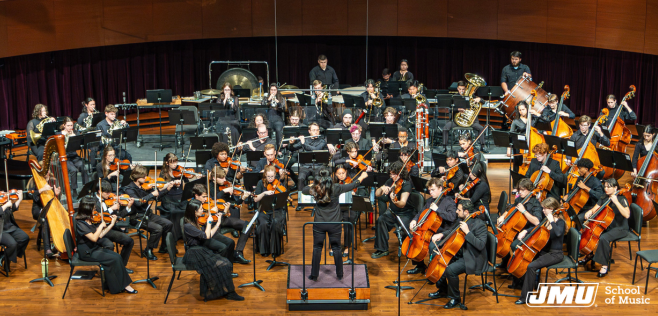
The JMU Symphony Orchestra, under the direction of Dr. Kira Omelchenko, is the premier orchestra within the School of Music at James Madison University. Membership is open, through the audition process, to all JMU students who attend the University. String sections include music majors, music minors, as well as other/non-major students. Wind, Brass, and Percussion sections are comprised of primarily School of Music's top music majors. This select group of 60-70 musicians present approximately six to eight performances during each academic year. Music programmed is challenging and covers a broad range of styles, including standard symphonic repertoire, contemporary works, world premieres, and collaborations with concerto/aria winners.
The JMU Symphony Orchestra has made numerous appearancecs at VMEA, Virginia's state music education conference, and also participates annually, in conjunction with Carnegie Hall (NY) in their "LinkUp" Youth Concert series. Major works recently performed include Stravinsky's Firebird Suite, Dvořák's Symphony No. 9, Respighi's Pines of Rome, Tchaikovsky Symphonies 4 and 5, Mahler's Symphony No. 5, Shostakovich's Symphony No. 5, Carl Orff's Carmina Burana (with the JMU Choral Area), and Rachmaninoff's Symphony No. 2.
In May 2027, the JMU Symphony Orchestra will embark on an extraordinary international tour to South Korea! Through performances and cultural exchange throughout Seoul and Busan, the JMU Symphony, comprised of 70 students, will have the opportunity to collaborate and share their creativity, passion, and artistry with Korean musicians and students. Repertoire will include a variety of symphonic pieces including works by American composers and a new piece by Texu Kim, a Korean American composer based in the U.S.
Steve Danyew (composer)
Steve Danyew's music has been hailed as "startingly beautiful" and "undeniably well-crafted and communicative" by the Miami Herald, and has been praised as possessing "sensitivity, skill, and tremendous sophistication" by the Kansas City Independent.
He is a composer who cares deeply about craftmanship and is dedicated to creating art that reflects the beauty of the natural world and the human spirit.
Danyew (b. 1983) is the recipient of numerous national and international awards for his work, and his compositions have been performed throughout the world in venues such as the Sydney Opera House, the Kennedy Center, Carnegie Hall, and the steps of the US Capitol.
Danyew's work, Into the Silent Land, was named the winner of the 2019 Walter Beeler Memorial Composition Prize. An early work for orchestra, The Night Eagle, was awarded a prestigious BMI Composer Award. Five of his compositions for wind band are featured between Volumes 11 and 12 of Teaching Music Through Performance in Band (GIA).
In addition to composing, Danyew is a passionate educator who teaches composition lessons through his own private studio. He also teaches courses focused on helping young musicians craft their own creative careers at the Eastman School of Music's Institute for Music Leadership. He is the contributing author for the 2nd edition of Ramon Ricker's book Lessons from a Street-Wise Professor: What You Won't Learn at Most Music Schools (Soundown, 2018). He is also a frequent guest composer and lecturer at schools throughout the United States.
In 2020, Danyew and his wife, Ashley, created Musician & Co to equip 21st-century musicians with the tools and education they need to be both artists and business owners. They offer business education, a resource library, a template shop, and personalized career strategy sessions, professional writing support, and brand development for musicians who want to build and manage their own music careers.
Danyew grew up in New England, playing the saxophone and improvising music on the piano. After a performance of his own work, the South Florida Sun Sentinel proclaimed him a "saxophone virtuoso par excellence, making the instrument sing as well as shout." Danyew performed as a saxophonist in the University of Miami Wind Ensemble under the direction of Gary Green, and this formative experience led him to begin composing works for wind band. Danyew received a B.M. in Composition from the Frost School of Music at the University of Miami where his primary composition teachers were Scott Stinson and Dennis Kam. In 2025, he was one of 100 Frost School of Music alumni awarded a Frost Centennial Medal in celebration of the school's 100th anniversary. He also holds an M.M. in Composition from the Eastman School of Music. Additionally, Danyew has served as a Composer Fellow at the Yale Summer Music School with Martin Bresnick and as a Composer Fellow at the Composers Conference with Mario Davidovsky.
Dr. Sam Suggs (double bass)
Acknowledged for his "precise technique, interpretive vision, and impeccable musicianship" (Boston Globe), Sam Suggs cultivates a versatile career as a collaborative and creative double bassist. On the faculties of the Yellow Barn Chamber Music Festival and James Madison University, Sam is one of Strad Magazine's "five up-and-coming bass players" and a winner of the International Society of Bassists and Concert Artists Guild competitions.
As a bassist-composer, he received the biennial Special Recognition Award for Composition from the International Society of Bassists, and he breaks boundaries with "brilliant and compelling programming" (The Strad) and execution that "quite simply boggled the mind" (Oregon Arts Watch).
He has guest performed with the Attacca Quartet, Saint Paul Chamber Orchestra, Orpheus Chamber Orchestra, Alarm Will Sound, and Eighth Blackbird.
As a recording artist, he is the featured bass soloist/arranger in the soundtrack for Netflix’s Oscar Award-winning documentary The Only Girl in the Orchestra and his solo in the 2024 video game Pacific Drive "had a haunting and yearning quality that beautifully conveyed the concept of isolation" (Polygon). In 2025, he released the premiere recording and edition of Melodic Etudes by jazz legend Rufus Reid.
Son of birdwatchers and an alum of the Greater Buffalo Youth Orchestra, he has a doctorate from the Yale School of Music and has taught masterclasses all over the world including at the Curtis Institute, Colburn School, New England Conservatory, and Juilliard Shanghai Summer Strings. Sam is a Thomastik-Infeld Artist and managed by General Arts Touring. @s3suggs
Visit Professor Suggs' YouTube Channel
Dr. Kira Omelchenko (director)
Award-winning conductor and music educator, Dr. Kira Omelchenko serves as the Director of Orchestras and Associate Professor of Music at James Madison University (JMU). In this role, she provides artistic and administrative leadership for the university’s orchestra program, conducts the Symphony Orchestra, oversees the Chamber Orchestra and Opera Orchestra and mentors their conductors. Dr. Omelchenko also leads the graduate orchestral conducting curriculum where she teaches a studio of graduate conducting students. In addition, she serves as the Artistic Director of the annual JMU Summer String Camp.
Prior to joining JMU, Dr. Omelchenko served as Associate Dean of Performance and Recruitment, Associate Professor of Music, and the Conductor of the Symphony Orchestra at Wilfrid Laurier University Faculty of Music (Ontario, Canada). From 2014-2019 Dr. Omelchenko was the Director of the Orchestra and String Studies at Florida Southern College and served as the Director of Orchestra and Strings at The University of Tampa from 2012-2024. A passionate educator, Dr. Omelchenko was nominated for a Grammy Music Educator Award, the Laurier Innovation in Teaching Award, and was the recipient of the prestigious 2018 FSC Miller Distinguished Professor Award.
Dr. Omelchenko received a prestigious Fulbright Scholar Award in 2023-24 where she lived in New Zealand for five months conducting, teaching, and mentoring students, collaborated with local composers, and conducted research in the National Library of New Zealand. During her Fulbright, she was also a visiting scholar and artist-in-residence at The New Zealand School of Music—Te Kōkī, at Victoria University, in Wellington, New Zealand.
Most recently Dr. Omelchenko was a guest conductor and teacher at the 2026 and 2025 Sofia Arts and New Music Festival (Bulgaria) with the Sofia Philharmonic and has been invited to permanently join its conducting staff. Recent engagements include concerts with National Symphony Orchestra (Peru) at the Musicantes Festival, guest conducting the 2026 American Viola Society National Festival, and conducting numerous All County Festivals and Honor Orchestras in Virginia, Maryland, and New York. Her previous conducting engagements also include Carnegie Hall, the Vienna Opera Academy, Oregon and Florida All-State Orchestras, Orlando All-County Orchestra, Kitchener-Waterloo Symphony, Waterloo Chamber Players, Prince Edward Island Symphony Orchestra, leading the 2025 ASTA National Conference Director’s Orchestra, and conducting residencies in Thailand, South Korea, China, Australia, and New Zealand. Upcoming invitations include conducting the 2026-27 All-State Orchestras in Texas, California, and Kansas.
Winner of the International Conductors Workshop and Competition, Dr. Omelchenko is currently a finalists for the 2026 National American Prize in Music, for the Vytautas Marijosius Memorial Award in Orchestral Programming, which recognizes and rewards the best achievement in the unique field of orchestral programming, where the selection of repertoire by knowledgeable, creative and courageous music directors builds orchestras and audiences, educates young people and adults, and enriches the community. She was also the 2022 recipient of the Ernst Bacon Memorial Award for the Performance of American Music, a finalist in the 2022 Virtual concert production category, and is a past prize winner in Opera Conducting category.
As the 2017 winner of the International Institute for Conductors in Bulgaria, Dr. Omelchenko conducted the Vidin State Philharmonic Orchestra in a Concerto Festival and was invited back to guest conduct in their following season. In the summers of 2019 and 2018, Dr. Omelchenko served as artist in residence and guest conductor at the University of Aveiro (Portugal) where she mentored graduate conducting students and conducted the University Orchestra. During her residency in Portugal, she was also invited as a guest lecturer and conducting mentor at the Conservatorio Superior de Música de Castilla y León in Salamanca, Spain. In addition, she served as the string director at the International Opera Performing Experience Festival in Mercatello sul Metauro (Italy) in July 2019.
Additional guest conducting appearances include conducting the 2021 Florida All-State Honors Orchestra, the Gwinnett Symphony Chamber Symphony (Georgia), the Imperial Symphony Orchestra (Florida), the Seasons Music Festival Orchestra in Yakima, Washington, and the Bulgarian State Opera in Burgas. In 2015 Dr. Omelchenko was selected to participate in a conducting festival in St. Petersburg, Russia where she conducted the orchestra in the historic Mariinsky Theatre. She has held international conducting fellowships and has studied in Vienna, Rotterdam and Amsterdam conservatories in the Netherlands and Bulgaria. She has also participated in conducting workshops with Gustav Meier, Ulrich Nicolai, Toby Purser, Alessandro Pagliazzi, and Harold Farberman.
A passionate global educator, Dr. Omelchenko has led students in a variety of study and performance abroad opportunities, including travels to Italy, Russia, Bulgaria, and Portugal. She has worked with middle school and high school students in Summer Orchestra Music Camps at the University of Iowa, The University of Tampa, and Florida Southern College where she served as the director from 2014-2019. As a highly sought-after clinician she has adjudicated for Florida Orchestra Association, Music USA Festival at Universal Studios in Orlando, Brightparks Travel Festivals, and OrlandoFest, and has conducted various All-County Orchestra Festivals.
As a collaborative leader in community engagement, she has served on Faculty Senate and the Board of Directors for the Imperial Symphony Orchestra and the St. Augustine Youth Orchestra. As an advocate for diversity, equity, inclusion and accessibility, Dr. Omelchenko serves on the orchestra panel for And We Were Heard (AWWH), an organization that brings quality recordings of works by underrepresented composers, and is a mentor for Girls Who Conduct, a program that encourages the upcoming generation of women, women-identifying, and non-binary conductors.
Recognized for her research and contribution to her field, Dr. Omelchenko has been awarded numerous research grants including the JMU CVPA College of Visual and Performing Arts Cultural Connection Grant, JMU CVPA Faculty Professional Development Grant, Laurier Student Life Levy, Laurier Research Grant, Ontario Arts Grants, American String Teachers Association Grants, Sigma Alpha Iota Professional Development Grants, FSC Faculty Summer Stipend and Professional Grants, FSC Faculty and Student Collaboration Grant, as well as the University of Tampa Alumni, Dana, and the David Delo Research Professor Grants.
As a recipient of the Sigma Alpha Iota Conducting Scholarship, Dr. Omelchenko has presented research at international, national, and state conferences including the International Conference on Arts & Humanities (IAFOR), The National Society for Experiential Education (NSEE), National Association for Music Education (NAfME), American String Teachers Association (ASTA), College Orchestra Directors Association (CODA), Florida Music Education Association (FMEA), Virginia Music Education Association (VMEA), and the Viriginia American String Teachers Association (VASTA).
Dr. Omelchenko’s research on health and music has been published in Health Education Journal (SAGE publications, UK) and her research on New Zealand symphonic composers have been published in the International Conductors Guild Journal and the College Orchestra Directors Association (CODA) Journal. Her development and innovation of ensemble curriculum have been published in College Orchestra Directors Association (CODA) Journal, Music Educators Journal (MEJ), Advances in Online Education Journal (AOE), and The International Academic Forum (IAFOR International Arts & Humanities, 2022). She has been a contributing author for Wenger Music Corporation and Sigma Alpha Iota (SAI) Panpipes magazine.
A native of Kansas, Dr. Omelchenko holds a bachelor’s degree in degree in music and theatre with a dance concentration from Knox College, a master’s degree in orchestral conducting from the University of New Mexico, and a doctoral degree in orchestral conducting from the University of Iowa, where she studied with William LaRue Jones.
Noelle Singleton (graduate conductor)
Noelle Singleton is a doctoral student in orchestral conducting, pedagogy, and literature at James Madison University, where she conducts the JMU Chamber Orchestra and serves as music director for JMU Opera's upcoming production of Mozart's Die Zauberflöte. Prior to her studies at JMU, she held a faculty appointment at Brigham Young University - Idaho, directing the University Orchestra and teaching violin. A passionate advocate for historical and underrepresented voices, Singleton's scholarship and programming prominently feature works by female composers such as Augusta Holmès, Florence Price, and Louise Farrenc. She hold MM and BM degrees in orchestral conducting and music education.
Dalton Guin (graduate conductor)
Dalton M. Guin is a conductor and hornist from Erwin, North Carolina. He has performed with various groups throughout the United States, Canada, New Zealand, Palau, and Amerika Samoa. Dalton regularly performs in North Carolina and Virginia, and consistently works with middle school, high school, collegiate, and professional groups in musical theatre productions. He is a member of the Bluestone Contemporary Ensemble and a founding member of the Skyline Brass Quintet, both based at James Madison University. Dalton is currently the Conductor and Music Director for the Nelson County Community Orchestra. He holds a Bachelor of Music in Horn Performance and a Master of Music in Instrumental Conducting from the University of North Carolina at Greensboro. Dalton is currently pursuing a Doctor of Musical Arts degree in Orchestral Conducting, Pedagogy, & Literature at James Madison University in the studio of Dr. Kira Omelchenko.
Thanks for our generous Friends of the Arts & Design scholarship donors whose support allows our students to continue to create, perform, and inspire.
Arts & Design Hero ($5,000+)
- Patricia Gould & Hasan Karsiloglu
- Ann & Mark Siciliano
- Richard & Sue Orem
- Joshua & Trish Weinstein
Arts & Design Champion ($1,500-$4,999)
- Beth Chandler Cahill & Jim Cahill
- Jonathan Fox
- Rubén Graciani & Matt Pardo
- Marilou Johnson
- Matthew & Sarah Von Schuch
Arts & Design Advocate ($500-$1,499)
- John & Susan Allemeier
- Jerry Benson & Martha Ross
- Nancy Davis
- Patrick & Stephanie Driscoll
- Holly Haney & Bob Kolvoord
- Quillon Hall & Karin Tollefson-Hall
- Gina & Tom Holden
- Thomas McKenzie
Arts & Design Ally ($250-$499)
- Sue Agranoff
- Ellen & George Aschenbrenner
- Charles Boepple
- Reginald Bryson & Souha Khawam
- Eric & Jess Guinivan
- MiKyoung Lee
- Amy & Sean Myers-Payne
- James & Virginia Newman
- Rebekah Noonan
- Cyndia & Dexter Taylor
- Heather & Theodore Tseng
- Bethany & Scott Vriesman
- Connie & Hugh Westfall
- Cecelia Wolf
- Diane & Leonard Young
Dear Patron,
Thank you for attending this School of Music performance; we appreciate your support! The JMU School of Music educates the most talented students from around the world to shape the fabric of society. We are ecstatic to showcase the talent and hard work of our students and faculty.
Scholarship contributions help young musicians blossom into mature artists. With your support, we will be able to offer our talented students more financial help in pursuing their goals. If you are interested in supporting our students' passion and dedication, please consider contributing to the Music Scholarship Fund at James Madison University by clicking the button below.