



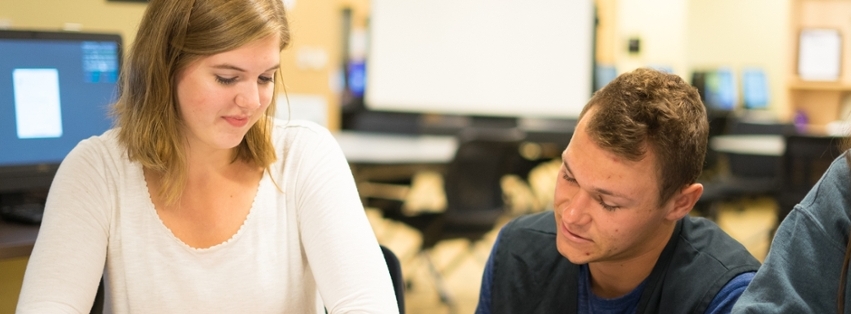
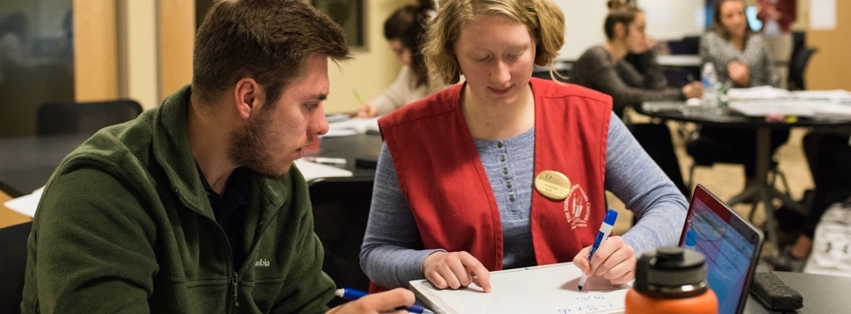

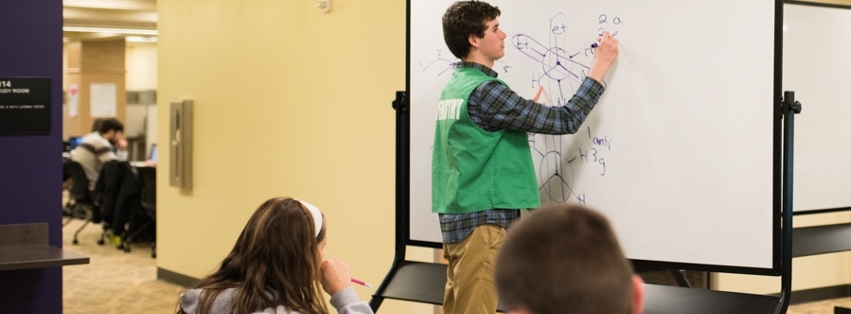
Welcome to the Science and Math Learning Center, located in the Student Success Center, 1st floor, SSC 1100. We assist students in understanding course content, homework assignments and lab reports found in many first and second year physics, chemistry, math, and statistics courses.
The SMLC will be offering online tutoring in math, chemistry, and statistics from May 26th through June 18th and in physics from May 26th through July 2nd!

View qualifications and application to become part of the SMLC team!
Looking for free support in your science and/or math course(s)? See the announcement below for how the SMLC can help!
Summer 2026
Online:
The SMLC offers a FREE synchronous virtual drop-in cafe-style tutoring service for JMU students enrolled in our supported courses where you can consult with a tutor online through Zoom. No appointments!
Math, Chemistry, Statistics: May 26th-June 18th
Physics: May 26th-July 2nd
How to Access Synchronous Tutoring: See the instructions below.
- Navigate to the "Tutoring Schedules" section on the left menu
- Click the subject you need help with
- Log in with your JMU e-id and password
- You will see the tutoring schedules and tutors listed who are available at those times.
- Click on a tutor's name at the appropriate day/time to enter their Zoom room - you can join/leave the Zoom meeting at any time during the tutor's shift!
- Follow the sign in prompts (if applicable) to sign in and launch your JMU Zoom account
- Ask the tutor your questions. Note: Since this service is drop-in style, there may be other students in the session who are also seeking support.
- Reminder: In compliance with the JMU Honor Code, our tutors are not able to help with tests, quizzes, etc. Tutors may ask to provide evidence of the soiurce of a question.
- For tips on how to have a successful synchronous tutoring experience, see the SMLC Etiquette Policy.
- Questions? Email Jenna Guenther at guenthjc@jmu.edu
Supported Courses At The SMLC*
Statistics
- MATH 105
- MATH 220
- COB 191
- ISAT 251
Math
- MATH 103
- MATH 155-156
- MATH 199
- MATH 205
- MATH 231-232
- MATH 235-236
- ISAT 150
- ISAT 151
Chemistry
- CHEM 120
- CHEM 131 & 131L
- CHEM 132 & 132L
- CHEM 241 & 241L
- CHEM 242 & 242L
Physics
- PHYS 140 & 140L
- PHYS 150 & 150L
- PHYS 240 & 240L
- PHYS 250 & 250L
Philosophy
- PHIL 120
- PHIL 150
- PHIL 250
*If you don't see the course you're looking for in this list, contact your professor for other resources. Additionally, you could see if your class is supported by Peer Assisted Study Sessions.
The SMLC is always looking for outstanding students to hire during the academic year! Check out our How To Become an SMLC Tutor page for more details!
The Science and Math Learning Center is a Level 1 and Level 2 certified program through the College Reading and Learning Association (CRLA) International Tutor Training Program Certification!

Hours of Operation:
IN PERSON: Mon.-Thurs. 11am-8pm
ONLINE: Select evenings.
See subject schedules for details.


