

Prominent whistleblowers share experience with students, faculty
News


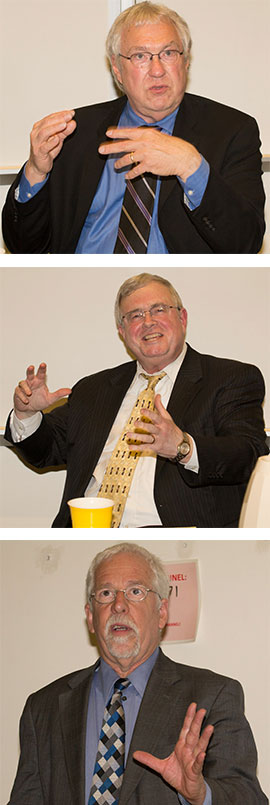
Rick Piltz and Thomas Tamm do not consider themselves heroes, but they feel justified by their efforts to expose abuses of power by the federal government agencies they worked for.
Piltz and Tamm visited several JMU classes during the day Tuesday to discuss their experience as whistleblowers and also participated in an evening discussion in the Health and Human Services Building. The two men are speakers for the "American Whistleblower Tour: Essential Voices for Accountability" organized by the Government Accountability Project, the nation’s leading whistleblower protection and advocacy organization.
Piltz is a former senior associate in the coordination office of the U.S. Climate Change Science Program. In 2005, he blew the whistle on the White House’s improper editing and censorship of science program reports on global warming intended for the public and Congress. Piltz released edited reports to The New York Times that documented the improper editing, which downplayed the reality of human-driven global warming and its harmful impacts. The changes also introduced an element of scientific uncertainty that had not been part of the original reports.
Tamm was a well-regarded Justice Department attorney in the capital cases unit who, in 2003, transferred to the Office of Intelligence Policy and Review. While working there, he became aware of a program that bypassed the Foreign Intelligence Surveillance Act court in an arrangement where only the attorney general would sign certain wiretap requests. After Tamm’s inquiries about the program repeatedly ran into walls of silence, he contacted The New York Times, which in 2005 ran a Pulitzer Prize-winning cover story about the George W. Bush administration’s warrantless wiretapping program. The program was part of a wide-ranging covert surveillance activities authorized by President Bush in the aftermath of 9/11.
Piltz said it took some time for him to decide to blow the whistle on the edited science reports, which he gradually kept copies of. "This was a story that needed to come out, but it wasn't a story I could put out unless I wanted to be unemployed," he said. "You're not going to challenge the White House on something like this."
Piltz said it was obvious the reports were being edited by a Bush appointee to play down the global warming problem. The person responsible for the editing, Phillip A. Cooney, did not have a science background. "He was an oil industry lobbyist, but he was running the White House environmental office," Piltz said.
Piltz said he tried to do his job and make his office function to the best of its ability, but it became clear at the start of Bush's second term that the policing of the climate reports was only going to get worse. Unable to find anyone who would champion the right values, he decided to resign. Piltz did not have another job lined up and wasn't sure what to do next, he said, but he wanted to expose what was happening. He eventually turned to the Government Accountability Project, which led to contacting the New York Times.
The story gained the attention of other media around the nation and the world, and while it didn't change the administration's policy on global warming, the administration did ease up on its editing and censorship of scientists, said Piltz, who is now the director of Climate Science Watch, a government watchdog agency sponsored by GAP.
Cooney resigned after the story broke and took a job with Exxon Mobil.
Tamm said he knew he needed to do something when a supervisor and a congressional staffer gave him vague answers to questions he asked about certain surveillance requests that were handled differently than the rest. Rather than being heard by the full special court of 11 judges, they went to just one judge. Tamm's supervisor also told him it was probably illegal.
"I agonized about it for months," Tamm said, before making the decision to talk to reporters from the New York Times. It turned out the reporters had sources in other departments and were investigating other alleged transgressions by the administration. "They new more about it than I did," he said.
The story finally broke in 2005, about a year after Tamm had approached the reporters about it. And while the New York Times was lauded with a Pulitzer Prize, Tamm became the subject of a federal investigation. In August 2007, his home in Maryland was raided by 18 federal agents looking for information about the leaks that led to the New York Times story. It took three years for the government to drop the investigation.
"My biggest regret is what I put my family through," said Tamm, who received a Ridenhour Truth-Telling Award in 2009. The award, which comes with a $10,000 stipend and was presented to Piltz in 2006, is the highest honor for whistleblowers.
"In our view these people are patriots," said Louis Clark, president of GAP and moderator of the evening discussion. "The purpose of this tour is to have you meet some of the heroes who have really had an impact on your life and in many cases you might not have even known that."
The GAP visit was sponsored by the Madison Collaborative: Ethical Reasoning in Action and the departments of integrated science and technology; political science; and writing, rhetoric and technical communication.


