

JMU researchers awarded $45,650 in 4-VA grants
News



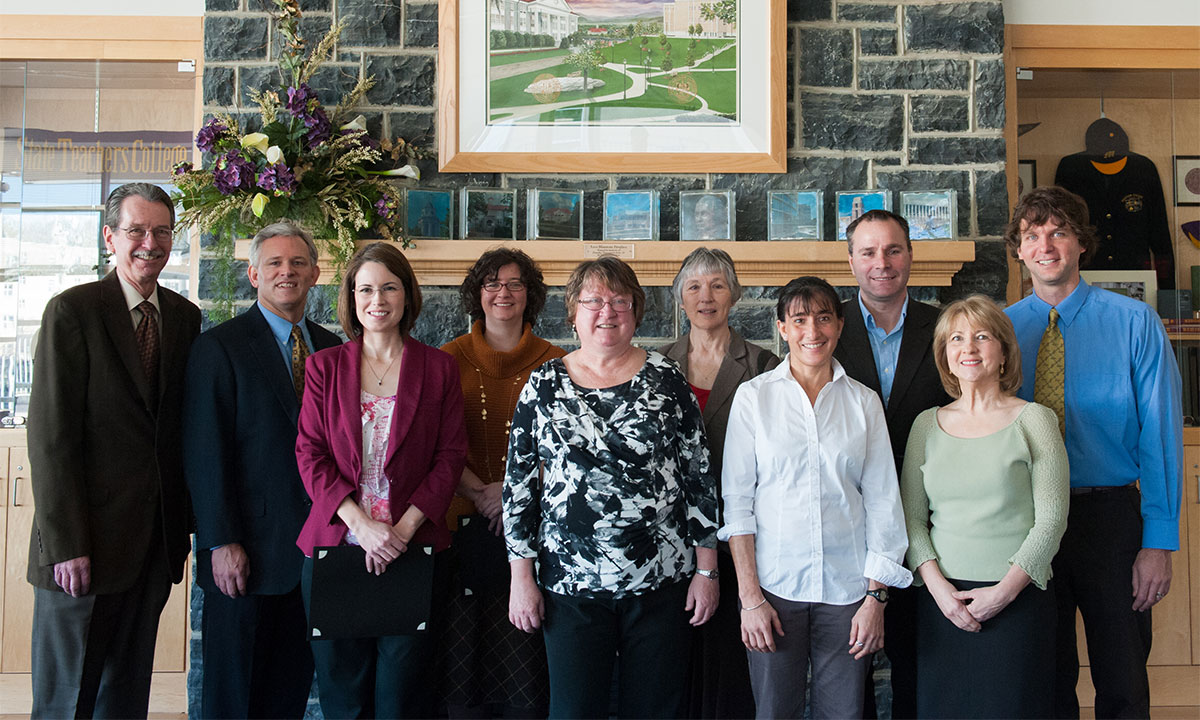
Researchers from JMU received more than $45,000 in 4-VA grants Friday, Feb. 15 to stimulate collaborative research projects or to redesign courses.
Dr. Costel Constantin, assistant professor of physics and astronomy, received the program's first $20,000 scale-up grant to involve students in a project he directs with a colleague at the University of Virginia, Dr. Patrick Hopkins in the department of mechanical and aerospace engineering. Students from both schools involved in the research will be exposed to a wide variety of instruments, including a state-of-the-art laser system built for time domain thermo-reflectance measurements.
The research data obtained during summer 2013 will be used as preliminary data in seeking external funding from the National Science Foundation and other available funding agencies. The collaboration will enhance JMU's ability to motivate students to pursue an advanced degree in physics and engineering. U.Va. is matching the grant with $20,000.
In addition to the scale-up grant, six 4-VA mini-grants totaling $25,650 were awarded to seven JMU researchers.
The mini-grant recipients are:
- Dr. Louise Temple, professor of integrated science and technology, who received $4,100 for a collaborative research proposal that will develop a faculty and student partnership in authentic research that will be ongoing for the next two to three years. JMU students involved in the project will preform research in the summer and spend several weeks at Virginia Commonwealth University partnering with Dr. Gordon Archer and a doctoral student. Students at JMU will build on a pilot study conducted in an advanced ISAT research class at JMU and work by a clinician and a graduate student at VCU. To enhance collaboration, researchers will utilize the video conferencing capabilities at both universities to hold virtual lab meetings every month. In addition, the grant will fund research that will lead to the submission of a joint proposal to the Commonwealth Research Board in Fall 2013.
- Dr. Susan Halsell, associate professor of biology, who received $1,550 for a collaborative research project with George Mason University on drosophila research. Students will be trained in new techniques and will hold periodic lab meetings via the 4-VA technology. Co-authored presentations will occur at national meetings such as the Drosophila Research Conference and at regional meetings. JMU undergraduates will be included as presenters at these meetings.
- Dr. Roshna Wunderlich and Dr. Mark Gabriele, associate professors of biology, received $5,000 to redesign the Bio 290 Human Anatomy laboratory class at JMU so students will be introduced to laboratory concepts prior to the lab so they arrive prepared to use the concepts. This will reduce the amount of time faculty spend introducing material and increase the amount of time using material. The project also will provide a visual database of images and videos that students can utilize after lab. The project could expand the collaboration to both undergraduate and graduate medical faculty at other institutions in Virginia.
- Dr. Michele Estes, assistant professor of learning, technology and leadership education, who received $5,000 to address the challenge of distributed labs in STEM. Estes and Dr. Stephanie Moore at the University of Virginia have extensive experience in accessibility and universal design, which plays an important role in the development of online labs and will help ensure they are designed to serve the greatest number of learners to the greatest extent possible. Estes and Moore will articulate common learning objectives and outcomes that indicate characteristics of instructional quality of online labs and develop a plan and instructional strategy for the development and evaluation of online labs. In addition, the grant will fund research that will lead to a submission for a National Science Foundation proposal.
- Dr. Robert Prins, associate professor of engineering, who received $5,000 to support faculty-led collaborative research in electric mobility. The proposal aims to fund JMU student(s) to participate in an applied research project with Moto Electra LLC, thus strengthening the relationship between JMU and its corporate collaborator.
- Dr. Anne De Piante Henriksen, professor of integrated science and technology, who received $5,000 to collaborate with the department of biochemistry and molecular genetics, and with the Center for Public Genomics, at the University of Virginia. Henriksen will participate in world-class research in the areas of neuroscience, neuroendocrinology and cell signaling. The experience will enable Henriksen to bring valuable insight and experience back to JMU undergraduates. The project will also allow for a strong relationship to develop, which could lead to future collaborations with U.Va.
The 4-VA consortium was organized in 2010 by the presidents of JMU, George Mason University, University of Virginia and Virginia Tech, in an effort to foster collaboration and to meet the needs of the Commonwealth indentified by the Governor’s Higher Education Commission and his Jobs Commission.
JMU President Jon Alger said the consortium not only highlights the "great research being done here at JMU," but also provides a model for solving the day's big problems through teamwork.
4-VA scale-up grants will be awarded twice a year to faculty who already have an established research agenda, have an established partnership in the research, can demonstrate promise and past progress and are about to launch a proposal for an externally-funded grant.
The 4-VA mini-grants, which range from $1,000-$5,000, could be awarded as often as once a quarter—subject to funding availability and qualified proposals—to support faculty efforts that contribute to 4-VA initiatives related to research and instruction. Potential outcomes include shared courses, redesigned courses or collaborate research projects.
Faculty can apply for the state-funded grants anytime. Awards are typically announced during the last week of July, October, January and May.


