

JMU profs share encyclopedic knowledge
News



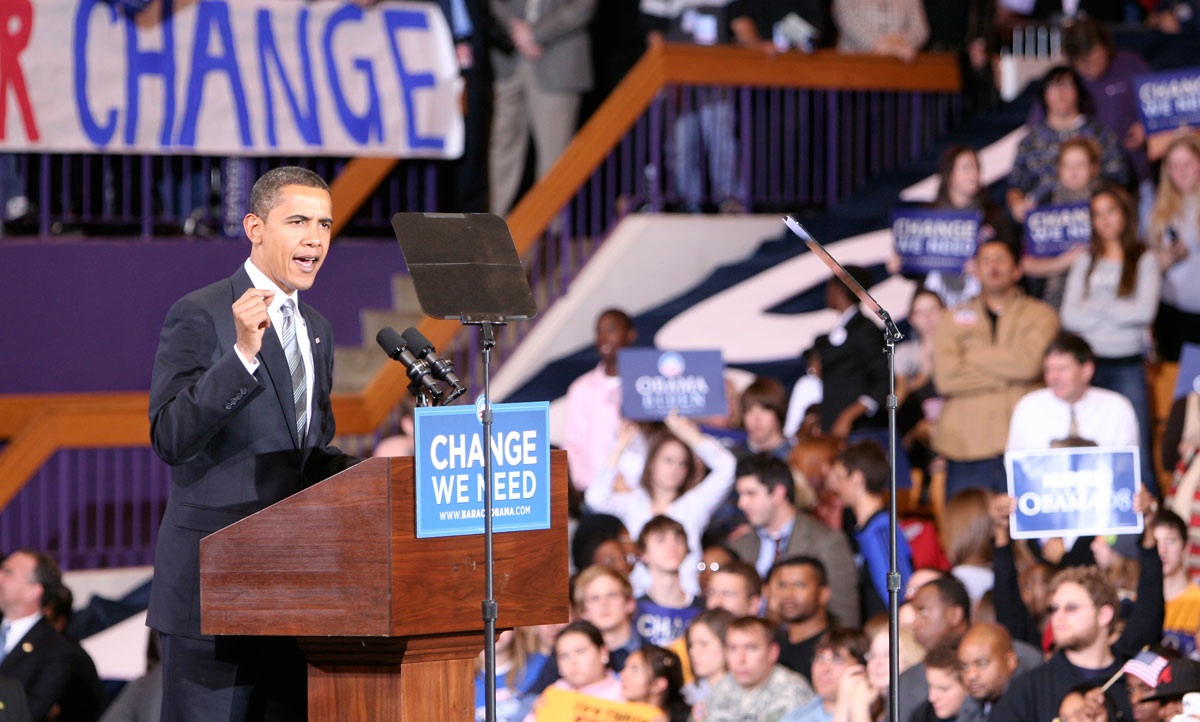
Presidential campaigns have urged voters to "Don't Stop Thinking about Tomorrow," "Don't Change Horses in Mid-Stream," "Like Ike" and "Keep Cool with Coolidge." They have declared: "It's the Economy, Stupid," "Back to Normalcy," "America Needs a Change" and "Stand Up for America."
Campaign communication has coursed through the years via deeply partisan newspapers to whistle-stop train tours to fireside chats to social media.
From the time of George Washington, who drew from his sense of duty to accept reluctantly the role pressed upon him as the first president of the United States of America, to the hard-fought and often downright nasty contests since 1788, the campaigns for the highest office in the land have generated a treasure-trove of stories, facts and statistics.
To provide a resource to manage so much information and to analyze each of the 56 campaigns that led to the elections of Presidents Washington through Barack Obama, three James Madison University political science professors have combined their knowledge of U.S. presidential campaigns to publish a three-volume encyclopedia, just in time for party conventions and the general election.
"Presidential Campaigns, Slogans, Issues, and Platforms: The Complete Encyclopedia" by Drs. Robert N. Roberts, Scott J. Hammond and Valerie J. Sulfaro is a mammoth revision of a 2004 encyclopedia cowritten by Roberts and Hammond for the Greenwood Publishing Group Inc., also the publisher of the current volumes. "The new encyclopedia is more up to date, of course, with sections on the 2004 and 2008 campaigns," Roberts said. "We've also added much more material on campaign issues, a lot more breadth and depth."
Sulfaro, who teaches political behavior, political parties, and elections and serves as the political communication coordinator for JMU's Department of Political Science, expanded the work from 2000 onward, including major analysis of issues such as immigration and race, women's equality, environmental policy and foreign policy.
"I'm interested in political theory," Hammond said, "and Bob is a pundit. Analyst is better."
"I'm technically a pundit," Roberts said, which he and his cowriters define as "a term to describe an individual who provides political commentary and predictions in print and electronic media outlets" in an encyclopedia entry on the word.
Campaigning for the White House changed substantially in the 20th century. Earlier, "the presidential candidates did not really run their own campaigns. We forget that," said Roberts. "The whole idea of a candidate running his own campaign apart from the party is fairly new," adding that Dwight Eisenhower's campaign, which was run by the Republican Party, is a late example. "The parties ran their campaigns because the parties were essential in terms of getting out your vote."
Now, the authors argue, people are not as identified with parties per se. "They're more identified with issues the parties back. That's a big change," Roberts said.
While we bemoan the negative tone of modern presidential campaigns, the encyclopedia is chuck full of examples to what Roberts describes as "a lot of terribly negative campaigning, particularly in the 19th century. "It was much worse and we don't perceive that. The 19th century was just brutal."
"People accused other people of murder," Hammond added. "The attacks were much more personal. They would attack the candidates' character."
Roberts points to the Campaign of 1884 as his pick for the nastiest presidential race. As recapped in the encyclopedia: "Lacking significant policy differences separating the two nominees from the major parties, the campaign between Democrat Grover Cleveland, the eventual winner, and Republican James G. Blaine decays into a mudslinging brawl, becoming one of the nastiest campaigns in American history."
"Cleveland had become governor of New York based on the 'Grover the Good' campaign," Roberts said. "It came out that he had allegedly fathered a child out of wedlock – he admitted the child could have been his – that became a huge issue." Meanwhile, Blaine was dogged by serious allegations of wrongdoing in the railroad scandal, the same situation he faced in the 1876 presidential campaign.
"The slurs were often done by party faithful or surrogates, rather than by ads," Roberts said. Chants of "Ma, Ma, Where's My Pa?" and "Blaine, Blaine, James G. Blaine, the Continental Liar from the State of Maine" were just part of the campaign hoopla that included untoward remarks about Roman Catholics uttered by a member of the clergy who introduced Blaine prior to a campaign speech.
"There are no ground rules on what people bring up," Roberts said. "It's always been this way."
# # #


