

50 years lead to one last semester of storytelling
News


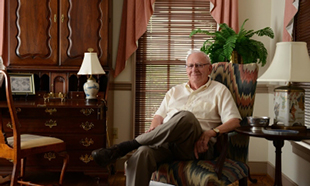
He may have technically retired from the James Madison University faculty in 1998, but Dr. Clive R. Hallman Jr., is looking forward to teaching two of his favorite history courses – The Old South and Colonial America – when JMU starts fall semester 2012. Just as he has for 50 years, Hallman will impart his knowledge of and love for American history to filled-to-capacity classrooms in Jackson Hall.
A total of 55 undergraduate students are enrolled in the classes that the professor emeritus of history declares are his final ones in a career that began in Madison College's summer session of 1962. "Dr. (Michael) Galgano and I decided I would teach this semester to take me full circle," Hallman said, referring to the head of JMU's history department.
Hallman's affiliation with the university began when he answered a plea from the director of the Division of the Social Sciences, Dr. Elmer Smith, to teach a survey class in early U.S. history during the summer term in place of a gravely ill professor. Hallman, who was teaching history in the upper school and serving as principal of the junior school at Staunton Military Academy, was one of the few educators in the area holding a master's degree in history, one of Madison's requirements.
Hallman taught that summer and in summer 1963 before leaving his post at SMA, where he had taught for eight years after earning degrees from Appalachian State University (M.A.) and Berry College (A.B.), to join the Madison College faculty in 1964. Two years later, he took leave to complete a doctoral degree program in early American history at the University of Georgia.
Known for calling his students by the name of their home state or city, Hallman says there is a teachable moment even in such an exercise. "If you're a Southerner, when you meet someone, the first thing you do is ask, 'Where are you from?' and if you're a Yankee, the first question is 'What do you do?' and if you're from California, it's, 'What’s your sign?"
"We were having fun one first day of class. I told them that story and we started going around and they seemed to get a kick out of it, so it sort of stuck. But I know their names too," said Hallman, who obviously hails from the South, Douglasville, Ga., which is located about 20 miles west of Atlanta, to be exact.
Hallman describes his teaching style as "storytelling to draw the students into conversations about history." His favorite course is one he is teaching this fall semester. "I trace my interest in Colonial American history to the road trips my Dad decided our family needed to take when my brother and I were young. He was interested in history and took us to see historical sites."
Among those treks was a visit to Colonial Williamsburg with its extensive re-creation of late 18th century houses, shops, gardens and dependencies. Hallman's affectionate affiliation with Colonial Williamsburg continues to this day. He has led JMU undergraduate and graduate students to the town as part of May and summer session courses for years to envision daily life in the Colonial era and to consider a specific topic, such as architecture.
The relationships he built with Colonial Williamsburg officials and interpreters led to a spur-of-the-moment invitation for Hallman and his students to cook an authentic Colonial meal in Williamsburg one January. Hallman put out the word to head to Williamsburg on a Friday, traveled on Saturday and got a meal on the table on Sunday.
"They milked the cow, they killed the chicken, they churned butter, and we cooked a meal of chicken, oysters, black-eyed peas and ash cake (a cornmeal-based dish) over the fire," Hallman recalls. "We ate our Sunday dinner about 3 o'clock. It took that long. The students didn't realize how much work it was to get a dinner together. For some of the folks, milking a cow was an experience."
Hallman describes "success" in the classroom as helping students develop an appreciation for history, a goal he says is harder to achieve in more recent years. "Since we went to the SOLs (Standards of Learning), you begin to see students come in that have no idea about the early part of American history," Hallman said. "Now, when you get down into the more recent stuff, politics and all that, they can handle that fairly well."
That's where the storytelling comes in. "If you don't do something like that, they get bored with fact after fact after fact. I try to pull the facts in there but connect them with a story or event. I try to get a conversation going, and fortunately, there's always one (student) that knows what's going on and helps get the ball rolling."
While most of his teaching has occurred in Jackson Hall, the home of JMU's history department, Hallman recalls teaching with Dr. Paul C. Cline, professor emeritus of political science and law, in Burruss Hall, where they taught a government class on closed-circuit television.
"We had four classrooms all hooked up to one studio. We had a full camera crew and communication with the classrooms. We couldn't see them, but we had remote voice. A little light would come on and we would know we had a question from classroom 5. Paul and I had a wonderful time teaching, but the closed-circuit television delivery just didn't catch on."
Hallman's contributions outside the college classroom are numerous. He regularly teaches sessions for the JMU-Lifelong Learning Institute to share his knowledge with adult learners. This fall, he's teaching "Thomas Jefferson: The Virginia Years."
Hallman serves as a member of the board of directors of the American Frontier Culture Foundation. He's the founding faculty advisor for the JMU chapter of Theta Chi, which traces its roots to the late 1960s when men displaced by the closing of Frederick College in Portsmouth transferred to Madison College and brought their fraternity with them. A few years later, wanting to affiliate with the national fraternity, members asked Hallman to be their advisor. In honor of his dedication, Fraternity and Sorority Life at JMU has named one of its top annual honors The Clive Hallman Outstanding Chapter Adviser Award.
"People ask me what I'm going to do after December. I say, 'I don't know; I'll think about that in January." Before then, he has students to teach.
# # #


