

Gathering History, Making Bridges
News


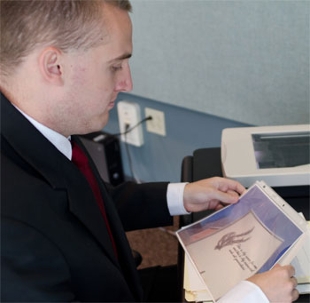
Organizers of the first Shenandoah Valley History Harvest, held at James Madison University in April, are overwhelmed by the public's willingness to share their historical religious artifacts for eventual online research.
"The History Harvest was a huge success," said Dr. Andrew Witmer, an assistant professor of history. "It generated an estimated 8,600 individual digital scans and 17 outright donations to JMU Special Collections. We collected clothing, congregational histories, photographs, church records, letters and journals."
One beauty of the History Harvest was that people did not have to "give up" their artifacts to participate. Instead, 35 students in Witmer's Introduction to U.S. Religious History class, working with professionals from Special Collections and the Center for Instructional Technology in Libraries and Educational Technologies, digitally scanned or photographed religious items with connections to Rockingham, Augusta, Page and Shenandoah counties. "People love their stuff, but they are willing to share them for scanning and photographing," Witmer said.
Artifacts gathered represented the Jewish, Mennonite, Amish, Presbyterian, Brethren, Episcopal and Seventh-day Adventist communities. By far the largest treasure trove is a collection of 18 banker's boxes from the Shenandoah Valley Academy in New Market, a Seventh-day Adventist Church-affiliated boarding high school established in 1908, the same year JMU was founded.
One student who worked to make the harvest a success, Kim Twomley, was instrumental in the sharing of the SVA collection through her assignment to the Page/Shenandoah Counties Outreach Committee of the project. The natural fit, given that she works for the academy and lives in Shenandoah County, led her to talk about her class and the harvest with coworkers in hopes of learning more about her church's Valley history.
"Jan Osborne, our director of alumni affairs, was born and raised here, has lived here all her life and knows everyone connected with the school and church for the past 60 years," Twomley said. "She handed me a book written by Richard Harris, a former pastor of the New Market SDA church, which chronicled the founding of the school. Sure enough, the first few chapters of the book were all about Mr. Charles Zirkle, the man who donated the property for the school to be built on and whose family was the first Seventh-day Adventists in the Shenandoah Valley."
Even better, Harris' research documents are property of the alumni department at the academy. "Embedded in those archives is the Zirkle family history," Twomley said, "and thus the founding documentation of the SDA church in the Valley. Jackpot!"
Archivists in Special Collections are currently organizing the collection, which is on loan to the library, and placing pieces in non-acidic folders for safekeeping, said Mark Peterson, archive specialist in Special Collections. "There's quite a bit of material and it will take us a while to scan the artifacts," Peterson said. "The Adventist collection will be important for the local community." He believes the collection will be available for researchers to access by the end of 2012, with much of the finding guide completed by the end of the summer.
Beyond the wealth of new materials the project generated for the library, the harvest's "crop" was practical experience for students. "As a history major, I appreciated the experience because it is exactly what JMU has trained us to do – value history and its story," said May graduate Kayla Patterson. "But more than that, we took something valuable to others and made it known to the public."
"I was pleased with how invested the students were in the project," Witmer said. "They represented JMU well."
"Our aim in holding this event was certainly to have valuable religious documents brought in for digitizing, but we also wanted to establish some ties to the community around JMU," said Russell Leary, who earned his undergraduate degree in political science in May and is now a JMU graduate student working toward a masters of art in teaching degree. "I believe the true value of the History Harvest came through many of the connections we were able to make through the process of reaching out to the academic and religious community around us."


