

Online Master's Program Feeding Need for School Speech Pathologists
News



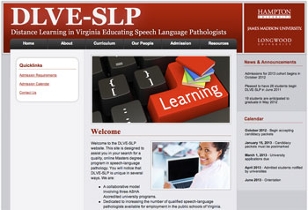 Since earning her bachelor’s degree from James Madison University in 1997, Jennifer Cythers Lee has enjoyed a successful career as an educator at Occoquan Elementary School in Woodbridge, where she currently serves as the school’s Title 1 math resource teacher. In the fall, the 37-year-old will take on another challenge in the classroom: identifying and assisting children with speech and language disorders.
Lee is one of 13 students who recently completed a Virginia collaborative distance-learning master’s degree program in speech-language pathology. The program, known as DLVE-SLP, is a partnership between JMU, Hampton University and Longwood University. Designed to address the ongoing shortage of certified speech-language pathologists within Virginia public schools, it is supported by a grant from the state Department of Education.
“I always knew I wanted to get my master’s,” Lee says. “I wanted to stay in the schools but also assume more of a leadership position.” She was drawn to speech-language pathology for the opportunity to work with special-needs students in small groups. “It allows me to see the connections between things.”
The DLVE-SLP program developed under the direction of Dr. Carol Dudding, assistant professor of communication sciences and disorders and interim director of speech-language pathology at JMU. Students must complete prerequisite courses and be admitted to one of the three partnering universities. In-state students are given first priority, and there is tuition assistance available in exchange for a student’s commitment to work in Virginia public schools after graduation.
The part-time program caters to working professionals, many of whom have family obligations. Students generally take two courses per semester and graduate in three years. The first cohort of students began in June 2007 and graduated in 2010. The second started in the summer of 2009 and graduated in May. A third group enrolled last year and will finish in 2014. All students attend a two-day orientation at the start of the program and an annual one-day program meeting. Cohorts generally number between 20 and 25 students with an average age of 34.
“Traditional programs don’t fit with somebody who’s working and can’t be flexible,” says Kim Palko, 45, a social worker who discovered the DLVE-SLP program after relocating to Northern Virginia from San Francisco. “There are a lot of universities in the D.C. area for speech pathology, but they didn’t have the program that I needed. Either it was cost-prohibitive or they required you to commit full-time. This worked around my schedule. It was a dream fulfillment.”
Because JMU is the fiscal agent for the state grant, every student who enrolls in the program is assigned a JMU email account and given access to the university’s Blackboard system and library services. Classes are taught online, either in real time via Illuminate or by allowing students to log on to Blackboard on their own time and listen to prerecorded lectures, view multimedia presentations and other materials, and download and complete assignments. “We have some students who get on at midnight, some who get on in the morning, some who are on all weekend,” Dudding says. In addition, courses have regular online discussion forums, and some faculty members hold virtual office hours.
Lee says the flexible schedule allowed her to complete her studies while continuing to work and tend to her three children, ages 6, 9 and 12. “It wasn’t always easy. I had to miss some baseball games and swimming practices. But my husband was very supportive and the kids adjusted pretty well. Overall it was doable, and the best thing was I didn’t have to commute.”
The curriculum employs teachers from each of the three schools plus the University of Virginia, a charter member of the program. “I really feel that we had an advantage in working with professors from all over the state,” Lee says. “All of our professors were well respected in the field of speech-language pathology, and this was very beneficial to our experiences.”
In addition to their coursework, students in the program are required to complete 400 clinical hours, beginning with a summer session in Harrisonburg during their second year. Once they return to their home university, they are assigned to work under the supervision of a local certified speech-language pathologist.
Speech-language pathologists deal with disorders ranging from auditory processing and cognitive communication to articulation and swallowing. “Certainly the caseload in public schools isn’t going down,” says program coordinator Teresa Druling, in part because “we’re identifying these children earlier than we did 20 or 30 years ago.” Also, more medically fragile children are being integrated into regular classrooms with the help of technology, she says. As a result, demand for speech-language pathologists in schools is high, and job openings are often advertised well into the academic year. Rural areas of the state are especially underserved.
JMU graduates of the DLVE-SLP program have a 100 percent pass rate on the Praxis test, the national exam for teacher certification, and their scores have been comparable to on-campus students, Dudding says. “We can say we’re doing a good job, but when students have those types of scores, that shows we’re doing a good job.” Also, the program’s attrition rate is low compared to other online education programs, a fact she says should help ensure its future.
Related links:


