
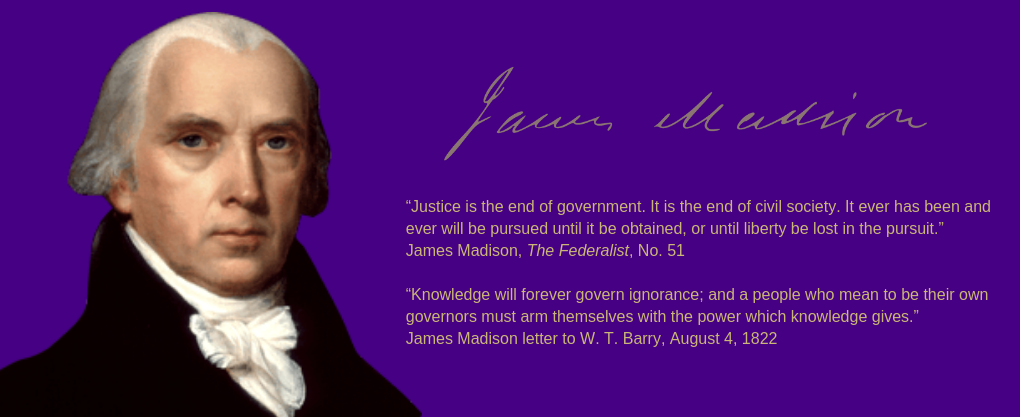
When Mr. Marbury and others take
their case to the Supreme Court, their counsel advises them that
proof may be required to show that in fact their appointments
were consented to by the Senate. The Senate keeps records of this
sort — where it gave its advice and consent to appointments and
treaties — in an Executive Journal maintained by the Secretary
of the Senate (who is not to be confused with the Secretary of
State, James Madison). It is called an executive journal since
the Senate shares powers over treaties and appointments with the
executive, i.e., the President.
Senate debates over these executive matters and
the Executive Journal were held in secret. Marbury and others
thus request that the Senate override its secrecy rule and provide
them with an extract of the Journal showing that they have been
confirmed.
A partisan debate follows and Marbury and the
others are denied the extracts. This denial has no impact on the
Supreme Court decision which turns on the Constitutional question
of the original jurisdiction of the court. The discussion, however,
is useful in showing the nature of the political warfare surrounding
the affair. One should not take seriously everything that is said.
The Democratic-Republicans advance a theory of presidential power
that would be disavowed by Madison and Thomas Jefferson, the Democratic-Republican
President. The Federalists' claim that they are not familiar with
the matter should be read with skepticism. The vote at the end
is party-line with Democratic-Republicans (DR) voting against
and Federalists (F) for the request.
This document was scanned
in by the James Madison Center and hand-corrected for errors.
Errors may survive, or be multiplied by, the hand correction.
If complete accuracy is desired, consult the facsimiles at the
Library of Congress site. Explanatory words or phrases have been
added in brackets []. Some of the words used have passed out of
common usage, but have been left as is. The meaning can be inferred
from context and from surviving variants of the words.
WILLIAM MARBURY AND OTHERS
The Senate took into consideration the motion
made on the 28th instant:
That the Secretary of the Senate be directed
to give an attested copy of the proceedings of the Senate of the
2d and 8d of March, 1801, so far as they relate to the nomination
and appointment of William Marbury, Robert T. Hooe, and Dennis
Ramsay, as justices of the peace for the counties of Washington
and Alexandria, in the Territory of Columbia, on the application
of them or either of them."
Mr. [John Eager] HOWARD [F, Maryland] said he
should not trouble the Senate with any observations upon the question;
the request was so reasonable, that he concluded it would pass
without objection.
Mr. [James] JACKSON [DR, Georgia] wished to have
some explanation of this business. It must, he said, be recollected
that an attempt was made at the last session to effect the same
thing, with this only difference, that the application was then
made by counsel; which now came from the men themselves. The motion
on that occasion was introduced by a member from Massachusetts,
who, after hearing the objections offered against it, thought
proper to withdraw it. He considered it now, as he then did. an
attack upon the Executive Department of Government, and as such
should be prepared to oppose it, as often, and in whatever shape
it might present itself.
Mr. [Jonathan] MASON [F, Massachusetts] observed
it was true, as the honorable gentleman from Georgia had stated,
a motion similar to the present resolution, he bad himself made
at the last session, and for the same purpose. It was in consequence
of a verbal application at the door of the Senate Chamber, from
one of the parties; or their counsel, to whom he was a stranger.
He gave to them his opinion at the time, that the application
was proper and would be granted as a thing of course. He was afterwards
surprised to hear objections offered — the principal ones however,
were that the record was a secret record, and that by a standing
rule, no copy was allowed but by special order. It was time now
to consider the propriety of granting it, when the parties themselves
applied in writing, stating the purposes for which they wanted
it, and upon this and the motion was either withdrawn or rejected.
In the present case they had applied in a respectful manner, in
form of memorial. and had stated the reasons of their application,
and the use they. wished to make of the copy, to establish an
existing right. They were citizens and parties to the Government
and to. its privileges. The principles upon which this Government
was founded were freedom and equality of rights, and a protection
to these rights. The petitioners now claim that protection, by
a request that we would grant to them our knowledge of the existence
of a fact necessary to establish one of their rights. Publicity
of record was a Constitutional provision, and a check in favor
of the people. It was a right belonging to the meanest citizen
to inspect the records of the Government, unless the divulging
of these records would be inconsistent with the public safety
and interest. And when that was not the case it was our duty to
grant the request — they had a right to demand it. It was upon
the same ground that every citizen had a right to demand and compel
the testimony of his fellow-citizens, upon peril of damages equal
to the loss of his testimony; it is an implied promise, founded
upon mutual protection and aid to each other in the support of
their individual rights. It is one of the great reasons for which
men associate. The same justice is due from public bodies, though
compulsory process is not in both cases to be had.
This request is so accordant with a common sense
of justice, that he had no doubt the mere exemplification of a
record, or a certified copy, in itself not improper to be made
public, would be granted by one enemy to another, in an enemy's
country. Mr. M[ason]. was at a loss to know what possible injury
could arise by giving a copy of a fact so notorious, and he hope
therefore the parties would be indulged.
Mr. JOHN BRECKENRIDGE [DR, Kentucky] thought
it improper to grant the prayer of the petitioners. The Executive
Journal is kept only for the private use of the Senate and there
is an express rule that extracts should not be given without the
order of the House. He knew of no instance in which they could
with propriety be claimed or given, but if there were any Such;
he begged gentlemen to point them out: As to the case in question,
to grant the prayer of. the petition would, he said, administer
to the means of assailing the Executive Department of the Government.
He considered the President as in some measure a party to the
Executive Journal, end therefore an extract of it ought not to
be communicated without his consent. The Senate ought to protect
the dignity of that branch in which they participate. The suit
is now pending on a mandamus to the Secretary of State [James
Madison]. The Senate ought not to aid the Judiciary in their invasion
of the rights of the Executive. There could be no use in giving
such extracts, and there might be mischief.
Mr. [Gouvernour] MORRIS [F, Pennsylvania] was
much in opinion with Mr. B[reckenridge]. He thought that the rule
respecting the Executive Journal was wise, and that extracts ought
not to be given for trivial purposes that it might be a means
of embarrassing the Government, and lessening the respect due
to those who administer it. That he had no apprehension of any
such on the part of the Judiciary; he was persuaded they would
treat with due respect the other parts of the Government. But
such attempts might be made by others, and therefore it was not
prudent to furnish the means, or to establish a rule of which
designing men might avail themselves for bad purposes. For these
reasons he was inclined to reject the proposed resolution. On
the other hand he considered the application of a suitor for evidence
to support his right, as of a very serious nature. A denial of
that evidence might amount to a denial of justice. He was not
prepared to go so far. If in possession of a deed making a link
in the chain of a suitor's title, the courts might compel him
to appear, and bring with him the deed; he did not feel himself
justified in using the authority with which, as a Senator, he
was invested, for the purpose of refusing that which another could
rightfully demand; and oblige him by law, as a private citizen,
to give. That in the present case, the merits of which were unknown
to him, it was possible, as has been suggested, that other evidence
might be produced, and though of inferior force, be validated
by the refusal of the Senate. Perhaps, too, the court might issue
process, compelling the Secretary to appear and bring with him
the Journal. It was equally possible that they might not think
it proper to issue such process, or that the Secretary [of the
Senate] might refuse to answer, alleging his duty to keep the
secrets of the Senate. That if from these or any other causes,
the Court should declare they could not do right because the Senate
withheld the evidence, he should feel himself guilty of a denial
of justice. That in effect the assent of the Senate being a pre-requisite
to the appointment of an officer, it might be necessary to show
that assent when his authority should be legally questioned. If
the Senate refuse on the present occasion, where the evidence
is said to be necessary to obtain the office, how could they grant
it on another occasion where it would be necessary to preserve
the office? On the whole, Mr. MORRIS declared he should reluctantly
give his vote in favor of the resolution, because the greater
weight of reason was in favor of it, and because he could not
answer to the world, or to his own conscience, the delay or denial
of justice.
Mr. [Robert] WRIGHT [DR, Maryland] said he was
opposed to the resolution; he could not discover that the applicants
had any right to the extract prayed for. The Senate had by a specific
rule declared the Executive records a secret. But he could not
conceive what benefit they (the petitioners) could derive from
an extract if they obtained it. They ask that the Secretary of
the Senate may be allowed to certify facts from the Executive
record; but the Supreme Court, nor no court; would admit such
a certificate as testimony, because the Secretary had no seal.
In order to get any benefit from this record, the court should
allow the petitioners a subpoena to the Secretary of the Senate,
with a duces tecum. He challenged all lawyers upon this subject,
and all men of common sense; they must all agree with him that
the thing prayed for could do the petitioners no good without
a seal. But, Mr. Wright said, he had further objections against
passing the resolution. It was well known why this certificate
was requested. It was to aid in an audacious attempt to pry into
Executive secrets, by a tribunal which had no authority to do
any such thing; and to enable the Supreme Court to assume an unheard
of and unbounded power, if not despotism. It was to enable the
Judiciary to exercise an authority over the President, which he
could never consent to. It was well known that the persons applying
were enemies to the President, and that the court were not friendly
to him, and, under these circumstances, to interfere in the business
would be making the Senate a party. No court on earth could control
the Legislature, and yet it had been held here on this floor that
they could, and this was a part of the same attempt to set the
court above the President, and to cast a stigma upon him. The
President had a right to withhold the commissions from these justices,
because they did not hold their offices de bene merito but de
bene placito.
Mr. [James] HILLOUSE [F, Connecticut] remarked
that he did not discern anything in the resolution under consideration
that had the smallest relation to the character and conduct of
the President, nor was there anything in the application that
could lead to such a conclusion. It is said there is a cause pending
before the Supreme Court of the United States, in which it is
important to ascertain the fact, that the Senate did advise and
consent to the appointment of the individuals named in this application
to be justices of the peace for this territory, and a copy of
the journals of the Senate is requested for that purpose —
the journals of the Senate being the only evidence of the fact,
can that evidence with propriety be withheld? The opinion that
such copy would not be admitted as evidence cannot be correct,
for it is the only mode in which many important facts in relation
to appointments to office, and the ratification of treaties, can
be proved. For what purpose are the journals (which are the only
record of the proceedings of the Senate) kept, if they are not
to be resorted to as evidence of what is done in Senate?
Suppose a question to arise in a court of justice
relative to the office of the marshal or judge, and it should
be claimed that there had never been a Constitutional appointment
to such office; for that the nomination had been rejected by the
Senate, and their advice and consent had never been obtained —
or in case of a treaty with a foreign nation the President should
by Proclamation declare the ratification, and promulge the same
as the Supreme law of the land, where the Senate had Refused their
advice and consent to such ratification — in neither case
would the act of the President be valid without the previous advice
and consent of the Senate, and how can it be proved that such
advice and consent has been had but by a resort to the journals
of the Senate? Surely the commission or proclamation of the President
could not be conclusive, because the Senate are an independent
body. on whom the Constitution has devolved certain Executive
duties of which the President can have no personal knowledge;
the performance of which duties are by the Constitution made indispensable
to the validity of certain acts of the President. In all these
cases the President may be deceived; the Secretary of the Senate
may by mistake or fraud certify that the advice and consent of
the Senate has been had to an appointment to office, or the ratification
of a treaty, when the fact is otherwise; and where, but to the
journals of the Senate, can we resort to correct the error? It
is a possible case that a President may assume the right, in opposition
to the opinion of the Senate, to make appointments to office and
ratify treaties, and shall it be said his commission or proclamation
is to be admitted as conclusive evidence, which cannot be questioned,
and in that way evade the Constitution ? This would be giving
to the President high prerogatives indeed; it would be investing
him with the absolute power of appointment; and declaring that
his proclamation shall be the supreme law of the land. The commission
of the President is undoubtedly high evidence of the appointment
to office and the proclamation of the ratification of a treaty,
but cannot be conclusive, because the Constitution has made the
advice and consent of the Senate a prerequisite, and indispensable
to the validity of the appointment or ratification, and nothing
can come in place of it. A rejection of this resolution will be
a denial of right to an individual, and, under any Government,
would be considered as an arbitrary, tyrannical act. Under these
impressions, he should give his vote in favor of the resolution.
Mr. [Aaron] OGDEN [F, New Jersey] observed,
that there was no rule in society better established, than the
one which denies to an individual the right of withholding his
testimony, when required to give it, in a court of law, upon the
prosecution of a legal suit. That this rule had no exceptions,
if the honor or interest of the witness would not be compromitted
thereby. That the present was a decent application to the Senate,
for the evidence of a fact. in their power to give, and upon which
a suit at law had been predicated. That the petitioners by applying
for a copy of the Executive Journal had pursued the only possible
mode of obtaining this evidence. That parol evidence of the contents
of this record could not be admitted, neither could a subpoena
cause it to travel out of the office to which it belongs.
That although Executive business is done with
closed doors, yet there is no rule that the Journal in question
should be kept secret; that it was open to inspection, and that
there was nothing to prevent the Secretary from giving the copy,
but the rule of the Senate, which requires that leave should be
first obtained. That no reason had been given, which was satisfactory
to his mind, why this leave should not be granted. That he would
not delay the Senate, by answering such arguments, as had been
adduce to prove that the evidence would not be admitted, and that,
if admitted, would not support the suit; because the court, before
whom the evidence might come, and not the witness, is alone competent
to decide such points.
That it was not true, as had been stated, that
no case would arise, where such copies as are now required, ought
to be allowed; such cases had been put, and the most important
rights of the citizen depend upon such testimony. That, upon a
quo warranto, whereby the right to officiate as a judge, although
acting under a commission, might be called in question, such testimony
would be allowed to go forth, if it would prove that this Senate
had never advised or consented to the appointment of such judge.
That a citizen might, in a court of law, deny
the proclamation of a treaty to be the supreme law of the land,
and prove its nullity by such testimony, if it would show that
such treaty had been negatived by more than one-third of the Senate
then present. That, if such copies might be allowed for evidence
in any case whatever, it followed, that it would be proper to
allow it in the present case. That no distinction existed between
the present case and the one which had been admitted during the
discussion, when it was said, that the House of Representatives,
when parties to an impeachment, had a right to demand on the Senate,
before whom the cause must be tried, the testimony of this Executive
Journal. That in such case the Senate would sit as a court, and
such testimony could not be obtained under the rule of the Senate,
unless leave should be given by the Senate in their Executive
capacity; and that all parties, whose rights were interested,
whether individual citizens or House of Representatives, stood
upon an equal floor, when in a court of justice.
That no danger, as had been apprehended, could
arise in regard to the dignity of the President, or the honor
of the Government. That our judges were an independent branch,
and no possible presumption could be admitted, that they would
do wrong, or transcend their jurisdiction; and that he should
therefore, with great clearness, vote for this resolution on the
table.
Mr. [James] JACKSON [DR, Georgia] said, the
Executive Journal ought not to he given to any applicants, much
less to these. He considered the whole as an attempt to injure
the Executive. The applicants had a process before the Supreme
Court, and let them get along with it as well as they could; if
they could obtain a decision of court in their favor, let them
make the most of it; he hoped the Senate would not interfere in
it, and become a party to an accusation which might end in an
impeachment, of which the Senate were the Constitutional judges.
One case, he would agree, might occur, when the Senate must give
up their Executive records, and everything else, if required by
the House of Representatives, as evidence to support an impeachment;
their call would be omnipotent, in his opinion. But he thought
the commission of the President was the only evidence of an appointment,
and in all cases conclusive. And he would never lend his aid to
set the Judiciary above the Executive. Let the applicants inform
the House of Representatives, if any officer of the Government
had injured them, and procure an impeachment, if they could; this
would be the proper remedy.
Mr. BRECKENRIDGE [DR?, Kentucky] said, he had
not supposed the question would have been so strongly contended.
He thought sufficient reasons had been stated in the beginning,
for rejecting the resolution. But arguments had been brought in
support of it, which required some notice. It had been stated
that extracts from the Executive Journal might be necessary to
prove the right of an officer to his office. This was unfounded.
The commission granted by the President was full and complete
evidence of the authority granted to the officer. That it must
always be presumed the commission had been granted in the manner
prescribed by the Constitution. This was a confidence reposed
in the President by the theory of our Constitution. That it must
be presumed the President will do right. That a commission from
him constitutes an officer, not only de facto, but, de jure: and
is in its nature so conclusive, that no court could inquire into
the validity of it. That the contrary insinuation is derogatory
to his dignity, which the Senate are bound to protect. That the
Senate should not countenance the Judiciary in their attack on
the Executive power, which is not constitutionally amenable to
the judges. That the case which had been relied on as to treaties,
was, in its nature similar. The full evidence was contained in
the President's proclamation. It was to be presumed that he had
not ratified a treaty without the consent of the Senate, and therefore
full faith was to be given to his proclamation. That it was dangerous
to countenance the pretensions set up by the judges to examine
into the conduct of other branches of the Government; for that,
if they had a right to examine, they must have, as a necessary
incident, the right to control the other departments of Government.
That such right was inconsistent with every idea of good government,
and must necessarily degrade those branches which the Judiciary
should thus under take to direct. The present suit was therefore
levelled [sic] at the dignity of the first Executive Magistrate,
and as he thought the Senate bound to protect that dignity, he
should vote against the resolution.
Mr. [Uriah] TRACY [F, Connecticut] said he was
not sorry for this discussion, and as there had never, to his
knowledge been a similar application, the decision on this would
form an important precedent; he therefore thought it best that
the subject should be examined in all its bearings. The first
inquiry that occurred to his mind was, could there be a case which
would render it proper to direct the Secretary to give an extract
from the Executive records?
A case might be stated which had in fact happened;
a gentleman who had been duly appointed a district judge, received,
by mistake, a commission as circuit judge; there was a circuit
judge already appointed, commissioned, and acting in that capacity,
so that two commissions, exactly similar in point of form and
substance, to two different men, were existing at the same time,
authorizing both to act in a capacity where the law allowed but
one to act. What can be done? Shall we resort to the President
to rectify the mistake? He is out of office, or it maybe he is
dead; shall we resort to the Secretary of State? He is out of
office. or dead. Besides, if both were living and disposed to
rectify the mistake, they could neither of them compel obedience.
Shall we resort to the Senate? A mandate from them would tend
only to show their imbecility, as their Executive functions extend
not to commissions, but solely to advice and consent on a nomination.
An application then to a court of justice by quo warranto, or
some other process, was the only proper efficient remedy to prevent
the conflicting operations of the two judges. Could any gentleman
point out another remedy?
What course would a court pursue in such an inquiry?
Upon inspection of the commissions both are equally authentic.
A resort must be had to the Executive Journal of the Senate; and
there, it would appear, that one judge was nominated as a district
judge, and as such only the appointment received the advice and
consent of the Senate, and that his commission had issued, by
mistake, as circuit judge instead of district judge. A judgment
of court, that such a commission was void, would be an effectual
remedy. But was not an extract of the Executive records of the
Senate the best evidence which the nature of the case admitted?
The records of the Executive, or Secretary of State, if any such
were kept, would amount to no more than that the Secretary of
the Senate made a report of certain transactions of the Senate;
in which report, if the Secretary should mistake the fact, either
by accident or corruption the evil must remain without a remedy.
The highest evidence which could in such a case
exist, he thought was to be derived from an extract of the record
kept by the Senate, and under a solemn order officially given
and attested by their Secretary. All other evidence which he could
conceive of was of a subordinate kind. But in objection it had
been stated that the Executive Journal was a secret, to which
the President is a party, and without his consent no extract should
be given. Mr. T[racy]. said that however this observation might
be just, in respect to confidential Messages, yet the Executive
Journal was as completely under the control of the Senate, and
of them only, as it would be if no President existed; as a House,
and a substantive branch of Government, they had a Constitutional
authority to keep Journals, and to make rules regulating their
conduct in that and all other official transactions; and acting
in that capacity, they had made a rule that no extracts should
be taken from the Executive Journal without an order of Senate;
plainly indicating that if they please to give such order, neither
the President nor any body else had a right to object. If the
Senate chose, they might act upon all nominations of the President
with open doors; but merely for their own convenience they had
acted hitherto in a different manner; but no member had ever thought
he violated any injunction of secrecy by informing that a nomination
was made, and every circumstance attending it, after the Senate
had acted upon it, nor even when it lay before them, undetermined.
He thought it was clearly proved that there was
a possible case when an extract might be given. The next consideration
would be, ought it to be given in this case?
The applicants say, that they are attempting
to obtain before a court of justice remedy for a wrong done by
the Secretary of State in withholding from them certain commissions
as justices of peace, to which they claim a right. They say an
extract from the Executive Journals, that the Senate advised and
consented to their appointment is, as they are advised, indispensable
in their cause. Now what answer can be given to this? Is it not
a dictate of common sense that they should have it? Have they
not a right to it, upon the plain principles of our social compact,
unless some injury will arise by granting It? The grant can injure
no person, and a refusal may injure the applicants. But it was
said, by furnishing this extract, the President would be put in
jeopardy. He could not possibly, discover the reason of all the
ferment and sensibility about the President. Was he in danger,
or could he be in danger from it? If an improper attack was made
upon the President, he would agree that so far from assisting
in it the Senate should rally in his defense.
Let us see, said he, what the facts are. The
request is for an extract from the Executive Journal of the Senate,
as testimony in a court of justice, and claimed to be absolutely
necessary to establish the rights of individuals. He knew nothing
of the cause, except what he derived from the petition, and the
declarations of gentlemen in debate, by which he learnt that a
mandamus was prayed for against the Secretary of State for withholding
certain commissions which had been completed by the President,
and left with the Secretary for delivery. The court was authorized
by statute of the Federal Legislature, among other things, to
issue writs of mandamus, in cases warranted by the principles
and usages of law, to any courts appointed, or persons holding
offices under the authority of the United States.
A plain simple proceeding, before a court competent
to hear and decide. What reasonable cause of alarm could this
be to the friends of the President? He could see none. And the
gratuitous observations of the gentleman from Maryland (Mr. WRIGHT,
DR) that the court were unfriendly to the President, and that
the applicants had done this to injure him, were, in his opinion,
out of order, improper, and totally irrelevant. But it was said
that this extract could do no good to those who request it; because
it did not make out their case. Gentlemen; he thought, affected
to know more about the case of these applicants than was requisite,
for a just decision of the petitioner. What was it to the Senate,
if the testimony is not complete? Suffice it to say, it is a part
and a necessary part of their testimony. Suppose, said he for
the sake of argument, that the Secretary oaf State has been bribed
to reserve these commissions; or, suppose the President had committed
them to me to carry them to the petitioners, and I had destroyed
them corruptly; and a claim was made before a court of justice
for a remedy against the wrong so done? Could damages be obtained
unless the plaintiff could show that every prerequisite was complied
with to make these commissions valuable; and, among the rest,
that the Senate had advised and consented to the appointments
? Or, put the question the other way, could not I defend successfully
against an action if I could show that no such advice and consent
was had, and that therefore the commissions were of no value?
He thought it clear that the testimony would be important, though
perhaps not all which the case would require. But another, and,
if possible, a more extraordinary objection had been made; that
an impeachment was all the remedy which was applicable to the
case stated. Let them obtain from the other House an impeachment,
say the gentlemen, if they can, and then we will try it.
I am bound, said Mr. T[racy]., to believe this
is the serious opinion of the luminaries of our nation, because
it is solemnly declared in debate, otherwise he should have said
that such an observation could not be serious. What will be the
effect of a conviction on an impeachment? A removal from office
and a disqualification from holding office. And is it not the
express declaration of the Constitution, that the party thus convicted
shall be liable to indictment. trial, and punishment, for the
same offence ; and is he not still liable to an action for private
damages. in case any have been suffered, by an individual
There could be no doubt but, in this very case,
damages would be recoverable, if the commissions were withheld
by the Secretary of State from any corrupt or sinister motives.
It was likewise said that the commission was prima facie evidence
of the holder's right, to office; and not only so, but conclusive;
and as the parties complaining had not commissions, they could
have no conclusive evidence of their right. This, he said, was
equally extraordinary with many other assertions. It seemed to
be a position laid down by the gentlemen that this petition should
be opposed. and any objection on earth was pertinent and sufficient
if, on a view of this subject, there was not at least a colorable
right in the applicants, he was exceedingly mistaken. A right
to what? to office? Yes, and a right to their commissions; which,
they say, are withheld, as a proof of their right to office
He would observe one word, upon the conclusive
operation of a Presidential commission, and a proclamation promulging
a treaty. The gentlemen say both are conclusive, and cannot be
invalidated by any possible testimony. If so, he thought the Senate
should go home, being useless at the seat of Government, for it
would be only requisite for a President to issue a proclamation
in case of treaty, and a commission in case of office, and the
advice and consent of the Senate was always to be presumed ; and
the contrary could not possibly be shown. This was saying, most
emphatically, that our President could do no wrong.
He was clear in the position that, in the case
stated, the petitioners would stand in need of the extract requested,
and that they had a right to it; that granting it would do no
harm, and withholding it would bean arbitrary denial of justice.
He therefore should vote for the resolution.
Mr. [Abraham] BALDWIN [DR, Georgia] had not been
in the House when the debate commenced. He thought, as it related
to Executive business, it ought to have been conducted as such
business usually is; that, as the question then stood, he should
be against the resolution. He considered it as relating to a part
of our Constitution, which the sages who framed, and certainly
those who adopted, it, had always considered as peculiarly delicate.
That it was one of those nice theories which. in varying from
established practice, ought to be carried into effect with great
discretion; that he had ever thought the unity of Executive power
essential to the energy of action which ought to prevail. Everything
therefore which tended to divide that oneness so, desirable, ought
to be avoided. That it was true the assent of the Senate was required
by the Constitution before an appointment of officers could take
place; that, on the nomination of the President the business was
inchoate; and although while it was in transitu the Senate kept
a journal for their own satisfaction, yet he thought such (their
private journal) ought not to be made public — more especially
as it would destroy that desirable oneness so useful in all things
which concern the Executive power; that he was, however, unwilling
to establish a precedent of any sort. He thought no general rule
should be made, either to grant or to withhold extracts from that
journal. Every application should, he thought, be considered and
decided under its particular circumstances. That the present case
was an application for a mandamus to the Secretary of State, by
persons conceiving or, stating themselves to be justices of the
peace; that, even if they could obtain the extract they ask for,
it would not answer their purpose; for, although the Senate approved
of an officer when nominated by the President, it did not follow
that the President would make the appointment — circumstances
might arise to alter his opinion. The applicant therefore for
a mandamus must be defeated, if he could not produce the President's
commission, and if he could, that was a sufficient evidence of
his right, without the extract asked for. Mr. B[aldwin]. was therefore
of opinion that the petitioners had asked for a thing which was
useless; and he was convinced that the Senate, exercising a sound
discretion, would not grant a thing which must be useless, and
which might, perhaps, be productive of evil consequences.
Mr. [Gouvenour] MORRIS [F, Pennsylvania] .—
Mr. President, when I first rose, in this debate, I felt and expressed
much doubt; but the better reason appearing in favor of the resolution,
had determined me to vote for it. At present, my opinion is clear
and decided. The conviction has been produced by the arguments
of those who opposed the resolution. These contain the most monstrous
system of tyranny that ever, I believe, was brought before a national
assembly. Permit me to notice a few of the strange positions which
we have just heard.
It has been said by a gentleman from Georgia;
on my right, (Mr. JACKSON,) that an extract from our Executive
Journal should not be given to a suitor in one of our courts,
because it may contain matter to support an impeachment against
the President, which impeachment is to be tried before us; and
therefore we, being judges, should not also become parties by
furnishing evidence. And yet the same gentleman has told us that,
upon the demand of the other House, (who, according to him, have
a right to demand everything.) we are bound to furnish this very
evidence, if they require it, for the purpose of bringing or maintaining
an impeachment. Thus we must withhold from a fellow-citizen the
evidence needed to support his right, because it may furnish ground
for impeachment, although no ground for impeachment exist. This,
too, it seems, is required by the impartiality which we should
preserve as judges, before whom such possible impeachment may
be tried. But when there is a question of impeachment, and when
we are in effect the judges, then, on the demand of the other
House, we are bound to furnish that evidence which we are now
bound to withhold.
We have been told that the Executive officers
are all dependent on the Chief, and act under his direction; that,
therefore, his dignity is implicated in their acts; and, consequently,
the conduct of these agents must not be questioned, lest his dignity
be impaired. What broader shield can be interposed to shelter
the agents of Executive authority? How can they be more completely
guarded against all just investigation?
We are further told that a condemnation of these
agents must affect the dignity of our First Magistrate. Must it,
indeed! And is, therefore, no prosecution to be made, is no condemnation
to take place ? This is indeed the golden chain let down from
Jove, to bind the earth in vassalage. And what becomes of our
President's dignity under this strange doctrine? A subordinate
agent abuses his trust — violates his duty — is guilty of malpractice
— he is arraigned; and because the culprit is convicted and condemned,
is the dignity of Government therefore violated?
We have been told that a treaty when proclaimed
by the President, is the supreme law, and that the previous assent
of the Senate cannot be inquired into. Gracious God! and is it
come to this, that the proclamation of our President shall he
the supreme law of the land; that we must submit to it without
inquiry? And how is this monstrous doctrine supported? Why we
are told that because it is not proper in the case of a common
statute to examine the journals of the two Houses, for the purpose
of knowing whether the assent of each was given, therefore, we
must not examine the Executive Journal of the Senate, to know
whether two-thirds of the members present advised and consented
to the ratification of a treaty. But are these cases at all similar?
The law is signed by the President of the United States, the President
of the Senate, and the Speaker of the House of Representatives.
It contains, therefore, the best evidence in the nature of things,
that the full assent required by the Constitution has been given.
But is this the case with a treaty? No. The evidence of the consent
of this Senate appears only by the extract from their minutes
made out by their Secretary. And shall this preclude the inquiry,
whether, in effect, that assent was given which your Secretary
has certified?
We have been told by gentlemen. who seem to know
all the merits of the case which is before the court, that the
dignity of the President is involved in it. For my own part, I
know nothing of the case; neither do I wish to know for I have
no authority to try it. But the gentlemen say the dignity of the
President is involved; and that we are in duty bound to protect
his dignity. But how? What have the petitioners asked? They have
asked the evidence of a fact. And how are we to protect the President's
dignity? By withholding that evidence. And are gentlemen then
of opinion that the disclosure of facts will impair the dignity
of our First Magistrate? Sir. I have no such apprehension. I trust
that our President has acted properly, and that a full inquiry
into facts must redound to his honor. Those who oppose this resolution
seem to think otherwise. But I ask are they prepared by their
vote to declare that injurious opinion? Is there a gentleman in
this Senate, who, when the yeas and nays are called, will record
his opinion that the dignity of our President can only be preserved
by with holding the evidence of facts?
We have been told, sir, by an honorable member
froth Kentucky (Mr. BRECKENRIDGE) that a right to examine, implies
a right to correct and control. This proposition has been frequently
advanced on different occasions. I never noticed it, because it
appeared to carry within itself the sufficient evidence of its
fallacy; but, since it is now again produced, it may be well to
give it one moment's notice. A right to examine whether we agreed
to a certain resolution, implies, it seems, a right to control
our conduct. It may be a question in an insurance cause, whether
damage was sustained by a violent wind at sea; does the examination
into the fact imply a right to command the winds and the seas?
Does the inquiry whether a ship has perished in a storm. imply
the right to correct and control the Almighty raiser of storms?
We have been told by the member last up, from
Georgia [Jackson], that the evidence asked for by the petitioners,
is useless; because, although the Senate may have approved of
them as officers upon the President's nomination, yet it was in
the discretion of the President to make or omit the appointment
which alone could confer a right. That gentleman seems to be perfectly
acquainted with the cause which is depending. He knows precisely
what proof is needful for the prosecutor; and deeming that which
he asks for to be insufficient, thinks proper to refuse it. It
appears to me, sir, that this Senate is not the proper tribunal,
either to examine the merits of the cause, or the validity and
weight of the evidence. These are the proper subjects of inquiry
elsewhere. If we adopt the gentleman's reasoning, however, we
prejudge the cause; and I shall be glad to know, if this practice
be adopted, what case can exist in which a like refusal may not
be made. A client is advised by his counsel to apply to us for
evidence in our power, as needful to support his rights. We refuse,
because, in our opinion, that evidence is not alone sufficient.
But the same gentleman has told us he would not
establish any general precedent. He would always judge of the
particular circumstances; and under the particular circumstances
of this case, he would withhold the evidence asked for. But will
not this establish a general precedent? How are precedents established?
Is it usual for judges to make decisions for the special purpose
of becoming precedents? No such thing. They give judge in a case
which comes before them, and that judgment becomes a precedent
for subsequent cases turning upon the same principle. I shall
be glad to know, then, how a distinction is hereafter to be made
between this acid other cases. Here is a suit pending in a court
of justice; and one of the parties applies for a piece of evidence
which he is advised is material to establish his right. You refuse
it. When in another cause, another party shall apply, on what
ground will you grant that which you now refuse? Will you again
prejudge the cause, and give them the proof because [sic, presumably,
because] you deem it sufficient to carry the cause?
Mr. President, one word more on that unity of
the Executive, which the gentleman last up is so much attached
to. Although I have already spoken longer than I intended, I must
pray one moment's attention. That honorable gentleman thinks there
should be a perfect unity in the Executive power. The division
of it is inconsistent with his ideas of good government, and therefore
he would admit of no inquiry as to facts which may have happened
in the course of Executive volition, but give full credit to the
commissions and proclamations of the President. These ideas, sir,
consist well with monarchic institutions. Our Sovereign Lord,
the King, is indeed possessed of the fullness of Executive power.
and may exercise it at his pleasure. But as to our Sovereign Lord
the President, the case is widely different. The American Constitution
has given to this Senate a wholesome check upon his sovereign
will: But according to the doctrine which gentlemen now advance,
this check is nugatory — neither the people nor the courts
shall question his commissions nor his proclamations. His commissions,
it seems, confer complete authority. His proclamations are the
supreme law. He may form what leagues he pleases with foreign
Powers, and when he shall proclaim them, we are held to implicit
obedience. To these doctrines, sir, I take leave to enter my dissent.
I hope that when the rights of American citizens are invaded,
not only the Supreme Court of the United States, but the lowest
county court of the most remote district will dare to examine,
to judge, and to redress. I hope this Senate will never, by an
admission of such base and slavish doctrines, surrender the authorities
conferred on them by our Constitution. I hope they will ever be
ready to aid the cause of freedom and justice. And in this hope
I shall give my vote for the resolution on your table.
Mr. [DeWitt] CLINTON [DR, New York] said that
everything which had been uttered in the debate confirmed the
first impression of his mind against the propriety of granting
the prayer of the petition. The Executive Journal from the very
nature of it was always secret. This secrecy never ought to be
violated unless some useful purpose was thereby to be attained.
In the present case it was very evident to him that the copy prayed
for could be of no real use to the petitioners. Giving them a
copy of the Journal would, however, be an expression of the Senate's
opinion that the testimony would be proper and useful in the suit
of the petitioners. By a side-wind the Senate would thus be drawn
to hive their weight to one side of the cause. He believed this
was the design of the petition, and the whole proceeding was insidious
and factious. He declared that he was far from imputing these
or indeed any improper motives to any of the Senate who were in
favor of authorizing the Secretary to give the copy as prayed
for; he was persuaded that they were aware of the perfect propriety
of the course they now advocated.
But we are told, said Mr. C[linton], by my colleague,
that perhaps the Supreme Court may send a subpoena for our Secretary,
and compel him to produce the Journal, in spite of our order forbidding
him. Such a step would certainly bring things to a crisis, and
for his own part he thought it desirable that measures might be
taken for ascertaining the real extent of the power of the court.
He was sure if they possessed the power contended for, the rule
of the Senate ought to be altered, so as to forbid our Secretary
from divulging the secret journal unless by order of the Senate
or of the Supreme Court.
A great Constitutional question is now agitated
in that court, involving a right to control the Executive. The
business may not stop there. High officers of the Government of
the United States might in the end be impeached and brought before
this House. He as a member might be called to try, and to decide
upon that impeachment, he therefore wished to remain neuter [sic];
to express no opinion beforehand, even by implication. He felt
this to be his duty, and was clearly of opinion that it was the
duty of the whole body, and that therefore they ought to refuse
the copy of their journals.
Mr. [James] Ross [F, Pennsylvania] said that
although, the Senate decided upon all Executive business with
closed doors, yet Executive proceedings were never considered
secret, except in two cases: when the Senate imposes an injunction
of secrecy upon the members, and in cases of confidential messages
from the President. In all other cases the Executive business
of the body is no secret; it has never been so considered in practice,
for it is communicated by Senators without reserve; and when nominations
are of moment they get into the newspapers before the Senate has
decided upon them. Entire lists of nominations have been published
antecedent to the sanction of the Senate, and yet no complaint
was ever made here that a rule of this body had been violated.
It cannot therefore be pretended that there is any injunction
of secrecy to forbid the copy prayed for by the petitioners. The
whole difficulty arises from a rule directing our Secretary not
to give certified extracts of the Journal without . express permission
of the Senate. This regulation is wise and very useful. It represses
idle curiosity, which, for improper purposes, might publish the
votes of the Senate respecting officers to nomination, or nominations
made and withdrawn by the President, before the Senate acted upon
them.
But when a citizen states that he has a suit
in a high court of justice; that the acts of this body and copies
of our journals will be material testimony in his cause; when
that part of the Journal asked for is not under any injunction
of secrecy, or in its nature confidential, what pretence can there
be for withholding it ? Will our giving leave to take a copy of
it express an opinion of the House whether it be legal testimony?
whether it will support or defeat the suit? Surely not. Much less
will it by implication insinuate that one party is right and the
other wrong. It is a public record, of which any person interested
has a right to demand a copy.
If the gentleman from New York (Mr. CLINTON)
were a recorder of deeds or of wills in the county where he resides,
would he refuse a copy of a deed or a will to a suitor in court?
Would he feel that by giving a copy he lessened his impartiality
as a juror or a judge in that suitor's cause, although at the
time of giving the copy he knew nothing of the merits of the case?
How could he possibly prejudge a cause the merits of which he
had never heard? And yet we, who are now in the same situation
precisely, are told that we are about to give an opinion.
There would be infinitely more force in alleging
that, by a refusal of the copy, we undertake to decide between
the parties; for in that case the Senate must be supposed to have
examined the petitioner's cause of action, and to have found it
such that the testimony prayed for would not sustain. An arbitrary
refusal certainly would not extinguish the petitioner's right.
No court would determine that a right shall be defeated because
those who are in possession of testimony to support it choose
to with hold that testimony, against all rules of justice. They
will either admit inferior testimony to establish the fact, if
material, or direct process to bring forward what is conceived
to be legally attainable. Our refusal then will not defeat the
suitor, and we shall be in the awkward situation of having interfered
to stop a proceeding, without having the power of accomplishing
our object.
Mr. R[oss] said, that his observations would
have ended here. had not new and highly dangerous doctrines been
advanced by gentlemen on the other side, during this debate. against
which he thought it his duty to enter his solemn protest. There
was an end of all free and regular Government if a commission
from the President was conclusive evidence of a right to office
against the journals of the Senate. There was an end to the Constitutional
power of legislation, if the President's proclamation of treaties
constituted the supreme law of the land. when the journals of
the Senate showed that more than one-third of the Senate had voted
against the acceptance and ratification of the treaty. The commission
and the proclamation were good prima facie evidence, but might
be encountered and defeated in the execution by the truth of the
case as established by the journals; and courts in proper cases
could not refuse to admit the inquiry when it became material.
Those who have advanced this extraordinary doctrine will soon
find, that if realized in practice, the transcendent powers of
the President will leave little if any authority or security to
the other departments of Government.
The question was then taken, will the Senate
agree to this resolution; and it passed in the negative —
yeas 13, nays 15, as follows:
Yeas — Messrs. Dayton, Dwight Foster, Hillhouse,
Howard, J. Mason, Morris, Ogden, Olcott, Plumer, Ross, Tracy,
Wells, and White.
NAYS — Messrs. Anderson, Baldwin, Bradley, Breckenridge,
Brown, Clinton, Cocke, Ellery, T. Foster, Franklin, Jackson, Logan,
Stone, Sumter, and Wright.
Ordered, That William Marbury, Robert T. Hooe,
and Dennis Ramsay, have leave to withdraw their petition.