
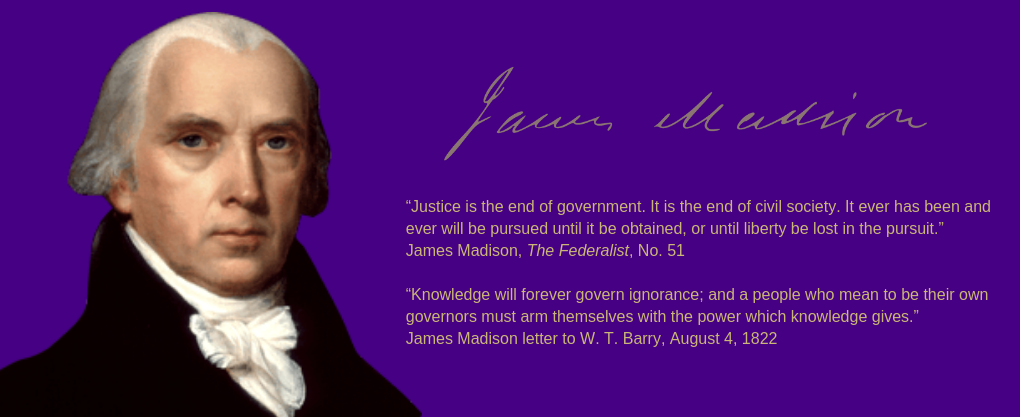
Of all the disappointed office seekers in American
history, only William Marbury obtained the honor of having his
portrait hang in the chambers of the United States Supreme Court.
In the Justices' small dining room designated by Chief Justice
Warren Burger as the "the John Marshall room," Chief
Justice Burger placed the portraits of Marbury and James Madison,
Marbury's legal adversary, as if the two men, in partnership,
had given the Chief Justice his commission to practice judicial
review.
The portraits hang side by side, their styles,
frames, and expressions in marked incongruity with one another.
Marbury, painted it is thought by Rembrandt Peale, a cousin of
his wife's, sits corpulently self-satisfied. n1 He returns the
viewer's gaze pleasantly, comfortable in the social and financial
status he has achieved. Compared to the soft, almost sepia tones
of Marbury's portrait, the smaller Madison painting by James Frothingham
has sharper contrasts. Madison looks past the observer, with an
intelligent, almost combative intensity.
Both portraits reflect aspects of their subjects'
characters. Madison was indeed the driving force of the Republican
party, and would have been its standard-bearer had not Jefferson
been held in such awe by his followers, Madison included. More
than any man, Madison made the Republican party a reality, organizing
it as the opposition in Congress, and giving Jefferson's party
a structure and rhetorical energy that eventually carried it to
victory. n2
In contrast, William Marbury sought the security
and the social prestige that came with wealth. His portrait belies
the drive and financial acumen that brought him worldly success.
He had been trained in private and governmental finance, and had
become used to demanding payments and obligations on behalf of
the state. He helped his friends, and they helped him, but Marbury
possessed a reputation for probity. Hundreds of thousands of dollars
passed through his hands in all of his offices of public trust,
with little suggestion that he had diverted any money to his own
pocket. [*351]
The story behind the case of Marbury v. Madison
n3 often begins with John Adams' appointment of Marbury as justice
of the peace and President Jefferson's decision to withhold delivery
of Marbury's commission a few days after Jefferson's inauguration
in 1801. n4 But Jefferson's order is, in fact, only the middle
of the story. This Article tells the first half. Marbury v.
Madison has frequently been described in terms of a political
contest between the Jeffersonians and the Federalists. n5 What
has not yet been taken account of, however, is the political contest
within the Federalist party that gave William Marbury his erstwhile
opportunity. This Article seeks to fill that historical lacuna
as well.
The two titular protagonists to the dispute,
William Marbury and James Madison, could not have imagined that
their original contretemps would ever find its way to litigation,
let alone develop mythic significance as the foundation stone
of judicial review. n6 Ironically, Madison did not arrive in Washington
until long after President Jefferson withheld Marbury's commission.
n7 For his part, Marbury was busy building an extraordinarily
successful and lucrative career in finance in Maryland. At the
time, he had been iving in Georgetown for two years. In Maryland
tradition, an appointment as justice of the peace was an essential
emblem of a man's membership in the political and financial elite.
Jefferson's denial of Marbury's appointment was a direct blow
to twenty years of work and ambition.
This Article describes how Marbury, the youngest
son of an impoverished remnant of a well-known family, elbowed
his way to wealth and influence among the Maryland gentry. Further,
this Article illuminates Marbury's choice between the two wings
of the Federalist party in Maryland - the Hamiltonian elite and
the Adams' loyalists - and how Marbury's partisan service brought
him to a position earning Thomas Jefferson's disdain and rebuff.
In the end, Marbury's appointment and rejection derived from the
very different characters of John Adams and Thomas Jefferson.
Part I describes Marbury's youth, his rise to
power, and his first contact with the Baltimore financial clique,
led by Samuel Chase, that would become his enemy. Part II delineates
how Marbury used his considerable financial influence and political
position to champion the interests of Maryland's downstate Federalists
against the Baltimore elite that became beholden to Alexander
Hamilton. Part III details the financial scandals that beset Marbury
just before Thomas Jefferson took office. Part IV looks into Marbury's
public association with those Maryland Federalists seeking to
prevent Jefferson from becoming President. Finally, Part V reveals
how John Adams appointed Marbury and his colleagues, why Jefferson
rejected them, and the tactics that the rushed Jefferson used
to appoint his own favorites.
Before beginning, however, it would be appropriate
to describe the office and its powers that William Marbury so
very much desired.
On Friday, February 27, 1801, John Adams signed
a bill for the governance of the District of Columbia that authorized,
among other offices, five-year appointments of justices of the
peace for the District's two counties, Alexandria County and Washington
County. n8 Adams had but five days left in his administration
to make the appointments.
Secretary of State John Marshall had primary
responsibility for gathering the names of the nominees. He relied
upon Leven Powell, a Federalist congressman from Virginia, and
his close friend, who had served with him in the House of Representatives,
for many of the names for the Alexandria contingent. n9 Marshall
turned also to Secretary of the Navy Benjamin Stoddert, another
close friend, fellow Cabinet member and Adams supporter, for nominees
for Washington County. n10 Marbury's name was [*353] included
in this latter group. Some of the names, personal friends of Adams,
almost certainly came from the President himself. Party allegiance
mattered for some of the appointments, but contrary to incoming
President Jefferson's assertion - and the presumption of some
ever since - party loyalty did not figure in the choice of all
the justices. n11 Indeed, some of Adams' appointees were prominent
Republicans.
Over the weekend, the nominations for justices
of the peace were completed, and on Monday, March 2, President
Adams dispatched nominations to the Senate for twenty-three justices
of the peace for Washington County, and nineteen for Alexandria
County. n12 The Senate approved the nominations the following
day, the last day of President Adams' administration. n13
The men nominated for justice of the peace were:
The Hon. Thomas Sim Lee, the Hon. Tristam Dalton,
the Hon. Benjamin Stoddert, the Hon. Uriah Forest, Daniel Carroll,
John Mason, James Barry, Thomas Beall, William Thornton, Daniel
Reintzell, Robert Brent, Thomas Peter, William Marberry [sic],
Thomas Addison, John Laird, Richard Forest, Cornelius Cunningham,
Marsham Waring, John Threlkeld, Lewis Deblois, William Hammond
Dorsey, Joseph Sprigg Belt, Abraham Boyd, Esquires, to be Justices
of the Peace for the County of Washington, in the District of
Columbia. William Fitzhugh, Robert Townsend Hooe, Richard Conway,
Charles Alexander, George Gilpin, Francis Peyton, George Taylor,
Dennis Ramsay, Simon Summers, John Potts, Jonah Thompson, William
Harper, Jonathan Swift, Abraham Faw, Charles Alexander, Jr., John
Herbert, Cuthbert Powell, Jacob Houghman, and Cleon Moore Esquires,
to be Justices of the Peace for the County of Alexandria.
On the same day, Adams also nominated notary
publics, registers of wills, and judges of the orphans' courts
for each county as well as 15 men for military commissions, two
surveyors, a collector and an attorneyThat night, the President
signed 68 civil and military commissions, already drawn up, at
his residence, and returned them to the office of the Secretary
of State where the seal of the United States was affixed. Each
commission was then countersigned by Secretary of State John Marshall.
The commissions remained that night in the offices of the Department
of State. Some of them, including William Marbury's, never left
the State Department.
Congress modeled the office of justice of the
peace for the District of Columbia after Maryland's version of
the position. From colonial times in Maryland, the judicial, executive,
and legislative powers of the justice of the peace made that magistrate
the primary political force in the community. As in England, the
office of justice of the peace was reserved for "men of means
and standing." n14 It was the most powerful public office
in the lives of the common people. Normally held by men untrained
in the law, n15 the justice of the peace was responsible for maintaining
order in his community. He was the arresting and arraigning magistrate,
and watcher over the morals of the community (drunkenness, gaming,
adultery, price evasion, actions of slaves and indentured servants).
He bound suspected ne'er-do-wells and required that they obtain
sureties. He authenticated deeds and affidavits, and held and
advertised lost property - generally horses and slaves. He raised
the "hue and cry" against escaped prisoners, and suppressed
public disorder of all sorts.
The justices of the peace also staffed the county
courts, typically sitting in groups of three or more, hearing
grand jury presentments and major civil cases. n17 As the eighteenth
century matured in Maryland, the power of the justices increased,
both in terms of new criminal, slave, and tax statutes that they
were called upon to enforce, and because in each county, some
of the justices of the peace also operated as county commissioners
or justices of the quorum, staffing the levy court, which was
essentially the county legislature. In 1801, Congress similarly
authorized the new justices of the peace of the District of Columbia
to sit en banc as the District's legislature. William Marbury
would have been one of those men.
I. Youth and Privation
Although William Marbury had not reached the
peak of his career in 1801 when President Adams appointed him
as a justice of the peace, he was a long way towards it. He was
thirty-eight years old at the time, born on November 7, 1762,
n20 most likely on a rude tobacco plantation near the town of
Piscataway, Maryland. He passed most of his childhood following
his father, also named William, in the elder Marbury's fruitless
quest for financial security.
The younger Marbury possessed an aggressive and
uncompromising personality, one that bore him from near penury
to great wealth. He did so despite the fact that it was a quarter
past the hour of opportunity in every place he lived. Marbury
spent most of his youth in Charles County, Maryland, just as it
was beginning a two-century-long decline. He moved to Annapolis
shortly after it lost its commercial prominence to Baltimore.
He then moved to Georgetown, which was suffering not only from
Baltimore's growing financial dominance, but also from Alexandria
besting it as the Potomac's port of entry. In Georgetown, Marbury
allied himself with the Federalists and the Adams Administration
just as they were on the brink of final and irrevocable defeat.
In the end, Marbury would even lose the suit for his withheld
commission at the hands of his fellow Federalist, John Marshall.
Despite his poor choice of geographical sites,
Marbury became rich and influential. Breaking from his family's
tradition, William Marbury found success in the world of finance,
not in farming, merchant trade, or even, until late in his career,
in land speculation. Ultimately, Marbury's mastery of finance
in Annapolis propelled him into prominence in the nation's new
capital on the Potomac, where his alliance with the Georgetown
and Annapolis merchants against the rising power of Baltimore
cast his lot with men who were John Adams' greatest supporters.
William Marbury's respected family name and his
character were bequeathed to him by Francis Marbury, who came
to the tobacco province of Maryland sometime in the late 1680s
while he was still in his 20s. n21 [*356] Francis reached Maryland
at a time when plentiful immigration to that province was falling
off dramatically. n22 While other English immigrants were heading
towards Pennsylvania or to the southern colonies, Francis Marbury
struck for the economically troubled Chesapeake region. His gamble
paid off and he prospered in the new world. Francis and his grandson,
William, seem to have shared a similar drive. Ultimately, Francis
achieved recognition and public office, including a position -
like that his grandson aspired to achieve - as a justice at the
county seat. n23 However, it was from his lands and plantations,
rather than public office, that Francis obtained his wealth and
distinction. Indeed, his status as a successful planter formed
the basis of his rise to public offices. n24 When Francis Marbury
established his holdings at the level just below the great proprietary
estates, and gained the political recognition of an appointment
as a justice at the county court, he had achieved nearly all to
which a man of his era and locale could aspire. When he died in
1735, Francis Marbury divided his extensive estates, totalling
more than 1,700 acres, among his large surviving family of children.
n25
Francis was born in either 1661 or 1662, according
to his own conflicting testimony. See Elise G. Jourdan, Land Records
of Prince George's County, 1717 to 1726, at 90, 97 (1991). Others
place his birth date in 1663. Meredith B. Colket, Jr., The English
Ancestry of Anne Marbury Hutchinson and Katherine Marbury.
During the latter decades of the seventeenth
century, more than one-third of all English immigrants to the
new world went to the Chesapeake. The vast majority had been servants,
seeking to work off their indentured status, and, with but an
axe and hoe, to become landed yeomen producing tobacco for the
English market. However, climate, disease, shortened lifespans,
the relatively small population of women, and the resultant late
marriages, as well as the physical demands of tobacco cultivation
and falling tobacco prices, brought an end to that kind of society.
Aubrey C. Land, Colonial Maryland: A History 9-17 (1981); Russell
R. Menard, Immigrants and Their Increase: The Process of Population
Growth in Early Colonial Maryland, in Law, Society, and Politics
in Early Maryland 88, 94-95 (Aubrey C. Land et al. eds., 1977)
[hereinafter Law, Society and Politics]. Thus, by the end of the
century, while New England immigrants had quadrupled in number,
the Chesapeake could count only 85,000 white settlers out of an
estimated total migration of between 100,000 and 135,000. John
J. McCusker & Russell R. Menard, The Economy of British America,
1607-1689, at 103, 136, 226, 228 (1985). The life expectancy of
men in seventeenth century Maryland was 43 years. Lois G. Carr
& Lorena S. Walsh, The Planter's Wife: The Experience of White
Women in Seventeenth-Century Maryland, 34 Wm. & Mary Q. 542,
542 (1977). For an account of the stagnation of the tobacco market,
see McCusker & Menard, supra, at 119-24.
Anne Arundel County Judgments, Marlboro Court,
1721-1722, at 212; see 2 Lois G. Carr, County Government in Maryland:
1689-1709, at 102 app. III (1987); Louise J. Hienton, Prince George's
Heritage: Sidelights on the Early History of Prince George's County,
Maryland From 1969 to 1800, at 18, 123 (1972). He was also a land
commissioner for Prince George's County and judge of a survey
in Charles County. Effie Gwynn Bowie, Across The Years In Prince
George's County 549 (1947). When Prince George's County was detached
from Charles County in 1696, Francis Malburry [sic] was appointed
the first Constable for the Piscattaway Hundred. Court Records
of Prince Georges County, Maryland: 1696-1699 (Joseph H. Smith
& Philip A. Crowl eds.), in 9 American Legal Records 5 (1964).
It was one thing for an ambitious planter to
have achieved elite status. It was another for his family to maintain
it. n26 All offspring of the landed gentry faced the task of sustaining
the wealth in land bequeathed to them. That was no easy chore.
Marital alliances were key stratagems, particularly for children
whose properties became burdened with debt. As the eighteenth
century progressed, land bequests were concentrated among a few
sons to maintain sufficient acreage for viable plantations. n27
Offspring diversified into the merchant trade, grain farming,
or simply emigrated to make up for the weakening base of tobacco.
n28 The possibility of failure was always present, and failure
did not mean merely a fall from the elite into the class of the
landless freemen. Adjudged indebtedness brought debtor's prison
and ignominy. n29
As time passed, the Marbury landholdings were
divided, sold and transferred. Some of the children expanded their
properties while others did not. William Marbury, who was to be
favored by President Adams, was the youngest son of the youngest
son of Francis. When it came time for his portion, there were
no lands left for him to inherit, and, indeed, records show that
he inherited nothing, even of his father's moveable estate. n30
He would be forced to succeed by resourcefulness rather than by
patrimony.
William Marbury was the son of William Marbury,
the only surviving son of Francis Marbury and his second wife,
Frances Heard. n31 The elder William was seventeen when his father
left him with one-fifth remainder of the Marbury lands in 1735.
n32 On that property, he and his wife raised [*358] and supported
eleven children, n33 while pursuing the false promise of tobacco
wealth. For the first fifty years of the eighteenth century, tobacco
continued as the unprofitable staple. Tobacco agents from England
monopolized trade and forced prices down. In addition, Britain
restricted the available markets and imposed heavy duties on the
cropThe combined policies stultified the province economically,
while at the same time primitive tobacco planting methods exhausted
the soil. n34 When Parliament passed the Townshend Acts and instituted
duties on colonial goods in 1767, triggering a colonial boycott
and embargo, the elder William Marbury's fortunes took a more
serious turn. n35 In June of 1767, he sold the remainder of his
lands, n36 leaving none of the extensive holdings Francis had
accumulated to William Marbury or his issue.
His first wife, Mary Green, was the granddaughter
of a previous Catholic governor of the province. Bowie, supra
note 23, at 549. He married Frances Heard the year after Mary
Green's death in 1713
When the Revolution came, all the Marbury men
supported the cause. The elder William Marbury took the statutorily
required oath of fidelity to the patriot side and his three oldest
sons served in the Revolution. The young William, however, did
not. n37 Economically, the elder Marbury's fortunes did not improve.
So far as can be determined, he never became a landholder again
and struggled along on leased acreage. The tobacco market never
fully recovered. Overproduction in wheat and tobacco depressed
those prices in the early 1780s. n38 With the severe winter of
1784-85, the collapse of the tobacco market prices in November,
1785, and the subsequent depression, the elder William was probably
wiped out once [*359] again. n39 He died a few years later, landless
but possessing a modest estate. n40
William Marbury grew up in those hard times,
spending his young years on both sides of the Potomac in a disrupted,
peripatetic childhood. He had seen his father fail at least twice
in his attempt to build tobacco plantations. To prosper, the young
William Marbury would have to look elsewhere, both in career and
venue. The vagaries of tobacco farming, the intensity of the labor
required, the quest for the security of land and for slaves to
do the labor, and the frequency of economic depressions, one of
the most severe occurring during William Marbury's early manhood,
made the goal of survival through the individual accumulation
of wealth palpably real to one growing up in that place and time.
In contrast to the letters of Virginians, New Yorkers, and New
Englanders of that era, the extant correspondence of William Marbury
is devoid of personal gossip, philosophical observations, or even
reports about the weather. The business of William Marbury's missives
was business.
In 1781, at age 19, William Marbury began his
career in Annapolis as a lowly clerk to Zephaniah Turner, the
state's Auditor General. n41 A few years later, when Turner returned
to Charles County as Tax Collector, Marbury followed. Marbury
spent the decade of the 1780's as Deputy Tax Collector to Turner,
to Turner's successor, n42 and in 1788, Marbury returned to Annapolis
as deputy to William Campbell, the Tax Collector for Anne Arundel
County. n43
While in Annapolis, Marbury first encountered
the powerful Chase cabal, a group of prominent men seeking to
turn the state's complex and inefficient method of finance to
their advantage. The combine's leader was Samuel Chase, future
associate justice of the United States Supreme Court, who in 1803,
would help decide the fate of Marbury's appointment as justice
of the peace. No man was more influential and more self-interested
in Maryland politics than Samuel Chase. n44 In the early part
of the 1780s, Chase, along with many other Marylanders, was facing
financial adversity, and he sought to use his political influence
to alleviate his distress.
In 1783, Maryland appointed Chase as its agent
to try to recover the state's investment in the Bank of England,
which its English trustees had withheld because of the Revolution.
Chase needed a quick resolution of the dispute and the commission
it promised. He failed in the attempt. n45 Chase, however, had
other schemes afoot. One of his allies was Daniel of St. Thomas
Jenifer, the Intendent of the Revenue. n46 Part of Jenifer's duty
was to make sure the state collected the debts owed to it. But
Chase, Jenifer, and another prominent Marylander, Luther Martin,
combined on a scheme whereby valuable loyalist property could
be purchased at a fraction of its value, delaying payment, and
in effect, bilking the state. The maneuver was later exposed in
a major scandal. n47
Chase and Martin operated out of Baltimore, Maryland's
boom town of the 1780s, which was seeking to wrest both economic
dominance and the capital from Annapolis. Working in Annapolis,
the young William Marbury may have become known to the Baltimore
cabal's opponents, including men like General Uriah Forrest (later
a mentor to Marbury). As head of the Commissioners for Confiscated
Property, Forrest con- [*361] ducted his office honorably and
was not a participant in Chase's ploy. n48 Chase and Martin also
led the paper money faction in the state legislature and made
strenuous efforts from 1785 to 1787 to have the state issue a
major new emission of paper money, much to the annoyance of those,
like Forrest and Marbury's boss, William Campbell, who were land
speculators and holders of federal and state securities. Chase,
a debtor approaching bankruptcy, was the most vigorous and prominent
supporter of debt relief through paper money. No other issue so
polarized the state at the time and in the end, Chase failed here
also.
Because of the corruption in Jenifer's handling
of his office, the Maryland Assembly did not reappoint him. Subsequently,
he became the most prominent Maryland delegate to the Constitutional
Convention in Philadelphia, where breaking with his erstwhile
allies, Luther Martin and Samuel Chase, Jennifer worked for a
strong national government with sufficient power to secure the
financial strength of the nation. n51 Jenifer was the leading
Maryland delegate solely because other more significant persons,
like Charles Carroll, Chase's primary opponent, had to remain
in Annapolis to fight Chase and his paper money schemes. n52 In
1788, Maryland's ratifying convention met in Annapolis and approved
the new Constitution with Chase in vehement opposition. n53 There,
William Marbury witnessed the triumph of the Federalists over
Baltimore's anti-Federalist faction, and saw a new national government
come into effect. With a new Constitution and government in power,
and the anti-Federalists defeated, Marbury's life changed. In
Annapolis, William Campbell was appointed Agent for the State
of Maryland, and in 1791, Campbell chose his former assistant,
William Marbury, as his Deputy. Meanwhile, in Philadelphia, Secretary
of the Treasury Alexander Hamilton induced the First Congress
to have the new federal government assume the entire [*362] Revolutionary
debt of the Continental and Confederation Congresses, and much
more controversially, to assume the war debt of the states as
well. Hamilton's plan represented a massive transfer of economic
power from the states to the federal government. Congress agreed
to accept all such debt certificates at face value and to exchange
them for federal stock certificates, which paid up to six percent
interest. Hamilton succeeded over the well-organized opposition
of James Madison in Congress, but only after Hamilton agreed to
a quid pro quo with Thomas Jefferson whereby Hamilton promised
to support the establishment of the national capital on the Potomac.
n54
Although many states, including Maryland, initially
opposed the assumption program, it would provide them with a firm
source of income for a decade or more. In terms of federal debt
alone, Maryland had sunk and therefore held some $ 818,000 in
federal securities while Maryland citizens retained approximately
$ 903,000 when Congress passed the funding bill. n55 In addition,
Maryland citizens held extensive state debt securities while the
state had already retired hundreds of thousands of dollars of
her own debt. n56 For Marbury personally, Hamilton's success in
Philadelphia provided him with power, wealth, and some extraordinarily
influential friends. The bulk of the private holdings of debt
securities were in the hands of but a few men, including William
Campbell, Uriah Forrest, and Benjamin Stoddert. n57 They all became
Marbury's allies.
The same year that he became Deputy Agent, Marbury
made another important Federalist contact in James Lingan, from
whom he purchased a handsome home in Annapolis. n58 Lingan, a
hero of the Maryland Line who fought with Washington at the Battle
of Long Island, was a prominent and wealthy Federalist. He held
the lucrative and enviable position [*363] of Collector of the
Port of Georgetown. n59 Lingan would also become one of President
Adams' "midnight appointments," nominated for the position
of Marshal for the District of Columbia. n60 It was Lingan, as
marshal, who led Thomas Jefferson into the chamber of the House
of Representatives to take the oath as President. n61 And it was
Lingan, whose position, in a few days after the inaugural, would
share a similar fate as Marbury's.
In 1793, Lingan, Uriah Forrest, Benjamin Stoddert,
and William Marbury's cousin, Francis Deakins, Jr., became original
incorporators of the Bank of Columbia, which became the most influential
financial institution in the new capital. Its board of directors
would elect the rising William Marbury to its number a few years
later. n62 Five of the original incorporators of the Bank of Columbia
would be appointed justices of the peace along with Marbury in
1801. n63
In 1796, Marbury himself became Agent of the
State of Maryland and rose rapidly to become the most powerful
unelected official in the state. The Maryland Assembly had instituted
the office of Agent to organize the state's disordered finances,
and gave it wide-ranging powers to supervise and collect the debts
owed to the state. n64 As Deputy Agent and later as Agent, Marbury
engaged in complex financial dealings, collecting back taxes,
selling estates, exchanging debt certificates for federal stock,
and brokering on his own, while his expertise and reputation grew
apace. Although Campbell and Marbury did not shirk from using
their positions to advance their own and their friends' financial
interests, a practice generally accepted at the time, n65 there
was little of the scent of corruption [*364] that had surrounded
Daniel of St. Thomas Jenifer when he had been Intendent of the
Revenue. Marbury successfully rode the wave of the "speculator's
windfall" n66 under Hamilton's assumption program, and he
prospered while maintaining a reputation for probity.
By the end of 1792, Marbury's financial skills
were recognized in the highest places, and he became especially
adept at handling state and federal securities. In early 1793,
the state of Maryland entrusted him with the responsibility upon
which thousands of dollars of equity of the state depended. The
state's deadline to exchange its old continental certificates
for federal stock was approaching. Marbury was detailed to induce
private securities holders (many of them now his friends) to exchange
their still valid continental paper for state debt certificates,
which the state had made great sacrifices in retiring. Those retired
state certificates were piled uselessly in boxes in the capitol.
But if they could be made into renewed debt certificates again,
they could be exchanged for federal paper. Then both the private
holders (with the revived state certificates now in their hands)
and the state (with the continental paper it had just traded for)
could turn in their respective debt certificates for new valuable
federal stock paying up to six percent interest. n67 Everyone
(except the federal treasury) would come out ahead. In only one
month, Marbury obtained over $ 200,000 in federal stock for the
state treasury for debts already retired. n68 For the creditor
elite of the state, and for the state itself, it was a dazzling
accomplishment.
II. Maryland Politics and Marbury's Rise
The first half of the decade of the 1790s was
a period of growing political foment in Maryland. In 1788 and
1789, the outnumbered anti-Federalists (once again led by Samuel
Chase) controlled only Baltimore, Anne Arundel, and Harford Counties
while the cities of Baltimore proper and Annapolis remained Federalist.
n69 The Federalist triumph in the ratifying convention repeated
itself in the elections for the Congress, for the Presidential
electors, as well as for the United States Senators, whom the
state legislatures chose. n70
Federalist hegemony, however, was soon riven
by policy and sectional conflicts. Most of the Maryland delegation
in Congress originally had opposed Hamilton's assumption plan,
inasmuch as Maryland had made good on sinking its own debt without
resorting to paper money. n71 At the time, Marylanders thought
that their retired or "dead" certificates would be useless
in Hamilton's scheme. Only later would Marbury's actions succeed
in resurrecting those certificates to the state's enrichment.
Nevertheless, when Hamilton promised Jefferson his support for
the Potomac as the site for the nation's capital, two Maryland
Congressmen, Daniel Carroll and George Gale, whose districts bordered
on the Potomac, changed their votes on assumption and provided
the margin for victory. n72 That switch killed an aborning New
York/Baltimore coalition seeking to displace the victorious Philadelphia/Potomac
combine and bring the capital to Baltimore. n73 It also split
Maryland politics between the Chesapeake and the Potomac for the
rest of the decade. n74 Annapolis, jealous of its place as the
state capital against which Baltimore had ambitions, and resentful
of the economic heft of Baltimore that sent the fortunes of Annapolis'
own merchants into decline, sided fully with the Potomac faction.
n75
The core of the Chesapeake coalition lay in the
original paper money cabal that Samuel Chase led in Baltimore.
n76 Eventually, the Chesapeake region became Republican and slowly
spread its influence, while Annapolis and the Potomac, especially
Georgetown and Charles County, remained conservative and steadfastly
Federalist. n77 The Federalists in [*366] Baltimore City, including
men like James McHenry n78 and Philip Barton Key, n79 were isolated
in the face of a growing Republican majority, but they remained
among the closest allies of Alexander Hamilton and his policies.
Meanwhile, the Federalist leaders of the Potomac - later the supporters
of John Adams against Hamilton and his Baltimore friends - found
an effective ally in William Marbury and ultimately brought him
into their circle. By siding with the Potomac party, Marbury joined
the most politically successful and influential Federalist element
in the state. Thus, the deal with Jefferson that gave Hamilton
his economic program brought Marbury wealth and influence. But
the same deal guaranteed the nation's capital for the Potomac,
and eventually carried Marbury into the arms of the Adams Federalists.
James McHenry, former surgeon, was a Baltimore
merchant who served in the Revolutionary war and eventually became
a member of George Washington's and Lafayette's staffs. He was
frequently elected to the State Senate, served two years as a
delegate to the Continental Congress, and was part of the Maryland
delegation, along with Luther Martin and Daniel of St. Thomas
Jenifer, to the Constitution Convention in Philadelphia. He attended
Maryland's ratifying convention and supported the approval of
the Constitution. He became Washington's Secretary of War after
a number of other candidates turned down Washington's request
to serve. He was an ally of Alexander Hamilton, but Washington
found his service inadequate. He served in Adams' Administration
until he was fired in 1800. Maryland Biography, supra note 41.
Key had been a loyalist during the Revolution
and actually joined Maryland's Loyalist Regiment. After the Treaty
of Paris of 1783 forbade further prosecutions of loyalists, Key
returned to the United States where he became an active politician
on behalf of the High Federalists. Key was elected to the Maryland
House of Delegates from 1794 to 1799, and to Congress from 1806
to 1813. Hobart Key, Jr., By My Strong Hand 161-62 (1965).
Although Marbury sympathized with the Federalist
party and its principles, he took no public stands on the controversies
of Washington's administration. While the country became embroiled
over the Indian defeat of St. Clair, the French Revolution, Washington's
Neutrality Proclamation, Citizen Genet's arrogant procession up
the East Coast, the emerging Republican party and its press, the
rise of the Jacobin Clubs, the fall from power of Secretary of
State John Randolph, and the desertion of the best minds in the
country from Washington's side, n80 Marbury remained largely unaffected
by issues of national politics, save when they might affect stock
prices, as with the British and French attacks on American shipping,
and the Jay Treaty, n81 its ratification, and implementation by
[*367] Congress. n82 Only the Whiskey Rebellion would involve
Marbury directly when he led the Annapolis militia on a show of
force to western Maryland to squelch a threat of revolt in Frederick.
n83 Other than that, Marbury kept his focus on his own state's
affairs and tended to his duties, gaining respect and connections,
and working to extend his own personal wealth. n84
When William Marbury assumed the post of Agent
for the state of Maryland in 1796, he simultaneously pursued three
objectives. He was determined to make his posting permanent by
enriching the state through vigorous tax collections. He sought
to make as much money as he could by engaging in as many commissioned
transactions as he could handle. n85 And he unabashedly abetted
the fortunes of his Annapolis and Potomac friends against Baltimore.
Maryland had never seen an Agent pursue his duties with such vigor.
As far away as Philadelphia, Marbury gained the [*368] reputation
as the state's most authoritative financial representative. He
soon gained adversaries as well.
One can infer from the manner in which Marbury
took on his new responsibilities that he thought his predecessors
had been lax in pursuing those who were indebted to the state.
Besides, the more funds he gained for the state, the more commissions
flowed to him. Accordingly, he announced immediately the end of
any tolerance for those who were delinquent in paying their debts
to the state. "As several of them," he announced, "have
heretofore neglected to comply, I will certainly put the law in
force against those who fail in making their returns and payments
on the first day of November next." n87 In response, one
harried debtor assured the Agent:
I shall immediately [have] the money directly
forwarded to you. And this, let me assure you that if I do not
pay off the whole before the 4th July, I will suffer the hand
that writes this to come off. I wish your answer. It will remove
my concern, but not lessen my exertions. n88
Marbury pursued his other duties with the same
unrelenting thoroughness. During the year, out of a total amount
of 40,785.10.11 in cash and bonds turned into Maryland's treasury,
Marbury accounted personally for 35,310.0.3. n89 Marbury's activities
demonstrated that the Agent was, in fact, a tax farmer, and he
acted like one, seeking commissions even for transactions his
right to which was problematic. n90 In addition, one of his [*369]
many other duties was to invest a $ 56,000 cash surplus in six
percent federal stock for the state. By a canny knowledge of the
bond market, and reliance upon his discerning brokers (plus aided
by a war scare against Great Britain in early 1796), Marbury obtained
the stock at a good discount. n91 With the $ 56,000 the Treasurer
gave to him that year, he purchased stock bearing a face value
of $ 62,424.91. n92
Besides the pursuit of commissions and the desire
to make his posting permanent, Marbury used his considerable influence
to champion the financial interests of the Annapolis and Potomac
Federalists against the growing influence of Baltimore. He wound
up doing battle against the highest of the High Federalists in
the state, and tying his future to the men in Georgetown.
In 1796, the last full year of Washington's administration,
the Federalists were in a national battle for electoral survival
against the newly organized Republicans, who hoped their opposition
to the Jay Treaty would carry them to victory. The Republicans
dominated the House of Representatives in early 1796 and aspired
to have Jefferson succeed Washington and change the Constitution
to allow for more popular control of the government. The Republicans'
two-to-one majority in the House evaporated, however, when Hamilton
orchestrated a flood of petitions in favor of implementing the
Jay Treaty. n93 While the heart of the Republican opposition to
the treaty and the President was in Virginia, Maryland remained
firmly in the hands of the Federalists. Virginians' attacks on
President Washington particularly alarmed Marylanders. The financial
elite of Baltimore led the Federalist coalition. n94 Nevertheless,
the pecu- [*370] liarities of Maryland finance and Maryland politics
led Marbury to battle the leading lights of Baltimore, their defense
of Federalism and the President notwithstanding.
Marbury began by challenging members of Washington's
cabinet, seeking to obtain satisfaction from the federal government
for arms lent by Maryland to suppress the Whiskey Rebellion of
1794. n95 In early February, in the midst of the Republican attacks
on Washington in Congress, Marbury went to Philadelphia and sought
out Timothy Pickering, regarded as a staunch Hamilton loyalist,
and who had recently resigned from his position as Secretary of
War to become Washington's Secretary of State, after Washington
could find no one else to take the job. n96 Pickering's replacement,
the affable James McHenry of Baltimore, a man even closer to Hamilton,
had not yet arrived in Philadelphia to take the oath of office.
n97 Pickering, distracted by resolutions in the House of Representatives
calling on the President to divulge secret correspondences dealing
with the Jay Treaty, was probably miffed at having to receive
the state's bill collector from Annapolis. He delayed meeting
with Marbury for some time, and then was reluctant to agree to
a settlement before the new Secretary of War began his term. n98
Back in Annapolis, the frustrated Marbury waited
to write to his fellow Marylander, McHenry, until he took office
as the new Secretary of War. James McHenry was not only in the
intellectual thrall of Hamilton, he was also one of Samuel Chase's
closest friends and associates. In fact, before Washington settled
on Pickering as Secretary of State, he considered Chase for the
post following a conversation he had with McHenry, who urged that
Chase be brought into the administration. Writing to Hamilton,
Washington spoke of his problems with Chase: "He is violently
opposed in his own State by a party, and is besides, or to speak
[*371] more correctly, has been, accused of some impurity in his
conduct." n99 After moving Pickering from War to State, Washington
went through the same agony in finding his replacement. After
a number of rejections, Washington settled on McHenry, and to
sweeten the offer, asked McHenry, "sound, I pray you, and
let me know without delay, if Mr. Samuel Chase would accept a
seat on the Supreme Judicial bench of the U. States." n100
Both offers were accepted immediately, and on February 8, 1796,
in Philadelphia, newly installed Justice Samuel Chase swore in
James McHenry as Secretary of War. n101
Barely ten days later, Marbury's dunning letter
arrived, insisting on payment for those arms and other materiel
that had been lost in the Whiskey campaign. n102 Swamped by his
own tasks as Agent, Marbury offered the hope that "it will
be unnecessary for me to come up again on this business until
the account is adjusted." n103 McHenry was not forthcoming,
however, and Marbury had to go back to Philadelphia in March to
do the state's bidding. n104 When Marbury interviewed McHenry
regarding the state's claim, the Secretary of War continued to
demur. He suggested that Maryland let the claim lay over until
he could petition the Maryland legislature at its next session
to authorize an arbitration of the dispute. Marbury suggested
instead "that we leave it to James Winchester and Philip
B. Key, Esqs. to assay and ascertain the amount of damages; that
you pay to me the amount so ascertained by them.…"
n105 Marbury assured McHenry that the reason for nominating Key
and Winchester was that "they are and will be members of
the legislature, and will explain all circumstances relative to
the business." n106 In fact, Marbury knew that Philip Barton
Key, although a Baltimore High Federalist, [*372] was dependent
on Marbury's assistance to gain title to some confiscated property
and might be counted upon to press Marbury's claim. n107
Marbury's conciliatory interposition was not
a disinterested defense of the state's claim. If McHenry went
straight to the legislature and obtained an arbitration, the settlement
would be sent directly to the Treasurer. Under Marbury's proposal,
the money would be routed through his own hands, with the consequent
commission. McHenry agreed to Marbury's proposition, but Winchester
declined to serve, and Key was apparently unsuccessful, if he
indeed made the attempt, in securing satisfaction for Marbury.
n108 Maryland's claim remained unsettled and Marbury never obtained
his commission. n109 A few months later, either through pique
or principle, Marbury refused to sell Key some state land at the
price Key desired, his repeated entreaties notwithstanding. n110
No sooner had Marbury challenged McHenry than
he frontally attacked Attorney General Luther Martin, another
Baltimore stalwart. It was not the act of a timorous man, for
Luther Martin possessed the formidable reputation as one of the
foremost lawyers in the country. n111 Martin had been an original
member of the Chase combine that ten years previously had connived
with the Intendent, Daniel of St. Thomas Jenifer, to gain confiscated
British properties on the sly (embarrassing Marbury's future friend
and champion, General Uriah Forrest, then Commissioner for Confiscated
Properties). As noted above, Martin and Chase also led Maryland's
paper money faction, and soon thereafter, the primary anti-Federalist
opposition to the Constitution in the state. n112 In the early
1790s, Martin assisted the Chesapeake party against those along
the Poto- [*373] mac, and now, in mid-decade, though a Federalist,
was still aiding his own and his Baltimore friends' interests
against the downstaters.
Martin had for some time been trying to wedge
his way into some valuable confiscated property that was the subject
of much litigation and on which bonds to the state had been defaulted.
n113 The statute required the Agent to intervene, through the
attorney general, in any suit for such property in which the state
had an interest. n114 The problem in this case was that the Attorney
General had personal interests on the other side. Martin was already
in trouble, having been indicted for taking bribes. n115 Marbury
added to Martin's woes. Informing the Governor and Council of
Martin's conflict of interest, and adding that the state could
"suffer considerably," Marbury was authorized to hire
an attorney to defend the state's interests against its own Attorney
General. n116
Finally, and most critically, Marbury sought
to prevent the Baltimore elite from capturing the state's financial
surplus. With the federal government's assumption of the state's
debt and the new federal securities in the state's treasury, the
mid-1790s was a boom time for Maryland. It was awash in revenues.
Not only did Maryland have an extra $ 56,000 to invest in 1796,
n117 but there was predicted an additional $ 35,000 surplus for
1797. n118 Marbury urged the state to invest the extra cash in
more federal stock. The Baltimore financiers, however, wanted
the money subscribed to the Bank of Baltimore, which had been
chartered with an approved capitalization of $ 1,200,000 of which
$ 180,000 could be subscribed to by the state. n119 Under the
business ethics of the time, trustees of a bank [*374] obtained
personal loans easily from the bank on favorable terms. It was
no wonder the Baltimore elite desired the full capitalization
of the bank.
Private investment money was scarce in 1796 with
the major syndicate of Robert Morris, John Nicholson, and James
Greenleaf in Washington City crumpling in bankruptcy and scandal.
n120 The Bank of Columbia in Georgetown was well established,
capitalized at $ 1,000,000, n121 but even it was encountering
difficulty in raising its subscriptions. n122 If Baltimore received
the benefit of the state surplus, Georgetown would be eclipsed
forever. Baltimore had already won the commercial contest with
Georgetown and Annapolis, and this would help propel it to become
the state's financial center as well. But it needed the cash.
The sectional lines were drawn.
Even though the Baltimore bankers, whom Hamilton
urged, were placing their enormous influence behind Washington
against the Republicans, Marbury's loyalties were sectional. The
political opposition to Marbury, however, was formidable and included
the Speaker of the House of Representatives, Philip Key (not to
be confused with Marbury's sometime ally, Philip Barton Key).
The Speaker reported to Secretary of War James McHenry about the
contest. Marbury, he declared, had become the obstacle to the
Bank of Baltimore's ambitions.
We shall have in our treasury after meeting the
demands of the state nearly $ 35,000. Some struggle will take
place how this sum is to be disposed off. The Agent and his party
are for investing it in 6 per cent stock with an eye to the commission
& to prevent Baltimore from drawing any benefit from the use
of it. Others are for taking shares in the new bank. This agent's
business keeps open a kind of shop that is well calculated to
promote the interest of a few in this town - and its high time
the door was closed. Our bank stock is yet in the moon and the
state in the clouds in pursuit of it. n123
As the debate in the legislature carried on in
November and December, Speaker Key despaired to McHenry, "so
powerfully does Potomack and the city [Annapolis] combine against
Baltimore that I much suspect no money will be invested in the
new bank." n124 The "Potomack," of course, rooted
its interest in the Bank of Columbia, located in [*375] Georgetown,
and in which Marbury had invested at least $ 3,200 of his own
money. n125 Marbury won. In November, the Legislature authorized
the purchase of an additional $ 40,000 of federal stock and reappointed
Marbury as Agent for the forthcoming year. The Bank of Columbia
remained partially insulated from the competition threatened by
the Baltimore financiers. The directors would soon show their
gratitude to their Annapolis ally.
By the end of the year, Marbury had become one
of the most powerful financial figures in Maryland - and was very
wealthy to boot. It was time for a portrait, and so, he and his
wife took the trip to the studio of her cousin, Rembrandt Peale,
in Baltimore. n126 There, the portrait that would later hang in
the United States Supreme Court was finished. To complete this
most successful year of Marbury's life to date, he received news
in December that his brother, Joseph, had been appointed justice
of the peace for Charles County. n127
III. Success and Scandal
Following Marbury's successful defeat of the
Baltimore banking clique in 1796, there was a short and direct
route into the inner circle of the Georgetown Federalists. He
was elevated to the board of directors of the Bank of Columbia
in early 1798, n128 and the following year, was appointed agent
to the Washington Navy Yard, n129 whereupon he moved his family
and his future from Annapolis to Georgetown. The man who appointed
him as naval agent, brought him to Georgetown, undoubtedly sponsored
him as director of the Bank of Columbia, and almost certainly
championed his name as a justice of the peace, was Benjamin Stoddert.
Stoddert was eleven years senior to Marbury,
and like so many of Marbury's allies, came from Charles County,
Maryland. He was grandson to James Stoddert, wealthy planter,
merchant, neighbor and fellow justice of the peace to Francis
Marbury, William Marbury's grandfather. Benjamin Stoddert had
trained to be a merchant, and was at the University of [*376]
Pennsylvania when the Revolutionary War began in which he fought
and was severely wounded at Brandywine. n130
Resigning his commission as Major in 1779, he
soon became Secretary to the Board of War under the Articles of
Confederation, serving under John Adams. n131 He then returned
to Maryland, and appropriate to his social standing, served on
the Governor's Council for two years (while the young William
Marbury was but a clerk to the Auditor General) before moving
to Georgetown in 1783, where he became even more wealthy through
his merchant and shipping partnership with General Uriah Forrest,
another close friend of Adams. n132 During the next few years,
with Forrest in London and Stoddert in Georgetown, the firm became
extraordinarily prosperous. n133 In 1785, when he became an original
proprietor of the Potomac Company, he became associated with George
Washington and virtually every elite personage in Georgetown and
Alexandria. n134 He was one of the prime purchasers of federal
stock under Hamilton's assumption program and invested heavily
in land in and around Georgetown. n135 Consequently, when George
Washington chose the district just southeast of Georgetown to
be the nation's capital in 1790, Stoddert, allied with Uriah Forrest,
James Lingan, and others as long time proponents of the site,
was in a prime position to make an even greater fortune. n136
Stoddert and the other Potomac landowners hosted
President Washington for dinner at Uriah Forrest's home in Georgetown
on March 28, 1791, where they worked out the terms of the land
transfer to the federal government. n137 Subsequently, Stoddert
purchased more lands within the boundaries of the federal district,
awaiting an expected flood of immigrants. n138 By 1797, however,
with the collapse of the market for house lots in Washington City,
Stoddert, along with Forrest and other land speculators, faced
the prospect of financial downfall. n139 Marbury's defense of
the Bank of Columbia was not enough to stay the creditors. Stoddert
was particularly hard-pressed, not only because he and Forrest
had wound up their merchant association in 1793, n140 but also
because his acceptance of the major responsibility of his life,
Secretary of the Navy to John Adams, would soon divert him from
his personal affairs. n141 At that critical point in Stoddert's
career, Marbury came to Stoddert's financial rescue.
Marbury provided Stoddert the extraordinary sum
of 9,000 as a three-year mortgage encumbering virtually all of
Stoddert's enormous holdings in western Maryland. n142 But Marbury's
intervention merely stayed the day. A few days after Jefferson
took office, Stoddert mortgaged his substantial home in Georgetown.
n143 He also had to transfer the bulk of his western holdings
to Marbury to cure his existing mortgage and, in May, [*378] 1801,
he took out an additional mortgage with Marbury on lands closer
to Washington, D.C. n144
Benjamin Stoddert, however, was never intimidated
by anyone (save perhaps Washington), including the one who held
Stoddert's financial future in his hands. In all of his dealings,
Stoddert was a master of detail, uncompromising in his contests
with others, and resolute in his objectives. n145 Absolutely loyal
to those whom he served, he expected the same dedication from
those who reported to him. While the Cabinet's Hamiltonian trio
of Pickering at State, McHenry at War, and Wolcott at Treasury
frustrated the designs of John Adams, Stoddert's arrival refreshed
and invigorated the Adams Presidency. Secretary of the Treasury
Oliver Wolcott wrote that Stoddert had "more of the confidence
of the President than any officer of the government." n146
Adams never forgot the quality and fidelity of Stoddert's service.
A week after Thomas Jefferson took office, Adams sent a letter
from his home in Massachusetts to acting Secretary of War Samuel
Dexter, closing, "my respects to the President, and complements
to Messrs. Madison, Lincoln, Dearborn, and love to Mr. Stoddert."
n147 Additionally, Adams wrote to Stoddert, "I am and ever
shall be, I believe, world without end, your friend." n148
Although the naval war with France, fought from
1798 to 1800, was a military standoff, it was a political victory
for the United States. n149 Stoddert assumed primary responsibility
for the successful American defense of its shipping interests,
which permitted John Adams to negotiate triumphantly for peace
from a position of proven military capacity. When [*379] Stoddert
accepted Adams' appointment, the United States Navy had only three
ships under its flag. By the end of 1798, it had twenty, and by
1800, thirty-nine. n150
Stoddert's accomplishments, however, came at
great political cost to him. The Jeffersonians objected vehemently
when Stoddert interpreted his statutory authorization to build
a number of 74-gun ships of the line as also permitting him to
purchase land and establish naval yards along the coast. Once
the Jeffersonians were in power, Secretary of the Treasury Gallatin
inspired a congressional investigation of Stoddert's practices.
n151 Central to Stoddert's plan was the establishment of a naval
yard in Washington at Anacostia, and in 1799, he called upon William
Marbury to become Naval Agent for the unbuilt facility. n152
The expected letter from Philadelphia arrived
in May, 1799. "Well knowing your ability and Integrity qualify
you for a more important service," Stoddert complimented
Marbury, "I have the honor to request that you will undertake
the Agency for this Ship - as well as for all other matters belonging
to the Navy Department in that quarter." n153 Stoddert, with
little time to lose, was setting up naval yards and planned to
build six 74-gun ships of the line under the appropriations that
Congress gave to him in February, 1799. n154 A war was to be fought,
and he planned on getting the ships built before Congress could
change its mind and cut back on its appropriations. n155 Stoddert's
long term objective was to establish a navy that could support
the United States' interests among the great powers. One of the
ships was to be completed in Washington. Stoddert directed Marbury
to find and obtain materials for a wharf at the [*380] yard, the
necessary outbuildings, and for the ship itself. "You will
be allowed as your compensation 2 p[su'r'] C[su't'] Commission
upon all money expended by you," Stoddert added before listing
the materials Marbury was to obtain, and enclosing an advance
of $ 5000. n156 Stoddert implored Marbury to get to Washington
as soon as possible to begin the work. n157 Once again Marbury
had to fulfill the role of deputy, only this time to one whose
intricate management of navy affairs brooked no variation. It
was a trying, and in some ways, a mortifying experience for him.
Unfamiliar with maritime matters, Marbury had to be given detailed
instructions about virtually every detail, including how to bargain
for and purchase meat, flour, shot, rigging, iron, ballast, and
timber. n158 In the end, Marbury would find that being naval agent
to Stoddert would bring not honor, but public disfavor.
If Marbury had earlier found Annapolis filled
with intrigue and rough dealing, Washington City was many times
more hard-hearted. Longtime resident Stoddert cautioned him, "I
too well know the mode of conducting business in the city of Washington
to think it proper to trust anything to chance." n159 As
former Senator Tristam Dalton observed, "few, very few, are
to be found, whose tales and representations are to be relied
upon. This is a country of speculators. Whoever treads this ground
must do it with the utmost caution, if he expects to escape impositions
and censure." n160 Marbury soon found Dalton's words to be
prophetic. Although Marbury's services to Stoddert and Forrest
were to gain him a justice of the peace appointment, his involvement
with two other Federalists, John Templeman and Louis Deblois,
involved him in separate but simultaneous public scandals and
helped earn for him the disdain of Thomas Jefferson.
Immediately after his appointment as naval agent,
Marbury advertised for the necessary timber for the proposed 74-gun
ship, n161 and soon found a ready supplier for the price that
Stoddert authorized. John Templeman, a wealthy Georgetown merchant
and fellow member of the Bank of Columbia's board of directors,
was that supplier. n162 Because timber deliveries had fallen short
in the past, Stoddert decided to double the order and have Templeman
obtain timber for the other five ships as well. n163 Templeman's
performance, however, never matched his confidence in fulfilling
the contract. n164
The construction of the wharf at the naval yard
posed an additional problem. By late December, 1799, delays frustrated
Stoddert, and he demanded that Marbury begin construction of the
wharf as soon as possible. n165 Marbury completed the contract
the following week, n166 and found a log provisioner in Lewis
Deblois, who also owned a wharf on the Potomac. n167 Despite some
labor problems, the wharf was finally laid by year's end, but
the construction of the ship dock and the ship itself had still
not begun. Events then went forward that would lead to the public
embarrassment of naval agent Marbury.
Throughout 1800, Stoddert continued having his
friend John Templeman supply the ship's timber, despite the expense
and shortage Tem- [*382] pleman was encountering. n168 Marbury
was not happy with Templeman's performance and searched for another
supplier. In late summer, 1800, he found a prospect in John Hughes
of Alexandria and his partner, Thomas Rouse. In early December,
the ship dock was ready, but on Friday, December 12, 1800, word
arrived from South Carolina that Jefferson had unexpectedly taken
that state's electoral votes and the presidential election. n169
Stoddert hurriedly wrote to Marbury the next day. Piqued that
the 74-gun ship was to have begun "some months past,"
and needing to report to Congress, Stoddert urged Marbury to contract
for materials as soon as possible, and told him to raise the offering
price, although insisting on "good personal or real Security
not only for the money advanced — but for the performance
of the contract." n170 Stoddert needed to keep the construction
of the ship on line before the change in administrations in March.
n171
That same Saturday, before Stoddert's letter
arrived from the Navy Department with the new directions for Marbury,
Hughes showed up from Alexandria at Marbury's Georgetown office
ready to sign the contract. It was a day of confusion, as the
prospect of the dreaded Jefferson becoming President afflicted
Federalists all over the city. Marbury, likely distracted, agreed
to Hughes' terms, but asked him to return on Monday to sign the
contract, perhaps in order to have the document ready by then.
n172
When Hughes returned on Monday, Marbury informed
him of Stoddert's new instructions containing a higher offering
price for the timber, but with a strict requirement of security
for the contract. Hughes was happy to find out that the price
offered was now higher, but dismayed when Marbury "demanded
such security of me, as he had never before [*383] hinted at."
n173 Hughes protested the new demand and Marbury left the office
to consult with Stoddert who was in Georgetown that day.
While Marbury was absent, John Templeman, still
angling to obtain the new contract despite having failed to deliver
under earlier agreements, showed up at Marbury's office and drew
Hughes and Rouse aside. If Hughes and Rouse would take him in
as a partner, Templeman wheedled, he would stand in as their security.
Certainly, Stoddert would find that security enough. n174
Meanwhile, at Stoddert's office, Marbury found
the Secretary of the Navy unwilling to compromise. Despite Marbury's
protests that he had given his word to Hughes, Stoddert insisted
on the surety. n175 Chagrinned, Marbury returned to his own office
and informed Hughes and Rouse that the terms were firm. He suggested,
however, that Robert T. Hooe of Alexandria would be an adequate
surety. Marbury and Hooe were friends, so Marbury was reasonably
certain that he could count on Hooe for help. Hooe, like so many
of Marbury's intimates, haled originally from Charles County,
Maryland. During the Revolution, he moved his operations to Alexandria
and became one of that city's wealthiest merchants. n176 Approximately
one year after Marbury sent Hughes to gain Hooe's backing, Hooe
became co-plaintiff with Marbury in his suit against Madison for
their jointly withheld justice of the peace commissions. n177
Hughes and Rouse then told Marbury of Templeman's
offer to become partners with Hughes to gain the contract from
Stoddert. Marbury was outraged. For over a year, Marbury contended
with Templeman's shortfalls, and bore Stoddert's incessant scolding
for not obtaining the timber. As Rouse recounted, Marbury declared
that:
Templeman was quite out of the question, for
he did not see any reason he had to expect any other contract
until first having concluded the one he had already agreed in;
and further Capt. Marbury assured us that no other person should
have the contract but Mr. Hughes and myself, and that he would
write Mr. Hughes the next post to Alexandria, respecting the same.
n178
But Templeman was not through. Within a week,
he secured a new partner and offered, once again, to supply the
timber, but now at an even higher price than what Stoddert had
authorized. Marbury dutifully informed Stoddert of Templeman's
offer, and Stoddert told Marbury to raise the price to meet Templeman's
request. n179 When Marbury informed Stoddert that Hughes had agreed
to the stated price, Stoddert ordered him to sign the contract
with the higher price for Templeman. n180 Even though Templeman
had fallen short of supplying timber under earlier contracts,
Stoddert opined that Hughes would never find sufficient security
for the performance of the contract. n181
Marbury, firmly overruled, never sent the promised
letter to Hughes confirming the terms. The inevitable reckoning
occurred in February, 1801. True to Marbury's prediction, Hughes
obtained Robert Hooe's surety. When he returned to Marbury's office
with Hooe's guaranty in hand, he discovered that the contract
had been let to Templeman. He blamed Marbury for misleading him.
The scandal became public in late February and was reported fully
in the press on March 11, 1801, just at the time when President
Jefferson was deciding which of John Adams' justices of the peace
appointments should be kept and which should be dropped. n182
The vicissitudes Marbury and Stoddert encountered
in their haste to build the dock and the ship ultimately caused
the expenditures for the Washington shipyard to exceed even the
more developed yards in New York, Portsmouth, Boston, Philadelphia
and Norfolk. n183 None of this was lost on Jefferson, who, with
his Secretary of the Treasury Albert Gallatin, was committed to
reducing the federal budget. Upon taking office, Jefferson was
confronted with some large sums Stoddert had asked Marbury to
disburse to Templeman, even over and above the amount due under
the contract. On March 12, 1801, in a defensive letter to Marbury,
Stoddert declared that he had underestimated the price for timber
when the earlier contracts with Templeman and others had been
signed in 1799 and that Templeman was bearing a loss as a result.
He directed Marbury to [*385] pay Templeman a supplement. n184
At the same time, he explained the situation fully to Jefferson
and assumed personal responsibility for placing the contractor
at risk. n185 Jefferson was unmoved. When he received Stoddert's
letter, he countermanded the order to Marbury immediately. n186
In the end, Jefferson canceled construction of
all of the 74-gun ships of the line, and the timber, which was
so expensively and laboriously acquired, rotted in the yards.
n187 Undoubtedly in Jefferson's mind, Marbury forever became associated
with the ambitious Stoddert and the costly overruns. A few months
later, Jefferson's Secretary of War, Henry Dearborn, unceremoniously
fired Marbury as naval agent. n188
The Templeman affair had been scandal enough,
and it followed on the heels of a bitter public dispute between
Marbury and Lewis Deblois, a fellow Federalist and foreman of
the navy yard. Marbury had contracted with Deblois to supply the
logs for the wharf in 1799, and then hired him to supervise the
daily laborers at the yard because Deblois owned and operated
a wharf not far from the navy yard. n189 Deblois was the son-in-law
of Tristam Dalton, former Senator from Massachusetts, Treasurer
of the Mint under Washington, and longtime friend and colleague
of John Adams. n190 Washington City's economic collapse in the
late 1790s plunged Dalton into bankruptcy. n191 Nonetheless, highly
regarded by men of both parties, John Adams appointed Dalton as
[*386] justice of the peace for Washington County, probably as
a sinecure for his friend. n192
Dalton's son-in-law, Lewis Deblois, saw his own
ventures fall with the syndicate of Nicholson, Greenleaf, and
Morris, whose unsecured speculations in Washington retarded the
city's development for years afterward. n193 With a large family
of young daughters, and the commercial activity of Washington
near a standstill, Deblois was also near bankruptcy. He took the
job as foreman of the navy yard in early 1800 only to be dismissed
publicly by Marbury that summer. Deblois' reputation was left
in tatters. A public feud between the two men erupted.
Marbury had made the most serious accusations
against Deblois. According to Marbury's version of the events,
shortly after he had hired Deblois as foreman for the building
of the wharf, Marbury discovered that Deblois was billing the
navy department a dollar a day for each day laborer he hired,
but was paying the men only 2/3 dollar and pocketing the balance.
n194 He forced Deblois to refund the difference to the navy. Ready
to fire Deblois, Marbury was compelled by Stoddert to receive
naval Captain Thomas Tingey to supervise the building of the wharf.
Tingey asked that Deblois be given a second chance. But Deblois'
self-dealing did not abate. Marbury soon discovered that Deblois
had engaged a blacksmith to fashion a crane for Deblois' house
out of iron purchased for the navy yard, and that Deblois had
even billed the navy yard for labor. Deblois also promised the
blacksmith that he could have the lucrative contract for iron
smithing at the navy yard in return for a kickback. Furthermore,
Marbury uncovered evidence that Deblois overcharged the department
for the logs he purchased for the wharf on his original contract.
n195
Marbury finally fired Deblois in the summer of
1800 and let those in Georgetown know why. Unemployable, Deblois
took his case to the Re- [*387] publican press, and accused Marbury
of being "a base calumniator, unworthy any longer to hold
the weighty and confidential office that you now fill under this
general government." n196 When Marbury offered to have the
three (unnamed) "esteemed gentlemen" who had originally
recommended Deblois review the charges, Deblois demurred: "From
my own experience, I was convinced that characters, however pure,
would not have had fair play, if put in competition with your
own." n197 Apparently bested in the war of letters in the
press, Deblois broke off the contest, but both protagonists had
been tainted in the fracas. In the final irony of the affair,
John Adams appointed Lewis Deblois as a justice of [*388] the
peace along with Marbury and Deblois' father-in-law, Tristam Dalton.
n198 The explanation is not difficult. In the rushed few days
that Secretary of State John Marshall had for putting together
a list of nominees, names came from differing sources. Marbury
was among those who were prominent Federalist partisans of Adams
grouped around Stoddert. Dalton was a friend of Adams, and he
and his son were in need of a financial safe haven.
IV. Marbury and the Federalist Campaign Against
Jefferson
For all his problems as naval agent, Marbury
had nonetheless moved easily into the highest circles of the Federalist
elite in Georgetown, a town that had become the center for the
elite gentry of Charles County and other southern Maryland counties.
n199 He became Uriah Forrest's broker, and he and his family made
their abode in Forrest's home at the western end of Georgetown,
the very place where President Washington and the landed proprietors
had made the terms that secured the city of Washington as the
nation's capital. n200 The Marbury family soon became active in
Georgetown society. Marbury was elected a manager of the dancing
assemblies for the social elite. n201 Dr. William Thornton, architect
of the Capitol, welcomed Marbury at his home, even though Thornton
was an avowed Republican. n202 Marbury also served as a member
of the board of directors of the Bank of Columbia, had lucrative
investments, and had begun making prudent purchases of land. n203
Marbury had not [*389] only become part of the Forrest-Stoddert
social elite, but was drawn into their politics just at the time
when the fault line between the Hamilton and Adams Federalists
became permanent and unbridgeable. In addition, membership in
Uriah Forrest's Federalist clique not only brought Marbury into
the inner circle of Adams' favorites, it also made him an object
of the Republican party's enmity. n204
Forrest was the head of the Federalist party
in Georgetown and knew Maryland politics well, having served on
the Governor's Council, n205 in the lower house, and in the Senate.
n206 He had also been elected Mayor of Georgetown, representative
to the Continental Congress, representative to the United States
Congress, and in 1800 served as justice of the peace for Montgomery
County. n207 Like Benjamin Stoddert and James Lingan, Forrest
had a distinguished record in the Revolution, serving the entire
war and suffering the loss of a leg. n208 He was long a friend
of John Adams and wholeheartedly admired him. It was Forrest who
apprised the recently inaugurated Adams in 1797 that despite Vice-President
Jefferson's protestations of support and friendship, Jefferson
was in fact seeking to undermine Adams' power. n209 It was also
Forrest's blunt advice to the President in April 1799 that, though
late in the day, salvaged the Ad- [*390] ams administration from
the continuing machinations of the Hamiltonian faction. n210
As President, John Adams faced two initial tasks;
first, to neutralize the threat from France without all-out war
and without alliance with Britain, and second, to free his administration
from Hamilton's influence over the cabinet. Washington had neutralized
the British threat to American shipping through diplomatic and
trade concessions in the Jay Treaty in 1794, while warning about
the dangers of entangling alliances in a European war in his farewell
address. However, the cost of Washington's policy had been the
solidification of Republican opposition and retaliation by France
on the high seas. Those legacies he left Adams to deal with.
Adams necessarily was a lesser light to Washington,
and believed earnestly that he had been the target of Hamilton's
intrigue to keep him from both the Vice-Presidency and the Presidency.
The most prominent members of Adams' cabinet - Timothy Pickering
at State, James McHenry at War, and Oliver Wolcott at Treasury
- were holdovers from Washington's administration and maintained
close ties to Alexander Hamilton. n211 Adams needed every friend
he could find to advance his brand of moderate Federalism. He
found three stalwarts in Uriah Forrest, Benjamin Stoddert, and
John Marshall. Neutralizing the Republican opposition, making
peace with France, and taking control of his administration were
each daunting tasks. Although Adams accomplished two of them,
it was not enough.
Adams was hampered by his own emotional and vacillating
personality, his distaste for political conflict, and his constitutional
notion of a strict separation of powers. He believed that the
"spirit of faction" that Hamilton and Jefferson exemplified
would destroy the Union, and he therefore steadfastly stood apart
from party affairs. n212 He added to his own political isolation
with long absences from the capital during which time he retreated
to his New England farm. It provided him with a place of respite
and renewed focus. But the administration of his government suffered
from his frequent departures from Philadelphia. It took Uriah
Forrest's letter in April 1799 to shake Adams from the illusion
that he [*391] could run the federal government from a distant
farmstead. n213 Forrest was forthright: Adams could no longer
allow a hostile cabinet to direct his administration.
The public sentiment is very much against your
being so much away from the seat of government, from a conviction
that, when you are there, the public vessel will be properly steered;
and that these critical times require an experienced pilot. The
people elected you to administer the government. They did not
elect your officers.…n214
Forrest warned Adams that his cabinet was not
primarily loyal to him, and that the President should not be distant
from the seat of government. The plea was well taken. Adams was
in the midst of taking the controversial step of sending a new
diplomatic mission to France in an attempt to settle hostilities.
His administration hung in the balance.
Adams had a number of friends backing his more
moderate Federalist course domestically and internationally, but
he possessed little taste for structuring a political coalition
to bring it about. He believed the nation needed a larger army,
but not of the size that the Federalists in Congress were pushing.
He wanted, instead, to defend the nation through the "wooden
walls" of a navy. n215 Adams preferred using his executive
powers to stymie policy he disapproved of, rather than the veto.
He delayed appointments to the army and, although he did not oppose
(as Hamilton did) the Alien and Sedition Acts, n216 he purposely
left the acts against aliens unenforced. n217
Meanwhile, Adams' friends were moving into positions
of power. Attorney General Charles Lee, later Marbury's attorney
in his suit against Madison, gave loyal and principled legal advice.
n218 Secretary of the Navy Benjamin Stoddert (whose wife was a
particularly close friend to Mrs. Adams) n219 met the French threat
on the oceans. John Marshall, bowing to direct pressure from George
Washington, entered Congress and [*392] wielded much influence.
n220 He served with Leven Powell, who also became one of Adams'
firmest backers. n221
Adams began his independent course in December
1798 when he resisted the calls from his party for war with France.
In February, 1799, he shocked his cabinet by nominating a new
mission to re-open negotiations with France. n222 Attorney General
Lee and Congressman John Marshall offered their unequivocal support
immediately. n223 With the Fifth Congress' adjournment in March,
1799, Adams was impatient to leave Philadelphia for his farm.
He had hardly settled into his New England home, however, when
Uriah Forrest's alarming missive arrived. As early as 1796, Adams'
friend, Elbridge Gerry, had warned Adams of Pickering's alliance
with Hamilton, whom Adams believed had worked to prevent his election.
But at that time, Adams dared not split the Federalist party in
the face of the rising Republican strength by firing Pickering
at the start of his new and untried administration. The new President
also convinced himself that "Pickering and his colleagues
are as much attached to me as I desire." n224 By 1799, however,
he could no longer ignore what all others knew.
In September 1799, an even more blunt letter
from Secretary of the Navy Stoddert followed Forrest's entreaty,
pleading with the President to come to the capital and take charge
of the difficult diplomacy regarding Britain and France without
falling into war. The letter warned that Adams' absence could
only increase the chances for a Republican victory in the next
election. n225
In October, Adams took Uriah Forrest's and Benjamin
Stoddert's advice to heart and returned to the capital - temporarily
moved to Trenton to escape Philadelphia's annual yellow fever
epidemic. n226 Adams discov- [*393] ered that Hamilton, recently
arrived on army business, was seeking to prevent the envoys from
leaving on their peace mission to France. Receiving Hamilton,
Adams listened to his argument why the mission should be aborted.
Sure he had been the object of Hamilton's intrigues for over a
decade, Adams dismissed his arguments. "Never in my life
did I hear a man talk more like a fool," Adams wrote of the
meeting. n227 Adams ordered Pickering to provide the envoys their
formal instructions, and he ordered Stoddert to prepare passage.
Stoddert reserved one of the navy's best frigates, The United
States, and the mission sailed for France in November, 1799. n228
In May, 1800, President Adams finally made the
move he should have done three years earlier: he removed Pickering
and McHenry from the cabinet, discharging Pickering directly when
the Secretary of State refused to resign. n229 Adams convinced
John Marshall to be Secretary of State and Samuel Dexter to be
Secretary of War. At Treasury, President Adams kept Wolcott, who
continued to delude the President about his loyalty while still
reporting to Hamilton. n230 The Pickering and McHenry removals
openly split the Federalist party and Hamilton soon called for
Adams' defeat. n231 By that time, however, President Adams had
a cabinet, with the exception of Wolcott, who supported his moderate
Federalism. In the last year of its term, the Adams presidency
had become an administration. The next month, June 1800, President
Adams went south to make a tour of the new capital, staying with
his friend, Uriah Forrest, n232 while the executive departments
in Philadelphia packed. A few weeks later, the entire government
moved to cramped and unfinished quarters in the still wilderness
capital of Washington. n233
With the government in Washington, Uriah Forrest
called upon Marbury to help secure Adams' re-election. The issue
that concerned Forrest was how Maryland's electoral vote for President
would be decided in the 1800 election. Ever since an indefatigable
Aaron Burr had organized a Republican victory in the New York
state legislative elections over the efforts of Alexander Hamilton
in early May, it seemed that Jefferson and the Republicans were
closing in on victory. Because the New York state legislature
chose the state's presidential electors, it was evident that New
York's entire electoral vote would go to Jefferson. n234
Leven Powell, a friend of John Marshall's and
his fellow Federalist Congressman from Virginia, was taken aback
by the New York vote, and he described the "friends of the
government" as "exceedingly alarmed" at the trend.
n235 As the summer passed, however, the Federalists seemed to
be holding on. They hoped to salvage the Presidency, just as they
had in 1796, when John Adams defeated Thomas Jefferson by only
three electoral votes, exactly the margin that Adams had gained
over his rival in Maryland. n236 Although New York's twelve electoral
votes were lost to Jefferson and Burr, n237 the Federalists hoped
to squeeze out some votes for Adams in other states.
Pennsylvania's legislature also chose its presidential
electors, but Maryland had always permitted its voters to select
its electors by individual district. n238 Inasmuch as Pennsylvania
was expected to go Republican, and Maryland to remain Federalist,
Powell suggested that the manner of choosing electors in each
state be reversed: "Pennsylvania must therefore pass a law
to choose the electors by districts or we'll have none…,
and if Maryland would either choose her electors by the Assembly
or a general [*395] ticket his [i.e., Adams'] election might be
secured." n239 Jefferson's home state of Virginia had changed
its own method to a general ticket to ensure that no stray Federalist
electoral votes could be cast for Adams. n240 Cunningly, the Virginia
legislature held off making the change until the Federalist-controlled
legislature in Maryland had adjourned. Otherwise, there would
undoubtedly have been a similar retaliatory move in Annapolis.
Consequently, the issue was put over in Maryland for the newly
elected legislature to decide. The Federalist candidates for the
Maryland state legislature ran on the platform of "a legislative
choice." If they succeeded, the state legislature would vote
Maryland's electoral votes, and all ten would be for Adams.
In Prince George's County, Marbury's cousin,
William Marbury, Jr., was mounting a successful campaign as state
representative on the Federalist platform. In Georgetown and in
Montgomery County, Uriah Forrest and his Federalist partisans
sought to do the same. Four representatives would be elected from
Montgomery County, and Forrest sought to make sure that they each
pledged to change Maryland's method of selecting presidential
electors. The Federalists of Montgomery County settled upon four
worthies as candidates, n241 but were surprised when Daniel Reintzell,
a prominent politician and justice of the peace, also announced
that he would stand for the post. n242 Reintzell, a Federalist,
declared himself an Adams' supporter, but refused to pledge himself
for "a legislative choice." His entry into the race
would split the Federalist vote, and his election might weaken
Adams' chances for a second term. There was also some suspicion
about Reintzell's motives because his two brothers were both Republican.
n243
A small delegation of the most prominent Federalists,
including Forrest and Marbury, met with Reintzell at the City
Tavern in early September to ask him to withdraw. Reintzell later
claimed that they offered him a [*396] plum position in Adams'
new administration as a payment for his standing down. He refused,
but Forrest continued the pressure. Reintzell then broke with
the Federalists publicly, taking his case to the press and naming
those who importuned him, including William Marbury. n244
Reintzell stayed in the race, running on the
Republican platform. He and the three other Republicans from Montgomery
County were defeated soundly in the October election, but state-wide,
the Republicans took over the legislature. There would be no "legislative
choice." n245 In the end, Maryland's voters, choosing their
electors by district, divided the state's ten electoral votes
evenly between Adams and Jefferson. n246 When the electoral votes
were tallied nationwide, Jefferson had bested Adams 73 to 65.
n247 Had the Federalists been able to hold on to the Maryland
legislature, all of Maryland's votes would have flowed to Adams.
John Adams would have been re-elected to a second Presidential
term, and the name of William Marbury would never have appeared
in the history books.
John Adams did not retaliate against Daniel Reintzell.
Because Reintzell had been a justice of the peace for Montgomery
County, the moderate Adams allowed him to continue in office by
appointing him justice of the peace with the other "midnight
appointments," notwithstanding party position. n248 Adams'
friends in Maryland had, nonetheless, tried to gain those votes
that would have garnered him victory. Along with others, William
Marbury had intervened publicly on behalf of John Adams in a move
that might have cost Thomas Jefferson the election. For good or
ill, Marbury's political future was tied to the fortunes of the
Adams' partisans.
On the very night that Jefferson was elected
President, William Marbury publicly proclaimed his Federalist
loyalty. With Thomas Jefferson and his titular running mate, Aaron
Burr, having obtained an equal number of electoral votes, n249
the House of Representatives would decide [*397] between the two.
After thirty-six ballots in which the Federalists tried unsuccessfully
to put Burr in the President's chair, they permitted the requisite
nine state majority to elect Jefferson on February 17, 1801. n250
That night, according to the Federalist newspaper,
the Washington Gazette, "[a] band of republicans, consisting
of the most worthless of the wretches assembled here, marched
from one end of the city to the other, and attempted to compel
the citizens to illuminate their houses." n251 Forty or fifty
of them came to the house of William Cranch, who was nephew to
Abigail Adams, Commissioner of the District of Columbia and soon-to-be-appointed
Circuit Court justice of the District of Columbia. Bowing to their
threats, Cranch put candles in all of his windows. n252 The mob
moved on through the city, arriving finally at Marbury's residence.
But Marbury would have none of it. "He refused in the most
resolute manner, to obey the mandate, and the mob left him imprecating
vengeance." n253
V. The Appointments
In the last weeks of John Adams' administration,
William Marbury had achieved, for his era and locale, what his
grandfather had done nearly a century before. Alexander Hamilton's
financial management of the new nation had given Marbury the opportunity
for social and material success. It was the peculiarities of local
Maryland politics, however, that brought Marbury into the small
but powerful group of Adams' loyalists arrayed against Hamilton's
faction and the Republicans. For that serendipitous loyalty, the
last Federalist President awarded Marbury an office.
In the rush of appointments before leaving office,
President Adams included Marbury among the twenty-three names
he sent to the Senate as justices of the peace for Washington
County. n254 Of that number, eleven were prominent Federalist
partisans, including Marbury, Benjamin Stoddert, and Uriah Forrest.
n255 Four other appointees were from old and [*398] respected
Federalist families in the area. n256 Adams also appointed five
men, three or four of whom were Republican, because they were
sitting justices of the peace under Maryland law. n257 William
Thornton, cele- [*399] brated architect of the Capitol, was also
an appointee, though he too was a Republican. n258 Finally, Adams
appointed Tristam Dalton and his son-in-law Lewis Deblois as personal
favors. In sum, Adams had appointed an estimated seventeen Federalists
and six Republicans.
After Thomas Jefferson was inaugurated, he discovered
the undelivered commissions, ordered them withheld, and within
two weeks, had substituted his own appointments. n259 Jefferson
had to move quickly. Civil society simply could not, at that time,
operate without justices of the peace. Furthermore, these very
justices constituted the county legislatures of the federal district,
and those bodies were to convene within a month. n260 President
Jefferson's problem lay in justifying the replacement of the bulk
of Adams' nominees without appearing to be rankly partisan within
the first weeks of his administration. Jefferson had set his strategy
on wooing the great mass of Federalists to his side, without seeming
to be vindictive in replacing Federalist appointees with Republicans.
n261 His moving inaugural address had the desired effect of soothing
the worst fears of most of the Federalists, including John Marshall
who administered the oath. n262 Nonetheless, Jefferson had a partisan
agenda in substi- [*400] tuting Republicans for Adams' Federalist
appointees, but he had to tread carefully in light of the conciliatory
pose he had struck. His first cover was to claim that Adams had
appointed too many justices of the peace. His second was that
Adams had rewarded Federalists with an unnecessary and expensive
number of offices. n263 The excuses were flimsy. First of all,
many of the justices of the peace were, in fact, Republican. Second,
those offices were funded by the fees assessed for their services,
and not the federal treasury, so Jefferson could not claim credibly
that his action was a cost-cutting move. n264 Furthermore, throughout
the rest of Jefferson's administration, citizens desperately wrote
the President and the Secretary of State of their need for more
justices in the outlying areas of the district. n265 But Jefferson,
caught with his own excuse that Adams had appointed an excessive
number, could not appoint any more.
Nonetheless, Jefferson had to follow through
on his purported reasons for withholding the commissions. By March
16, he had made his recess appointments. n266 He reduced the number
of justices of the peace to fifteen for each county from the twenty-three
for Washington County and the nineteen for Alexandria County that
Adams had appointed. n267 He then reappointed a number of justices
while carefully culling those he regarded as enemies and substituting
those that supported him.
Of the fifteen men that Jefferson appointed for
Washington County, twelve, in fact, had been on Adams' list. He
reappointed the five former justices of the peace, most of whom
were Republican, as well as William Thornton, who was also Republican.
But when Henry Whetcroft, one of the two sitting justices of the
peace who Adams had overlooked inadvertently in the rush of the
last days, importuned Jefferson to continue him in office, Jefferson
asked his local patronage chief, John T. Mason (later to be appointed
U.S. Attorney for the District), of Whetcroft's political [*401]
leanings. When Mason informed Jefferson that Whetcroft was not
a Republican, Jefferson rejected him. n268