
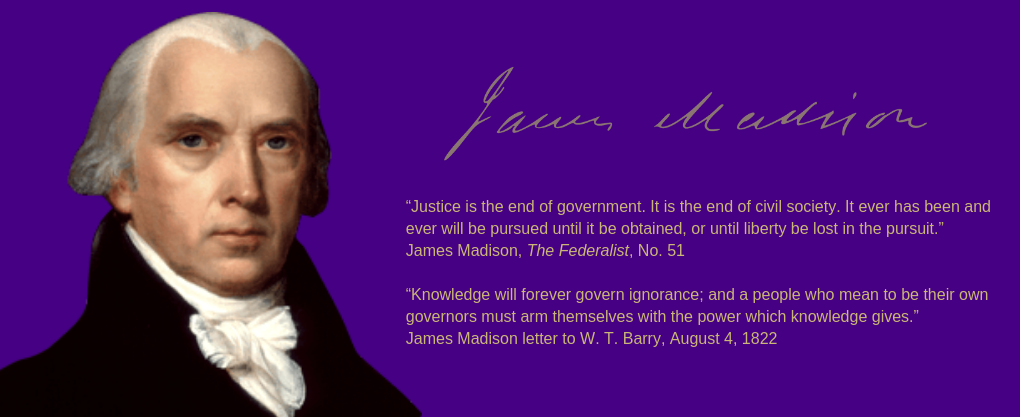
Images
of Madison's Notes
June 8, 1789
I am sorry to be accessary to the
loss of a single moment of time by the house. If I had been
indulged in my motion, and we had gone into a committee of the
whole, I think we might have rose, and resumed the consideration
of other business before this time; that is, so far as it depended
on what I proposed to bring forward. As that mode seems
not to give satisfaction, I will withdraw the motion, and move
you, sir, that a select committee be appointed to consider and
report such amendments as are proper for Congress to propose to
the legislatures of the several States, conformably to the 5th
article of the constitution (see Constitution
5).
I will state
my reasons why I think it proper to propose amendments; and state
the amendments themselves, so far as I think they ought to be
proposed. If I thought I could fulfill the duty which I
owe to myself and my constituents, to let the subject pass over
in silence, I most certainly should not trespass upon the indulgence
of this house. But I cannot do this; and am therefore compelled
to beg a patient hearing to what I have to lay before you.
And I do most sincerely believe that if congress will devote but
one day to this subjects, so far as to satisfy the public that
we do not disregard their wishes, it will have a salutary influence
on the public councils, and prepare the way for a favorable reception
of our future measures.
It appears to me that this house
is bound by every motive of prudence, not to let the first session
pass over without proposing to the state legislatures some things
to be incorporated into the constitution, as will render it as
acceptable to the whole people of the United States, as it has
been found acceptable to a majority of them. I wish, among
other reasons why something should be done, that those who have
been friendly to the adoption of this constitution, may have the
opportunity of proving to those who were opposed to it, that they
were as sincerely devoted to liberty and a republican government,
as those who charged them with wishing the adoption of this constitution
in order to lay the foundation of an aristocracy or despotism.
It will be a desirable thing to extinguish from the bosom of every
member of the community any apprehensions, that there are those
among his countrymen who wish to deprive them of the liberty for
which they valiantly fought and honorably bled. And if there
are amendments desired, of such a nature as will not injure the
constitution, and they can be engrafted so as to give satisfaction
to the doubting part of our fellow citizens; the friends of the
federal government will evince that spirit of deference and concession
for which they have hitherto been distinguished.
It cannot be a secret to the gentlemen
in this house, that, notwithstanding the ratification of this
system of government by eleven of the thirteen United States,
in some cases unanimously, in others by large majorities; yet
still there is a great number of our constituents who are dissatisfied
with it; among whom are many respectable for their talents, their
patriotism, and respectable for the jealousy they have for their
liberty, which, though mistaken in its object, is laudable in
its motive. There is a great body of the people falling
under this description, who as present feel much inclined to join
their support to the cause of federalism, if they were satisfied
in this one point: We ought not to disregard their inclination,
but, on principles of amity and moderation, conform to their wishes,
and expressly declare the great rights of mankind secured under
this constitution. The acquiescence which our fellow citizens
show under the government, calls upon us for a like return of
moderation. But perhaps there is
a stronger motive than this for our going into a consideration
of the subject; it is to provide those securities for liberty
which are required by a part of the community. I allude in a particular
manner to those two states who have not thought fit to throw themselves
into the bosom of the confederacy: it is a desirable thing, on
our part as well as theirs, that a re-union should take place
as soon as possible. I have no doubt, if we proceed to take
those steps which would be prudent and requisite at this juncture,
that in a short time we should see that disposition prevailing
in those states that are not come in, that we have seen prevailing
[in] those states which are.
But I will candidly acknowledge,
that, over and above all these considerations, I do conceive that
the constitution may be amended; that is to say, if all power
is subject to abuse, that then it is possible the abuse of the
powers of the general government may be guarded against in a more
secure manner than is now done, while no one advantage, arising
from the exercise of that power, shall be damaged or endangered
by it. We have in this way something to gain, and, if we
proceed with caution, nothing to lose; and in this case it is
necessary to proceed with caution; for while we feel all these
inducements to go into a revisal of the constitution, we must
feel for the constitution itself, and make that revisal a moderate
one. I should be unwilling to see a door
opened for a re-consideration of the whole structure of the government,
for a re-consideration of the principles and the substance of
the powers given; because I doubt, if such a door was opened,
if we should be very likely to stop at that point which would
be safe to the government itself: But I do wish to see a door
opened to consider, so far as to incorporate those provisions
for the security of rights, against which I believe no serious
objection has been made by any class of our constituents, such
as would be likely to meet with the concurrence of two-thirds
of both houses, and the approbation of three-fourths of the state
legislatures. I will not propose a single alteration which
I do not wish to see take place, as intrinsically proper in itself,
or proper because it is wished for by a respectable number of
my fellow citizens; and therefore I shall not propose a single
alteration but is likely to meet the concurrence required by the
constitution.
There have been objections of various
kinds made against the constitution: Some were levelled against
its structure, because the president was without a council; because
the senate, which is a legislative body, had judicial powers in
trials on impeachments; and because the powers of that body were
compounded in other respects, in a manner that did not correspond
with a particular theory; because it grants more power than is
supposed to be necessary for every good purpose; and controls
the ordinary powers of the state governments. I know some
respectable characters who opposed this government on these grounds;
but I believe that the great mass of the people who opposed it,
disliked it because it did not contain effectual provision against
encroachments on particular rights, and those safeguards which
they have been long accustomed to have interposed between them
and the magistrate who exercised the sovereign power: nor ought
we to consider them safe, while a great number of our fellow citizens
think these securities necessary.
It has been a fortunate thing that
the objection to the government has been made on the ground I
stated; because it will be practicable on that ground to obviate
the objection, so far as to satisfy the public mind that their
liberties will be perpetual, and this without endangering any
part of the constitution, which is considered as essential to
the existence of the government by those who promoted its adoption.
The amendments which have occurred
to me, proper to be recommended by congress to the state legislatures
are these:
First. That
there be prefixed to the constitution a declaration —
That all power is originally vested
in, and consequently derived from the people.
That government is instituted,
and ought to be exercised for the benefit of the people; which
consists in the enjoyment of life and liberty, with the right
of acquiring and using property, and generally of pursuing and
obtaining happiness and safety.
That the people have an indubitable,
unalienable, and indefeasible right to reform or change their
government, whenever it be found adverse or inadequate to the
purposes of its institution.
Secondly. That
in article 2nd. section 2, clause 3 (see
Constitution 1.2.3), these words be struck
out, to wit, "The number of representatives shall not exceed
one for every thirty thousand, but each state shall have at least
one representative, and until such enumeration shall be made."
And that in place thereof be inserted these words, to wit, "After
the first actual enumeration, there shall be one representative
for every thirty thousand, until the number amount to after which
the proportion shall be so regulated by congress, that the number
shall never be less than nor more than but each state shall after
the first enumeration, have at least two representatives; and
prior thereto."
Thirdly.
That in article 2nd, section 6, clause 1 (see
Constitution 1.6.1), there be added to the
end of the first sentence, these words, to wit, "But no law
varying the compensation last ascertained shall operate before
the next ensuing election of representatives."
Fourthly. That in article 2nd, section
9, between clauses 3 and 4 (see
Constitution 1.9.3), be inserted these clauses,
to wit,
The civil rights of none shall be abridged on account of
religious belief or worship, nor shall any national religion
be established, nor shall the full and equal rights of conscience
by in any manner, or on any pretext infringed (see
Constitution 1).
The people shall not be deprived or abridged of their right
to speak, to write, or to publish their sentiments; and the
freedom of the press, as one of the great bulwarks of liberty,
shall be inviolable (see
Bill of Rights 1).
The people shall not be restrained from peaceably assembling
and consulting for their common good, nor from applying to
the legislature by petitions, or remonstrances for redress
of their grievances (see
Bill of Rights 1).
The right of the people to keep and bear
arms shall not be infringed; a well armed, and well regulated
militia being the best security of a free country: but no
person religiously scrupulous of bearing arms, shall be compelled
to render military service in person (see
Bill of Rights 2).
No soldier shall in time of peace be quartered in any house
without the consent of the owner; nor at any time, but in
a manner warranted by law (see
Bill of Rights 3).
No person shall be subject, except in cases of impeachment,
to more than one punishment, or one trial for the same office;
nor shall be compelled to be a witness against himself; nor
be deprived of life, liberty, or property without due process
of law; nor be obliged to relinquish his property, where it
may be necessary for public use, without a just compensation
(see
Bill of Rights 5).
Excessive bail shall not be required,
nor excessive fines imposed, nor cruel and unusual punishments
inflicted (see
Bill of Rights 8).
The rights of the people to be secured in their persons,
their houses, their papers, and their other property from
all unreasonable searches and seizures, shall not be violated
by warrants issued without probable cause, supported by oath
or affirmation, or not particularly describing the places
to be searched, or the persons or things to be seized (see
Bill of Rights 4).
In all criminal prosecutions, the accused shall enjoy the
right to a speedy and public trial, to be informed of the
cause and nature of the accusation, to be confronted with
his accusers, and the witnesses against him; to have a compulsory
process for obtaining witnesses in his favor; and to have
the assistance of counsel for his defense (see
Bill of Rights 6).
The exceptions here or elsewhere in the constitution,
made in favor of particular rights, shall not be so construed
as to diminish the just importance of other rights retained
by the people; or as to enlarge the powers delegated
by the constitution; but either as actual limitations of such
powers, or as inserted merely for greater caution (see
Bill of Rights 9).
Fifthly. That
in article 2nd, section 10, between clauses 1 and 2 (see
Constitution 1.10), be inserted this clause,
to wit: No state shall violate the equal rights of conscience,
or the freedom of the press, or the trial by jury in criminal
cases.
Sixthly. That article 3rd, section
2, be annexed to the end of clause 2nd (see
Constitution 3.2.2), these words to wit:
but no appeal to such court shall be allowed where the value in
controversy shall not amount to___dollars: nor shall any fact
triable by jury, according to the course of common law, be otherwise
re-examinable than may consist with the principles of common law.
Seventhly. That in article 3rd,
section 2, the third clause be struck out (see
Constitution 3.2.3), and in its place be
inserted the classes following, to wit:
The trial of all crimes (except in cases of impeachments,
and cases arising in the land or naval forces, or the militia
when on actual service in time of war or public danger) shall
be by an impartial jury of freeholders of the vicinage, with
the requisite of unanimity for conviction, of the right of challenge,
and other accustomed requisites; and in all crimes punishable
with loss of life or member, presentment or indictment by a
grand jury shall be an essential preliminary (see
Bill of Rights 6),
provided that in cases of crimes committed within any county
which may be in possession of an enemy, or in which a general
insurrection may prevail, the trial may by law be authorized
in some other county of the same state, as near as may be to
the seat of the offence.
In cases of crimes committed not
within any county, the trial may by law be in such county as
the laws shall have prescribed. In suits at common law, between
man and man, the trial by jury, as one of the best securities
to the rights of the people, ought to remain inviolate.
Eighthly. That immediately after
article 6th (see
Constitution 6.1.3), be inserted, as article
7th, the clauses following, to wit:
The powers delegated by this
constitution, are appropriated to the departments to which they
are respectively distributed: so that the legislative department
shall never exercise the powers vested in the executive or judicial;
nor the executive exercise the powers vested in the legislative
or judicial; nor the judicial exercise the powers vested in
the legislative or executive departments.
The powers not delegated by this
constitution, nor prohibited by it to the states, are reserved
to the States respectively (see
Bill of Rights 10).
Ninthly. That article 7th, be numbered
as article 8th.
The first
of these amendments, relates to what may be called a bill of rights;
I will own that I never considered this provision so essential
to the federal constitution, as to make it improper to ratify
it, until such an amendment was added; at the same time, I always
conceived, that in a certain form and to a certain extent, such
a provision was neither improper nor altogether useless. I am
aware, that a great number of the most respectable friends to
the government and champions for republican liberty, have thought
such a provision, not only unnecessary, but even improper, nay,
I believe some have gone so far as to think it even dangerous.
Some policy has been made use of perhaps by gentlemen on both
sides of the question: I acknowledge the ingenuity of those arguments
which were drawn against the constitution, by a comparison with
the policy of Great-Britain, in establishing a declaration of
rights; but there is too great a difference in the case to warrant
the comparison: therefore the arguments drawn from that source,
were in a great measure inapplicable. In the declaration of rights
which that country has established, the truth is, they have gone
no farther, than to raise a barrier against the power of the crown;
the power of the legislature is left altogether indefinite. Although
I know whenever the great rights, the trial by jury, freedom of
the press, or liberty of conscience, came in question in that
body, the invasion of them is resisted by able advocates, yet
their Magna Charta does not contain any one provision for the
security of those rights, respecting which, the people of America
are most alarmed. The freedom of the press and rights of conscience,
those choicest privileges of the people, are unguarded in the
British constitution.
But although the case may be widely
different, and it may not be thought necessary to provide limits
for the legislative power in that country, yet a different opinion
prevails in the United States. The people of many states, have
thought it necessary to raise barriers against power in all forms
and departments of government, and I am inclined to believe, if
once bills of rights are established in all the states as well
as the federal constitution, we shall find the although some of
them are rather unimportant, yet, upon the whole, they will have
a salutary tendency.
It may be said, in some instances
they do no more than state the perfect equality of mankind; this
to be sure is an absolute truth, yet it is not absolutely necessary
to be inserted at the head of a constitution.
In some instances they assert those
rights which are exercised by the people in forming and establishing
a plan of government. In other instances, they specify those rights
which are retained when particular powers are given up to be exercised
by the legislature. In other instances, they specify positive
rights, which may seem to result from the nature of the compact.
Trial by jury cannot be considered as a natural right, but a right
resulting from the social compact which regulates the action of
the community, but is as essential to secure the liberty of the
people as any one of the pre-existent rights of nature. In other
instances they lay down dogmatic maxims with respect to the construction
of the government; declaring, that the legislative, executive,
and judicial branches shall be kept separate and distinct: Perhaps
the best way of securing this in practice is to provide such checks,
as will prevent the encroachment of the one upon the other.
But whatever may be form which the
several states have adopted in making declarations in favor of
particular rights, the great object in view is to limit and qualify
the powers of government, by excepting out of the grant of power
those cases in which the government ought not to act, or to act
only in a particular mode. They point these exceptions sometimes
against the abuse of the executive power, sometimes against the
legislative, and, in some cases, against the community itself;
or, in other words, against the majority in favor of the minority.
In our government it is, perhaps,
less necessary to guard against the abuse in the executive department
than any other; because it is not the stronger branch of the system,
but the weaker: It therefore must be levelled against the legislative,
for it is the most powerful, and most likely to be abused, because
it is under the least control; hence, so far as a declaration
of rights can tend to prevent the exercise of undue power, it
cannot be doubted but such declaration is proper. But I confess
that I do conceive, that in a government modified like this of
the United States, the great danger lies rather in the abuse of
the community than in the legislative body. The prescriptions
in favor of liberty, ought to be levelled against that quarter
where the greatest danger lies, namely, that which possesses the
highest prerogative of power: But this [is] not found in either
the executive or legislative departments of government, but in
the body of the people, operating by the majority against the
minority.
It may be thought all paper barriers
against the power of the community are too weak to be worthy of
attention. I am sensible they are not so strong as to satisfy
gentlemen of every description who have seen and examined thoroughly
the texture of such a defence; yet, as they have a tendency to
impress some degree of respect for them, to establish the public
opinion in their favor, and rouse the attention of the whole community,
it may be one mean to control the majority from those acts to
which they might be otherwise inclined.
It has been said by way of objection
to a bill of rights, by many respectable gentlemen out of doors,
and I find opposition on the same principles likely to be made
by gentlemen on this floor, that they are unnecessary articles
of a republican government, upon the presumption that the people
have those rights in their own hands, and that is the proper place
for them to rest. It would be a sufficient answer to say that
this objection lies against such provisions under the state governments
as well as under the general government; and there are, I believe,
but few gentlemen who are inclined to push their theory so far
as to say that a declaration of rights in those cases is either
ineffectual or improper.
It has been said that in the federal
government they are unnecessary, because the powers are enumerated,
and it follows that all that are not granted by the constitution
are retained: that the constitution is a bill of powers, the great
residuum being the rights of the people; and therefore a bill
of rights cannot be so necessary as if the residuum was thrown
into the hands of the government. I admit that these arguments
are not entirely without foundation; but they are not conclusive
to the extent which has been supposed. It is true the powers of
the general government are circumscribed; they are directed to
particular objects; but even if government keeps within those
limits, it has certain discretionary powers with respect to the
means, which may admit of abuse to a certain extent, in the same
manner as the powers of the state governments under their constitutions
may to an indefinite extent; because in the constitution of the
United States there is a clause granting to Congress the power
to make all laws which shall be necessary and proper for carrying
into execution all the powers vested in the government of the
United States, or in any department or officer thereof; this enables
them to fulfil every purpose for which the government was established.
Now, may not laws be considered necessary and proper by Congress,
for it is them who are to judge of the necessity and propriety
to accomplish those special purposes which they may have in contemplation,
which laws in themselves are neither necessary or proper; as well
as improper laws could be enacted by the state legislatures, for
fulfilling the more extended objects of those governments. I will
state an instance which I think in point, and proves that this
might be the case. The general government has a right to pass
all laws which shall be necessary to collect its revenue; the
means for enforcing the collection are within the direction of
the legislature: may not general warrants be considered necessary
for this purpose, as well as for some purposes which it was supposed
at the framing of their constitutions the state governments had
in view. If there was reason for restraining the state governments
from exercising this power, there is like reason for restraining
the federal government.
It may be said, because it has been
said, that a bill of rights is not necessary, because the establishment
of this government has not repealed those declarations of rights
which are added to the several state constitutions: that those
rights of the people, which had been established by the most solemn
act, could not be annihilated by a subsequent act of the people,
who meant, and declared at the head of the instrument, that they
ordained and established a new system, for the express purpose
of securing to themselves and posterity the liberties they had
gained by an arduous conflict.
I admit the force of this observation,
but I do not look upon it to be conclusive. In the first place,
it is too uncertain ground to leave this provision upon, if a
provision is at all necessary to secure rights so important as
many of those I have mentioned are conceived to be, by the public
in general, as well as those in particular who opposed the adoption
of this constitution. Beside some states have no bills of rights,
there are others provided with very defective ones, and there
are others whose bills of rights are not only defective, but absolutely
improper; instead of securing some in the full extent which republican
principles would require, they limit them too much to agree with
the common ideas of liberty.
It has been objected also against
a bill of rights, that, by enumerating particular exceptions to
the grant of power, it would disparage those rights which were
not placed in that enumeration, and it might follow by implication,
that those rights which were not singled out, were intended to
be assigned into the hands of the general government, and were
consequently insecure. This is one of the most plausible arguments
I have ever heard urged against the admission of a bill of rights
into this system; but, I conceive, that may be guarded against.
I have attempted it, as gentlemen may see by turning to the last
clause of the 4th resolution.
It has been said, that it is necessary
to load the constitution with this provision, because it was not
found effectual in the constitution of the particular states.
It is true, there are a few particular states in which some of
the most valuable articles have not, at one time or other, been
violated; but does it not follow but they may have, to a certain
degree, a salutary effect against the abuse of power. If they
are incorporated into the constitution, independent tribunals
of justice will consider themselves in a peculiar manner the guardians
of those rights; they will be an impenetrable bulwark against
every assumption of power in the legislative or executive; they
will be naturally led to resist every encroachment upon rights
expressly stipulated for in the constitution by the declaration
of rights. Beside this security, there is a great probability
that such a declaration in the federal system would be enforced;
because the state legislatures will jealously and closely watch
the operation of this government, and be able to resist with more
effect every assumption of power than any other power on earth
can do; and the greatest opponents to a federal government admit
the state legislatures to be sure guardians of the people's liberty.
I conclude from this view of the subject, that it will be proper
in itself, and highly politic, for the tranquility of the public
mind, and the stability of the government, that we should offer
something, in the form I have proposed, to be incorporated in
the system of government, as a declaration of the rights of the
people.
In the next place I wish to see
that part of the constitution revised which declares, that the
number of representatives shall not exceed the proportion of one
for every thirty thousand persons, and allows one representative
to every state which rates below that proportion. If we attend
to the discussion of this subject, which has taken place in the
state conventions, and even in the opinion of the friends to the
constitution, an alteration here is proper. It is the sense of
the people of America, that the number of representatives ought
to be increased, but particularly that it should not be left in
the discretion of the government to diminish them, below that
proportion which certainly is in the power of the legislature
as the constitution now stands; and they may, as the population
of the country increases, increase the house of representatives
to a very unwieldy degree. I confess I always thought this part
of the constitution defective, though not dangerous; and that
it ought to be particularly attended to whenever congress should
go into the consideration of amendments.
There are several lesser cases enumerated
in my proposition, in which I wish also to see some alteration
take place. That article which leaves it in the power of the legislature
to ascertain its own emolument is one to which I allude. I do
not believe this is a power which, in the ordinary course of government,
is likely to be abused, perhaps of all the powers granted, it
is least likely to abuse; but there is a seeming impropriety in
leaving any set of men without control to put their hand into
the public coffers, to take out money to put in their pockets;
there is a seeming indecorum in such power, which leads me to
propose a change. We have a guide to this alteration in several
of the amendments which the different conventions have proposed.
I have gone therefore so far as to fix it, that no law, varying
the compensation, shall operate until there is a change in the
legislature; in which case it cannot be for the particular benefit
of those who are concerned in determining the value of the service.
I wish also, in revising the constitution,
we may throw into that section, which interdicts the abuse of
certain powers in the state legislatures, some other provisions
of equal if not greater importance than those already made. The
words, "No state shall pass any bill of attainder, ex post
facto law, &c." were wise and proper restrictions in
the constitution. I think there is more danger of those powers
being abused by the state governments than by the government of
the United States. The same may be said of other powers which
they possess, if not controlled by the general principle, that
laws are unconstitutional which infringe the rights of the community.
I should therefore wish to extend this interdiction, and add,
as I have stated in the 5th resolution, that no state shall violate
the equal right of conscience, freedom of the press, or trial
by jury in criminal cases; because it is proper that every government
should be disarmed of powers which trench upon those particular
rights. I know in some of the state constitutions the power of
the government is controlled by such a declaration, but others
are not. I cannot see any reason against obtaining even a double
security on those points; and nothing can give a more sincere
proof of the attachment of those who opposed this constitution
to these great and important rights, than to see them join in
obtaining the security I have now proposed; because it must be
admitted, on all hands, that the state governments are as liable
to attack these invaluable privileges as the general government
is, and therefore ought to be as cautiously guarded against.
I think it will be proper, with
respect to the judiciary powers, to satisfy the public mind on
those points which I have mentioned. Great inconvenience has been
apprehended to suitors from the distance they would be dragged
to obtain justice in the supreme court of the United States, upon
an appeal on an action for a small debt. To remedy this, declare,
that no appeal shall be made unless the matter in controversy
amounts to a particular sum: This, with the regulations respecting
jury trials in criminal cases, and suits at common law, it is
to be hoped will quiet and reconcile the minds of the people to
that part of the constitution.
I find, from looking into the amendments
proposed by the state conventions, that several are particularly
anxious that it should be declared in the constitution, that the
powers not therein delegated, should be reserved to the several
states. Perhaps words which may define this more precisely, than
the whole of the instrument now does, may be considered as superfluous.
I admit they may be deemed unnecessary; but there can be no harm
in making such a declaration, if gentlemen will allow that the
fact is as stated. I am sure I understand it so, and do therefore
propose it.
These are the points on which I
wish to see a revision of the constitution take place. How far
they will accord with the sense of this body, I cannot take upon
me absolutely to determine; but I believe every gentlemen will
readily admit that nothing is in contemplation, so far as I have
mentioned, that can endanger the beauty of the government in any
one important feature, even in the eyes of its most sanguine admirers.
I have proposed nothing that does not appear to me as proper in
itself, or eligible as patronized by a respectable number of our
fellow citizens; and if we can make the constitution better in
the opinion of those who are opposed to it, without weakening
its frame, or abridging its usefulness, in the judgment of those
who are attached to it, we act the part of wise and liberal men
to make such alterations as shall produce that effect.
Having done what I conceived was
my duty, in bringing before this house the subject of amendments,
and also stated such as wish for and approve, and offered the
reasons which occurred to me in their support; I shall content
myself for the present with moving, that a committee be appointed
to consider of and report such amendments as ought to be proposed
by congress to the legislatures of the states, to become, if ratified
by three-fourths thereof, part of the constitution of the United
States. By agreeing to this motion, the subject may be going on
in the committee, while other important business is proceeding
to a conclusion in the house. I should advocate greater dispatch
in the business of amendments, if I was not convinced of the absolute
necessity there is of pursuing the organization of the government;
because I think we should obtain the confidence of our fellow
citizens, in proportion as we fortify the rights of the people
against the encroachments of the government.
Congressional Register, I, 423-37 and Gazette
of the US., 10 and 13 June 1789.