



Gandhi, Nonviolence, and
Global Transformation
Course Numbers: GHUM 252, REL
314
Course
Description
Of all the world leaders in the
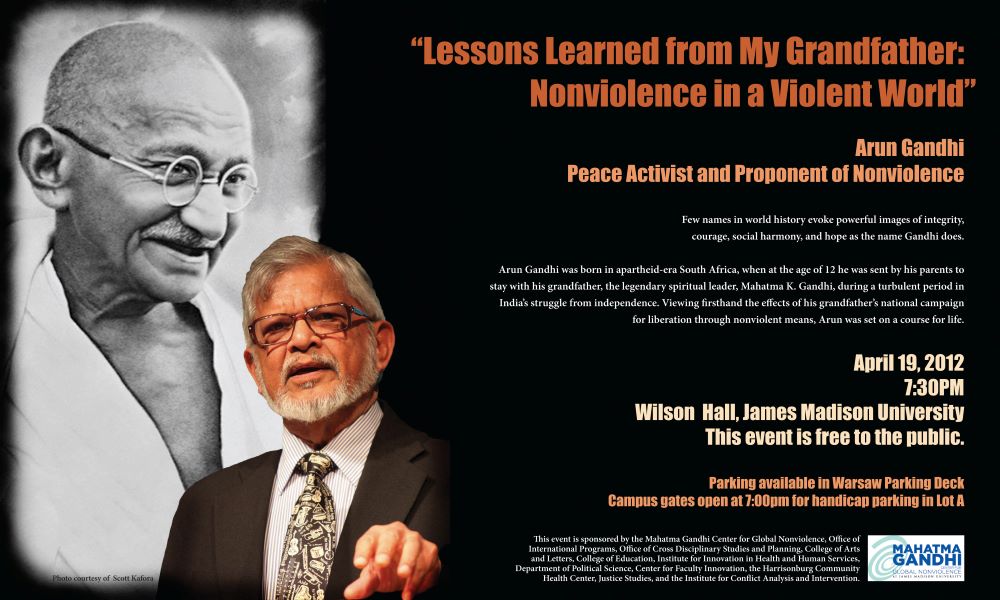
twentieth century, Mohandas Karamchand Gandhi (1869 - 1948) is
certainly one of the most influential. He is unique as a social
theorist, a moral and spiritual philosopher, and a social-political
activist. He serves as a bridge from post-modern to modern and
pre-modern thought, as well as between Western and non-Western
religious and cultural traditions. His experience transcended
boundaries of culture, geography, religion, and politics. Even
more, Gandhi's leadership changed the world. Indeed, it continues
to change the world. He challenged the dominant world structure of
his time, the colonial system, and struggled with some of the most
significant issues of our time: violence and terrorism, racism, the
oppression of women, the role of religion in the modern world, the
nature of capitalism, and conflict between ethnic and religious
communities. The ideas and the story of Mohandas Gandhi -- later
called Mahatma the Great Soul -- provide an excellent opportunity
to reflect upon the issues facing our modern world.
Course Design
In order to understand Gandhi, we
must understand the importance of the Hindu civilization as the
major source for cultural, ethnic, and national identities in
India. During the first unit of the course, therefore, we become
acquainted with Hindu civilization. Second, we consider popular
perceptions of Gandhi's life and work and consider key leadership
issues as epitomized in the film "Gandhi." Third, we turn to the
primary sources, Gandhi's own writings. Finally, we assess the
validity of different methods of interpreting Gandhi's work,
analyzing the assumptions, vocabulary, procedures, and insights of
modern commentators on Gandhi.
Prefatory Note
The ideas we explore are
alternatives to mainstream social thought, what Gideon Sjoberg
calls "counter-systems." They are inevitably critical. That
critique, and our responses to it, should energize our journey
through the course, and we should anticipate lively discussions in
which we disagree with one another, with oneself, with the
readings, and with Gandhi. We invite you to remain open-minded to
new knowledge, new ideas, and new connections; we do not need to
jettison our own perspectives, experiences, knowledge, and
insights, but we should allow the voices to speak for themselves in
their own realities and historical experience first and then in
dialogue with our own voices.