

Professor keeps tabs on 'God talk'
News



GOP presidential candidate Mitt Romney wears his Mormon faith on his sleeve. Fellow Republican contender and Texas Gov. Rick Perry launched his bid for the White House at a massive prayer rally last summer, claiming God told him to run. Newt Gingrich, author of "Rediscovering God in America," has resurrected his candidacy in part by talking openly about his conversion to Catholicism. Even President Obama, a Democrat who brought a spiritual advisor on board during his 2008 run amid rumors that he was a Muslim, has been known to use the pulpit to try to align himself with Christian voters, stating at the Lighting of the National Christmas Tree ceremony last month that Jesus' teaching "lies at the heart of my Christian faith."
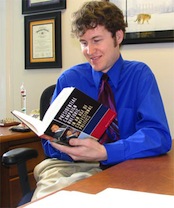
Indeed "God talk" has become firmly entrenched in American presidential campaigns, according to Dr. Brian T. Kaylor, assistant professor of communication studies at James Madison University and author of the 2011 book "Presidential Campaign Rhetoric in an Age of Confessional Politics."
"Simply put, candidates invoke God to justify their positions and political visions because it works," says Kaylor, a one-time Baptist minister who teaches courses in advocacy, political communication, rhetorical methods and public speaking at JMU. This semester, he will lead a special-topics course entitled "Communication, Religion and Politics." Kaylor also serves as an editorial consultant for several Christian organizations and publishes a blog, "For God's Sake, Shut Up!" which takes its name from the title of his 2007 book subtitled "Lessons for Christians on How to Speak Effectively and When to Remain Silent."
"Presidential Campaign Rhetoric in an Age of Confessional Politics," which grew out of Kaylor's dissertation at the University of Missouri, examines religious rhetoric as a powerful political tool in the modern era. Drawing on thousands of stump speeches, advertisements and debates, Kaylor points out that the candidate who talked the most about God on the campaign trail has won each of the past nine presidential elections, beginning with Jimmy Carter's surprise victory in 1976.
"Carter's 1976 campaign signaled a new era in presidential politics," Kaylor says. "Here was a former Sunday school teacher who quoted scripture. I don't think it was anything he did deliberately. He was probably just being himself. But his aides saw that it resonated with voters and encouraged him to continue doing it."
Carter's break with political tradition reflected a broader shift in American society, Kaylor says. "Religion in politics in America dates to Thomas Jefferson, but from the country's founding to about 1960, candidates didn't talk about their faith much," he says. That began to change with John F. Kennedy, who, in a tight race with Richard Nixon, was forced to answer questions about his Catholic views. Then for the first time in the early 1960s, evangelical Christians, who emphasize accepting Christ as one's personal savior and helping spread the word of the Gospel, surpassed mainline Protestants as the dominant religious group in America.
By 1976, the confessional style had gained a foothold in politics, and Gerald Ford, who was reared in the "quiet works" of Protestantism and thus not comfortable talking publicly about his faith, paid the price at the polls. "He said during the campaign, ‘I don't wear my religion on my sleeve,'" Kaylor says. "Fast forward to Bill Clinton, who made a point of saying, ‘I do wear religion on my sleeve.'" Ironically, Ronald Reagan "out-God-talked" Carter on his way to victory in the 1980 election, he says.
The rhetoric isn't likely to end anytime soon, according to Kaylor. "There is a link in the minds of voters between religion and morality. They'll say things like, ‘He's a Christian, so he must be a good man.' It's comforting for a lot of people." And it doesn't just play to the religious right, Kaylor adds. In October, the Democratic National Committee tapped the Rev. Derrick Harkins, a prominent African-American pastor in Washington, D.C., to lead its faith outreach. "Both sides of the aisle see the value in it and use it to justify their positions on a range of issues," he says, from health care to the environment to foreign policy.
GOP presidential candidates, meanwhile, are busy courting conservative evangelicals as the 2012 campaign kicks into high gear. The results of the recent Iowa caucus demonstrate the influence this key voting bloc holds, Kaylor writes in an article for EthicsDaily.com. Self-described "born-again" or "evangelical" Christians, who together made up 57 percent of participants in the first-in-the-nation poll, helped catapult former Sen. Rick Santorum of Pennsylvania and Rep. Ron Paul of Texas to the front of the pack with Romney, while simultaneously damaging Gingrich and Perry's chances and driving Minnesota Rep. Michele Bachmann out of the race, he writes.
Related links:
- Brian Kaylor, http://www.briankaylor.com
- "For God's Sake, Shut Up!", http://forgodssakeshutup.blogspot.com
- JMU School of Communication Studies, https://www.jmu.edu/commstudies
By James Heffernan, JMU Public Affairs

