
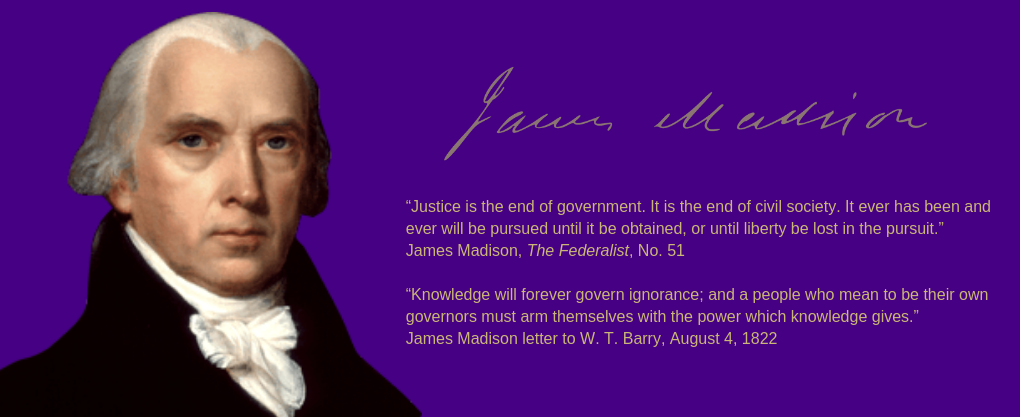
These quotes were selected to illuminate
the intertwined life of James Madison and the history of the
great political events of his time. You may search these quotes
by using the edit/find function on your browser.
Introduction
“My life has been so much of a public one, that any review
of it must mainly consist of the agency which was my lot in
public transactions.”
—Letter to James Robertson,
April 20, 1831 (Madison,
1865, IV, page 174)
Youthful Reading
“[A] book fell into my hands, which I read…with
particular advantage. I have always thought it the best that
had been written for cherishing in young minds a desire of improvement,
a taste for learning, and a lively sense of the duties, the
virtues, and the proprieties of life. The work I speak of is
the “Spectator,” well known by that title. It had
several authors, at the head of them Mr. Addison.…”
“Addison was of the first rank among the fine writers
of the age, and has given a definition of what he showed himself
an example. ‘Fine writing,’ he says ‘consists
of sentiments that are natural without being obvious;’
to which adding the remark of Swift, another celebrated author
of the same period, making a good style to consist ‘of
proper words in their proper places.…’”
—Letter to Richard D.
Cutts [nephew about 10 years old], January 4, 1829 (Madison,
1865, IV, pages 1-2)
Young and Disheartened
“As for myself, I am too dull and infirm now to look out
for any extraordinary things in this world, for I think my sensations
for many months past have intimated to me not to expect a long
and healthy life; though it may be better with me after some
time, [but] I hardly dare expect it, and therefore have little
spirit and to set about anything that is difficult in acquiring
and useless in possessing after one has exchanged time for eternity.”
— Letter to William Bradford,
Jr., November 1772 (Madison,
1865, I, page 6.)
Origins of the Revolution
“Your remark is very just on the subject of Independence.
It was not the offspring of a particular man or particular moment…Our
forefathers brought with them the germ of Independence in the
principle of self-taxation. Circumstances unfolded and perfected
it.
“The first occasion which aroused
this principle was…the projected Union at Albany in 1754,
when the proposal of the British Government to reimburse its
advances for the Colonies by a parliamentary tax on them was
met by the letter from Doctor Franklin to Governor Shirley,
pointing out the unconstitutionality, the injustice, and the
impolicy of such a tax.
The opposition and discussions produced by the stamp and subsequent
Acts of Parliament make another stage in the growth of Independence.
The attempts to distinguish between legislation on the subject
of taxes, and on other subjects, terminated in the disclosure
that no such distinction existed. And these combats against
the arrogated authority of the British Legislature paved the way
for burying in the same grave with it the forfeited authority
of the British King.”
— Letter to John Adams,
August 7, 1818 (Madison,
1865, III, page 165)
Declaration of Independence
“My first entrance on public life was in May, 1776, when
I became a member of the Convention in Virginia, which instructed
her delegates in Congress to propose the Declaration of Independence…It
has always been my impression that a re-establishment of the
Colonial relations to the parent country previous to the controversy
was the real object of every class of people, till despair of
obtaining it, and the exasperating effects of the war, and the
manner of conducting it, prepared the minds of all for the event
declared on the 4th of July, 1776, as preferable, with all its
difficulties and perils, to the alternative of submission to
a claim of power, at once external, unlimited, irresponsible,
and under every temptation to abuse from interest, ambition,
and revenge.”
— Letter to Jared Sparks,
January 5th, 1828 (Madison,
1865, III, page 609)
“Nothing can be more absurd than the cavil that the Declaration
contains known and not new truths. The object was to assert,
not to discover truths, and to make them the basis of the Revolutionary
act. The merit of the Declaration, therefore, could only consist
in a lucid communication of human rights, in a condensed enumeration
of the reasons for such an exercise of them, and in a style
and tone appropriate to the great occasion, and to the spirit
of the American people.”
— Letter to Thomas Jefferson,
September 6, 1823 (Madison,
1865, III, pages 336-337)
Thomas Jefferson
“I was a stranger to Mr. Jefferson [till] the year 1776,
when he took his seat in the first Legislature under the Constitution
of Virginia, then newly formed; being at that time myself a
member of that Body, and for the first time, a member of any
public Body. The acquaintance made with him on that occasion
was very slight; the distance between our ages being considerable,
and other distances much more so. During part of the time whilst
he was Governor of the State, a service to which he was called
not long after, I had a seat in Council, associated with him.
Our acquaintance then became more intimate, and a friendship
was formed which was for life, and which was never interrupted
in the slightest degree for a single moment.”
— Letter to Margaret
H. Smith, September, 1830 (Madison,
1865, IV, page 111)
Free Transit of the Mississippi
“[A]s the United States have an indisputable right to
the possession of the east bank of the Mississippi for a very
great distance, and the navigation of that river will essentially
tend to the prosperity and advantage of the citizens of the
United States that may reside on the Mississippi or the waters
running into it, it is conceived that the circumstances of Spain's
being in possession of the banks on both sides near its mouth,
cannot be deemed a natural or equitable bar to the free use
of the river.”
— Instructions to Dr.
Franklin and Mr. Jay Concerning the Free Navigation of the Mississippi,
& c. (from the Continental Congress to the Ambassadors to
France and Spain; drafted by James Madison) October 17, 1780
(Madison,
1865, IV, page 445)
“The vacant land of the United States lying on the waters
of the Mississippi is, perhaps, equal in extent to the land
actually settled. If no check be given to the emigrations from
the latter to the former, they probably will keep pace at least
with the increase of our people, till the population of both
becomes nearly equal.”
— Letter to Thomas Jefferson,
August 20, 1784 (Madison,
1865, I, page 96)
“Nature has given the use of the Mississippi to those
who may settle on its waters, as she gave to the United States
their independence. The impolicy of Spain may retard the former,
as that of Great Britain did the latter. But as Great Britain
could not defeat the latter, neither will Spain the former.
— Letter to Marquis LaFayette, March 20, 1785 (Madison,
1865, I, page 137)
Manumission Fails in Virginia
“The pulse of the [Virginia] House of Delegates was felt
on Thursday with regared to a general manumission [freeing of
the slaves], by a petition presented on that subject. It was
rejected without dissent, but not without an avowed patronage
of its principle by sundry respectable members. A motion was
made to throw it under the table, which was treated with as
much indignation on one side as the petition itself was on the
other. There are several petitions before the House against
any step toward freeing the Slaves, and even praying for a repeal
of the law which licences particular manumissions.”
— Letter to General Washington,
Novr 11, 1785 (Madison,
1865, I, page 543)
Memorial and Remonstrances
“The Anglican hierarchy existing in Virginia prior to
the Revolution was abolished by an early act of the Independent
Legislature. In the year 1785, a bill was introduced under the
auspices of Mr. Henry, imposing a general tax for the support
of ‘Teachers of the Christian Religion.’ It made
a progress, threatening a majority in its favor. As an expedient
to defeat it, we proposed that it should be postponed to another
session, and printed in the meantime for public consideration.
Such an appeal in a case so important and so unforeseen could
not be resisted. With a view to arouse the people, it was thought
proper that a memorial should be drawn up, the task being assigned
to me, to be printed and circulated throughout the State for
a general signature. The experiment succeeded. The memorial
was so extensively signed by the various religious sects, including
a considerable portion of the old hierarchy, that the projected
innovation was crushed, and under the influence of the popular
sentiment thus called forth, the well-known Bill prepared by
Mr. Jefferson, for ‘Establishing Religious freedom,’
passed into a law, as it now stands in our code of statutes.”
— Letter to General La
Fayette, November, 1826 (Madison,
1865, III, page 543)
The Preparation for a Convention
“The books which you have been so good as to forward to
me are so well assorted to my wishes that no suggestions are
necessary as to your future purchases.”
— Letter to Thomas Jefferson,
May 12th, 1786 (Madison,
1865, I, page 231)
The Call for a Convention
“Having witnessed, as a member of the Revolutionary Congress,
the inadequacies of the powers conferred by the ‘Articles
of Confederation,’ and having become, after the expiration
of my term of service there, a member of the Legislature of
Virginia, I felt it to be my duty to spare no efforts to impress
on that body the alarming condition of the U. States proceeding
from that cause, and the evils threatened by delay, in applying
a remedy. With this, propositions were made vesting in Congress
the necessary powers to regulate trade, then suffering under
the monopolizing power abroad, and State collisions at home,
and to draw from that source the convenient revenue it was capable
of yielding. The propositions, though received with favorable
attention, and at one moment agreed to in a crippled form, were
finally frustrated, or, rather, abandoned. Such, however, were
the impressions which the public discussions had made, that
an alternative proposition, which had been kept in reserve,
being seasonably brought forward by a highly respected member
[of the Virginia legislature], who, having long served in the
State [Virginia] councils without participating in the Federal,
had more the ear of the Legislature on that account, was adopted
with little opposition. The proposition invited the other states
to concur with Virginia in a convention of deputies commissioned
to devise and report a uniform system of commercial regulations.
Commissioners on the part of the State were at the same time
appointed, myself of the number. The convention proposed took
place at Annapolis, in August, 1786. Being, however, very partially
attended, and it appearing to the members that a rapid progress,
aided by the experiment on foot, had made in ripening the public
mind for a radical reform of the Federal polity, they determined
to waive the object for which they were appointed, and recommend
a convention, with enlarged powers, to be held the year following,
in the city of Philadelphia. The Legislature of Virginia happened
to be the first that acted on the recommendation, and being
a member [of the Virginia Legislature], the only one of the
attending commissioners at Annapolis who was so, my best exertions
were used in promoting a compliance with it, and in giving to
the example the most conciliating form, and all the weight that
could be derived from a list of deputies having the name of
Washington at its head.”
— Letter to Thomas J.
Wharton, August, 1827 (Madison,
1865, III, pages 586-587)
“The only step of moment taken by Congress, since my arrival,
has been a recommendation of a proposed meeting in May, for revising
the federal Articles [of Confederation].”
— Letter to the HonbleEdmund
Pendleton, February 24, 1787 (Madison,
1865, I, page 278)
Constitutional Convention
“That most of us carried into the Convention a profound
impression, produced by the experienced inadequacy of the old
Confederation, and by the monitory examples of all similar ones,
ancient and modern, as to the necessity of binding the States
together by a strong Constitution, is certain.”
— Letter to John G. Jackson,
December 27, 1821 (Madison,
1865, III, page 244)
“The resolutions [i.e., the Virginia Plan] proposed by
him [Virginia Governor Randolph] were the result of a consultation
among the Deputies [the Virginia delegation], the whole number,
seven, being present. The part which Virginia had borne in bringing
about the Convention suggested the idea that some such initiative
step might be expected from their deputation, and Mr. Randolph
was designated for the task. It was perfectly understood that
the propositions committed no one to their precise tenor or form,
and that the members of the deputation would be as free in discussing
and shaping them as the other members of the Convention. Mr. Randolph
was made the organ on the occasion, being then the Governor of
the State, of distinguished talents, and in the habit of public
speaking. General Washington, though at the head of the list,
was . . . disinclined to take the lead. It was also foreseen that
he would be immediately called to the presiding station.”
— Letter to John Tyler
(not sent?), 1833 (Madison,
1865, IV, page 281)
“It was generally agreed that the objects
of the Union could not be secured by any system founded on the
principle of a confederation of Sovereign States. A voluntary
observance of the federal law by all the members could never be
hoped for. A compulsive one could evidently never be reduced to
practice, and if it could, involved equal calamities to the innocent
and guilty, the necessity of a military force, both obnoxious
and dangerous, and, in general, a scene resembling much more a
civil war than the administration of a regular Government.
Hence was embraced the alternative of a Government which, instead
of operating on the States, should operate without their intervention
on the individuals composing them; and hence the change in the principle
and proportion of representation. This ground-work being laid,
the great objects which presented themselves were: 1. To unite a
proper energy in the Executive, and a proper stability in the Legislative
departments, with the essential characters of Republican Government.
2. To draw a line of demarkation which would give to the General
Government every power requisite for general purposes, and leave
to the States every power which might be most beneficially administered
by them. 3. To provide for the different interests of different
parts of the Union. 4. To adjust the clashing pretensions of the
large and small States. Each of these objects was pregnant with
difficulties. The whole of them together formed a task more difficult
than can be well conceived by those who were not concerned in the
execution of it.…The first of these objects, as respects the
Executive, was peculiarly embarrassing. On the question whether
it should consist of a single person or a plurality of co-ordinate
members, on the mode of appointment, on the duration in office,
on the degree of power, on the re-eligibility, tedious and reiterated
discussions took place. The plurality of co-ordinate members had
finally but few advocates. Governor [of Virginia] Randolph was at
the head of them. The modes of appointment proposed were various:
as by the people at large, by electors chosen by the people, by
the Executives of the States, by the Congress; some preferring a
joint ballot of the two Houses; some, a separate concurrent ballot,
allowing to each a negative on the other house; some, a nomination
of several candidates by one House, out of whom a choice should
be made by the other. Several other modifications were started.
The expedient at length adopted seemed to give pretty general satisfaction
to the members. As to the duration in office, a few would have preferred
a tenure during good behaviour; a considerable number would have
done so in case an easy and effectual removal by impeachment could
be settled. It was much agitated whether a long term, seven
years for example, with a subsequent and perpetual ineligibility,
or a short term, with a capacity to be re-elected, should be fixed.
In favor of the first opinion were urged the danger of a gradual
degeneracy of re-elections from time to time, into first a life
and then hereditary tenure, and the favorable effect of an incapacity
to be reappointed on the independent exercise of the Executive authority.
On the other side it was contended that the prospect of necessary
degradation would discourage the most dignified characters from
aspiring to the office; would take away the principal motive to
the faithful discharge of its duties--the hope of being rewarded
with a reappointment; would stimulate ambition to violent efforts
for holding over the Constitutional term; and instead of producing
an independent administration and a firmer defense of the constitutional
rights of the department, would render the officer more indifferent
to the importance of a place which he would soon be obliged to quit
forever, and more ready to yield to the encroachments of the Legislature,
of which he might again be a member. The questions concerning
the degree of power turned chiefly on the appointment to offices,
and the controul on the Legislature. An absolute appointment to
all offices, to some offices, to no offices, formed the scale of
opinions on the first point. On the second, some contended for an
absolute negative, as the only possible mean of reducing to practice
the theory of a free Government, which forbids a mixture of the
Legislative and Executive powers. Others would be content with a
revisionary power, to be overruled by three-fourths of both Houses.
It was warmly urged that the judiciary department should be associated
in the revision. The idea of some was, that a separate revision
should be given to the two departments; that if either objected,
two-thirds, if both, three-fourths, should be necessary to overrule.
In forming the Senate, the great anchor of the government, the questions,
as they come within the first object, turned mostly on the mode
of appointment, and the duration of it. The different modes proposed
were: 1. By the House of Representatives. 2. By the Executive. 3.
By electors chosen by the people for the purpose. 4. By the State
Legislatures. On the point of duration, the propositions descended
from good behaviour to four years, through the intermediate terms
of nine, seven, six, and five years. The election of the other branch
was first determined to be triennial, and afterwards reduced to
biennial. The second object, the due partition of power between
the General and local Governments, was perhaps, of all, the most
nice and difficult. A few contended for an entire abolition of the
States; some, for indefinite power of Legislation in the Congress,
with a negative on the laws of the States; some, for such a power
without a negative; some, for a limited power of legislation, with
such a negative; the majority, finally, for a limited power without
the negative. The question with regard to the negative underwent
repeated discussions, and was finally rejected by a bare majority.…”
— Letter to Thomas Jefferson,
October 24, 1787 (Madison 1865, I, pages 343-357)
“[Madison discusses] the third object above
mentioned, the adjustments of the different interests of different
parts of the continent. Some contended for an unlimited power
over trade, including exports as well as imports, and over slave
as well as other imports; some, for such a power, provided the
concurrence of two-thirds of both Houses were required; some,
for such a qualification of the power, with an exemption of exports
and slaves; others, for an exemption of exports only. The result
is seen in the Constitution. South Carolina and Georgia were inflexible
on the point of the Slaves.”
— Letter to Thomas Jefferson,
October 24, 1787 (Madison 1865, I, pages 343-357)
“The knot felt as the Gordian one [fourth
object in preceding letter] was the question between the between
the larger and smaller States on the rule of voting in the Senatorial
branch of the legislature; the latter claiming, the former opposing,
the rule of equality.…[A]n equal division of the votes on
the question had reiterated and prolonged till it had become…seriously
alarming. It was during this point of gloom that Dr. Franklin
made his proposition for a religious service in the Convention.…
[A] proposition had been made…to refer the knotty question
to a committee with a view to some compromise; the indications
being manifest that sundry members from the larger States were
relaxing in their opposition, and that some ground of compromise
was contemplated, such as finally took place.”
— Letter to Jared Sparkes,
April 8, 1831 (Madison,
1865, IV, pages 169-170)
“The finish given to the style and arrangement of the Constitution
fairly belong to the pen of Mr. [Gouverneur] Morris; the task
having been probably handed over to him by the Chairman of the
Committee [on Style]…with the ready concurrence of the others.
— Letter to Jared Sparkes,
April 8, 1831 (Madison,
1865, IV, page 169)
Ratification and Federalist Papers
“It will not escape you that three names only from Virginia
are subscribed to the act. Mr. Wythe did not return after the
death of his lady. Doctor McClurg left the Convention some time
before the adjournment. The Governor [Randolph] and Col. Mason
refused to be parties to it. Mr. Gerry was the only other member
who refused. The objections of the Governor turn principally
on the latitude of the general powers, and on the connection
established between the President and the Senate. He wished
that the plan should be proposed to the States, with liberty
to them to suggest alterations, which should all be referred
to another General Convention, to be incorporated into the plan
as far as might be judged expedient. He was not inveterate in
his opposition, and grounded his refusal to subscribe pretty
much on his unwillingness to commit himself, so as not to be
at liberty to be governed by further lights on the subject.
“Col. Mason left Philadelphia in an exceeding ill humor
indeed. A number of little circumstances, arising in part from
the impatience which prevailed towards the close of the business,
conspired to whet his acrimony. He returned to Virginia with
a fixed disposition to prevent the adoption of the plan, if
possible. He considers the want of a Bill of Rights as a fatal
objection. His other objections are to the substitution of the
Senate in place of an Executive Council, and to the powers vested
in that body; to the powers of the Judiciary; to the vice president
being made president of the Senate; to the smallness of the
number of Representatives; to the restriction on the States
with regard to ex post facto laws; and most of all, probably,
to the power of regulating trade by a majority only of each
House. He has some other lesser objections. Being now under
the necessity of justifying his refusal to sign, he will, of
course, muster every possible one. His conduct has given great
umbrage to the County of Fairfax, and particularly to the Town
of Alexandria. He is already instructed to promote in the Assembly
the calling a Convention, and will probably be either not deputed
to the Convention, or be tied up by express instructions. He
did not object in general to the powers vested in the National
Government so much as the modification. In some respects he
admitted that some further powers would have improved the system.
He acknowledged, in particular, that a negative on the State
laws and the appointment of the State Executives ought to be
ingredients; but supposed that the public mind would not now
bear them, and that experience would hereafter produce these
amendments.
— Letter to Thomas Jefferson,
October 24, 1787 (Madison,
1865, I, pages 343-357)
“The papers under the title of "Federalist"
and and signature of "Publius" were written by Alexander
Hamilton, James Madison, and John Jay, in the latter part of
the year 1787 and the former part of the year 1788. The immediate
object of them was to vindicate and recommend the new Constitution
to the State of New York, whose ratification of the instrument
was doubtful, as well as important. The undertaking was proposed
by A. Hamilton (who had probably consulted Mr. Jay and others)
to J. M. [James Madison], who agreed to take a part in it. The
papers were originally addressed to the people of N. York, under
the signature of a "Citizen of New York." This was
changed for that of "Publius," the first name of Valerius
Publicola. The reason for the change was, that one of the writers
was not a citizen of that State; another that the publication
had diffused itself among most of the other States. The papers
were first published at New York in a newspaper printed by Francis
Childs, at the rate, during great part of the time, at least,
of four numbers a week; and notwithstanding that exertion, they
were not compleated till a large proportion of the States had
decided upon the Constitution.”
— Letter to James K.
Paulding, July 24, 1818 (Madison,
1865, III, pages 99-100)
Election to the House
“I shall leave this place [Philadelphia] in a day or two
for Virginia, where my friends, who wish me to co-operate in
putting our political machine into activity as a member of the
house of Representatives, press me to attend. They made me a
candidate for the Senate, for which I had not allotted my pretensions.
The attempt was defeated by Mr. Henry, who is omnipotent in
the present Legislature, and who added to the expedients common
on such occasions a public philippic against my federal principles.
He has taken equal pains in forming the Counties into Districts,
for the election of Representatives, to associate with Orange
[County, Madison's home] such as are most devoted to his politics,
and most likely to be swayed by the prejudices excited against
me.”
— Letter to Thomas Jefferson,
Jany 14, 1789 (Madison
1865, I, pages 443-444)
“I fear, from the vague accounts that circulate, that the
Federalist candidates are likely to stand in the way of each other.
This is not the case, however, in my district. The field is left
entirely to [James] Monroe and myself. The event of our competition
will probably depend on the part to be taken by two or three descriptions
of people, whose decision is not known, if not yet to be ultimately
formed. I have pursued my pretensions much further than I had
premeditated, having not only made great use of epistolary means,
but actually visited two counties, Culpeper and Louisa, and publicly
contradicted the erroneous reports propagated against me. It has
very industriously inculcated that I am dogmatically attached
to the Constitution in every clause, syllable, and letter, and
therefor not a single amendment by my vote, either from conviction
or a spirit of accommodation.”
— Letter to George
Washington, Decr 8, 1788 (Madison
1865, I, pages 449-450)
Bill of Rights
“It appears to me that this house is bound by every motive
of prudence, not to let the first session pass over without
proposing to the state legislatures some things to be incorporated
into the constitution, as will render it as acceptable to the
whole people of the United States, as it has been found acceptable
to a majority of them. I wish, among other reasons why something
should be done, that those who have been friendly to the adoption
of this constitution, may have the opportunity of proving to
those who were opposed to it, that they were as sincerely devoted
to liberty and a republican government, as those who charged
them with wishing the adoption of this constitution in order
to lay the foundation of an aristocracy or despotism. It will
be a desirable thing to extinguish from the bosom of every member
of the community any apprehensions, that there are those among
his countrymen who wish to deprive them of the liberty for which
they valiantly fought and honorably bled. And if there are amendments
desired, of such a nature as will not injure the constitution,
and they can be ingrafted so as to give satisfaction to the
doubting part of our fellow citizens; the friends of the federal
government will evince that spirit of deference and concession
for which they have hitherto been distinguished.”
— Proposing
Bill of Rights to House, June 8, 1789
“[T]hose safe, if
not necessary, and those politic, if not obligatory, amendments…”
— Letter to John G. Jackson,
Dec. 27, 1821 (Madison,
1865, III, pages 243-247)
Marriage to Dolley
“Present my best respects to Mrs. Monroe and Eliza, and
tell them I shall be able on their return to present them with
a new acquaintance, who is prepared, by my representations,
to receive them with all the affection they merit, and who,
I flatter myself, will be entitled to theirs. The event which
put this in my power took place on the 15th of Septr.”
— Letter to James Monroe,
December 4, 1794 (Madison,
1865, II, page 27).
Alien and Sedition Acts
“The Alien bill proposed in the Senate is a monster that
must forever disgrace its parents.”
— Letter to Thomas Jefferson,
May 20, 1798 (Madison, 1865, II, page 142).
The Virginia Resolutions
“Concert among the States for redress against the alien
and sedition laws, as acts of usurped powers, was a leading
sentiment; and the attainment of a concert was the immediate
object of the course adopted by the [Virginia] Legislature;
which was that of inviting the other States ‘to concur
in declaring the acts to be unconstitutional, and to co-operate
by the necessary and proper measures in maintaining unimpaired
the authorities, rights, and liberties reserved to the States
respectively and to the people.’ …[B]y the necessary
and proper measures to be concurrently and co-operatively taken,
were meant measures known to the Constitution, particularly
the ordinary control of the people and Legislatures of the States
over the Government of the United States.…”
— Letter to Edward
Everett, August, 1830 (Madison,
1865, IV, page 105)
The Election of 1800
“It is not to be denied that the Constitution might have
been properly more full in prescribing the election of the President
and Vice President.…”
— Letter to Thomas
Jefferson, March 15, 1800 (Madison,
1865, II, page 157)
“I cannot apprehend any danger of a surprize that would
throw Mr. Jefferson out of the primary station. I cannot believe
that any such is intended, or that a single republican vote will
abandon him. The worst, therefore, that could possibly happen,
would be a tie, that would appeal to the House of Representatives,
where the candidates would certainly, I think, be arranged properly,
even on the recommendation of the secondary one.”
— Letter to James Monore
[Governor of Virginia], November 10, 1800 (Madison,
1865, II, page 162)
“There can be no danger, I presume, but that in such an
event [election in the House of Representatives], a proper one
[choice] will be made; but it is more desirable that it should
be precluded by the foresight of some of the Electors.”
— Letter to Thomas Jefferson,
Decr 20, 1800 (Madison,
1865, II, page 157)
“The situation of Mr. Jefferson during the critical period
of the Presidential contest in the House of Representatives was
equally marked by its peculiarity and its importance. He saw the
whole Government in a state of convulsion; he saw the danger of
an absolute interregnum in its Executive branch, the consequences
of which could not be foreseen; he saw as what he regarded as
the will of the people about to be trampled on.…”
— Letter to Robert Walsh,
Jany 25, 1831 (Madison,
1865, IV, page 157)
Louisiana Purchase
“Intelligence has come through several channels which
makes it probable that Louisiana has been ceded to France.”
— Letter to James Monroe,
June 1, 1801 (Madison,
1865, II, page 174)
“France and Spain cannot be too deeply impressed with the
necessity of revising their relations with us thro' the Mississippi
.…”
— Letter to James Monroe,
March 1, 1803 (Madison,
1865, II, page 178)
“We have just received the message of his Brittanic Majesty,
which is represented as the signal of a certain rupture with France.”
— Letter to James Monroe,
May 1, 1803 (Madison,
1865, II, page 182)
“The purchase of Louisiana in its full extent, tho' not
contemplated, is received with warm, and, in a manner, universal
approbation.…It will be of great importance… to take
the regulation and settlement of that Territory out of other hands
into those of the U.S.…By securing, also, the exclusive
jurisdiction of the Mississippi to the mouth, a source of much
perplexity and collision is effectually cut off.”
— Letter to James Monroe,
July 30, 1803 (Madison,
1865, II, pages 183-184)
“[T]he real cause of the success is to be found in the
sudden policy suggested to Napolean by the foreseen rupture of
the peace of Amiens, and, as a consequence, the seizure of Louisiana
by G[reat]. Britain, who would not only deprive France of her
acquistion, but turn it, politically or commercially, against
her, in relation to the United States or Spanish America.”
— Letter to J. W. Francis,
Novr 7, 1831 (Madison, 1865, IV, page 201)
War of 1812
“The command of the Lakes by a superior force on the water
ought to have been a fundemental point in the national policy
from the moment the peace [end of Revolutionary War?] took place.”
— Letter to Majr Genl
Dearborne, October 7, 1812 (Madison,
1865, II, page 545)
“It was not declared on the part of the United States
until it had been long made on them, in reality though not in
name; until arguments and postulations had been exhausted; until
a positive declaration had been received that the wrongs provoking
it would not be discontinued; nor until this last appeal could
no longer be delayed without breaking down the spirit of the
nation, destroying all confidence in itself and in its political
institutions, and either perpetuating a state of disgraceful
suffering or regaining by more costly sacrifices and more severe
struggles our lost rank and respect among independent powers.
“On the issue of the war are staked our national sovereignty
on the high seas and the security of an important class of citizens
whose occupations give the proper value to those of every other
class. Not to contend for such a stake is to surrender our equality
with other powers on the element common to all and to violate
the sacred title which every member of the society has to its
protection. I need not call into view the unlawfulness of the
practice by which our mariners are forced at the will of every
cruising officer from their own vessels into foreign ones, nor
paint the outrages inseparable from it. The proofs are in the
records of each successive Administration of our Government,
and the cruel sufferings of that portion of the American people
have found their way to every bosom not dead to the sympathies
of human nature.”
— Second Inaugural Address,
March 4, 1813
“On Lake Erie, the squadron under command of Captain
Perry having met the British squadron of superior force, a sanguinary
conflict ended in the capture of the whole. The conduct of that
officer, adroit as it was daring, and which was so well seconded
by his comrades, justly entitles them to the admiration and
gratitude of their country, and will fill an early page in its
naval annals with a victory never surpassed in luster, however
much it may have been in magnitude.”
— State of the Union,
1813
“The war [of 1812] has proved…that our free Government,
like other free Governments, though slow in its early movements,
acquires, in its progress, a force proportioned to its freedom.…”
— State of the Union,
1813
“Send…a commission of Brigadier and a brevet of
Major General for General Jackson.”
— To the Secretary of
War, May 17th, 1814 (Madison,
1865, III, page 398)
“If the power of France be broken down, which is more
than probable, for a time at least, and the allies of England
can be prevailed on to acquiesce in her measures against us,
which is possible, we may calculate on the utmost extension
she can give them, both on our Atlantic and inland frontier.”
— To the Secretary of
War, May 24, 1814 (Madison,
1865, III, page 401)
“You are not mistaken in viewing the conduct of the Eastern
States [New England] as the source of our greatest difficulties
in carrying on the war; as it is certainly the greatest, if
not the sole inducement with the enemy to persevere in it.”
— Letter to Wilson C.
Nicholas, Novr 25, 1814 (Madison,
1865, II, page 593)
“In Spain, every thing suffers under the phrenzy of the
Throne and the fanaticism of the people. But for our peace with
England, it is not impossible that a new war from that quarter
[Spain] would have been opened against us. The affair at New
Orleans [Jackson's victory], will perhaps, be a better guaranty
against such an event.”
— Letter to Thomas Jefferson,
March 12, 1815 (Madison,
1865, II, page 601)
War with Algiers
“Your predecessor made war without cause on the United
States; driving away their Consul, and putting into slavery
the Captain and crew of one of their vessels, sailing under
the faith of an existing treaty. The moment we had brought to
an honorable conclusion our war with a nation the most powerful
in Europe on the seas, we detached a squadron from our naval
force into the Mediterranean to take satisfaction for the wrongs
which Algiers had done to us. Our squadron met yours, defeated
it, and made prize of your largest ship and a smaller one. Our
Commander proceeded immediately to Algiers, offered you peace,
which you accepted and thereby saved the rest of your ships.…”
— Letter to the Dey of
Algiers, August, 1816 (Madison,
1865, III, page 16)
Missouri Compromise
“It appears to me, as it does to you, that a coupling
of Missouri with Maine, in order to force open the entrance
of the former through the door voluntarily opened to the latter,
is, to say the least, a very doubtful policy.”
— Letter to President
Monroe, February 10, 1820 (Madison, 1865, III, page 164)
“I find the idea is fast spreading that the zeal with which
the extension, so called, of slavery is opposed, has, with the
coalesced leaders, an object very different from the welfare of
the slaves, or the check to their increase; and that their real
object is, as you intimate, to form a new state of parties, founded
on local instead of political distinctions, thereby dividing the
Republicans of the North from those of the South, and making the
former instrumental in giving to the opponents of both an ascendency
over the whole.”
— Letter to President Monroe,
February 10, 1820 (Madison,
1865, III, page 164-165)
Controversy over Protective Tariff
“The power to regulate trade is a compound technical phrase,
to be expounded by the sense in which it has usually been taken,
as shewn by the purpose to which it has usually been applied.
To interpret it with a literal strictness, excluding whatever
is not specified, would exclude even the retaliating and extorting
power against the unequal policy of other nations, which is not
specified, yet is admitted by all to be included. The custom-house
has, in fact, been more generally used as the instrument for establishing
and protecting domestic manufactures, than for enforcing liberality
or reciprocity abroad.”
— Letter to W. C. Rives,
January 10, 1829 (Madison,
1865, IV, pages 3-4)
“[T]he tariff, in its present amount and form, is a source
of deep and extensive discontent, and I fear that without alleviations
separating the more moderate from the more violent opponents,
very serious effects are threatened. Of these, the most formidable
and not the least probable would be a Southern Convention.…”
— Letter to Henry Clay
(confidential), March 22, 1832 (Madison,
1865, IV, page 216)
“The more the question of the tariff is brought to the
test of facts, the more it will be found that the public discontents
have proceeded from the inequality than from the weight of its
pressure, and more from the exaggerations of both than from the
reality.…”
— Letter to Professor Davis
{not sent}, 1832(?), (Madison,
1865, IV, page 262)
Nullification
“In comparing the doctrine of Virginia in '98-'99 [Virginia
Resolutions concerning alien and sedition acts] with that of
the present day in S. Carolina [Nullification], will it not
be found that Virginia asserted that the States, as parties
to the constitutional compact, had a right and were bound, in
extreme cases only, and after a failure of all efforts for redress
under the forms of the constitution, to interpose in their sovereign
capacity for the purpose of arresting the evil of usurpation
and preserving the Constitution and the Union whereas the doctrine
of the present day [Nullification] in S[outh]. Carolina asserts,
that in a case of not greater magnitude than the degree of inequality
in a operation of a tariff in favor of manufactures, she may
of herself finally decide, by virtue of her sovereignty, that
the Constitution has been violated, and that if not yielded
to by the Federal Government, though supported by all the other
States, she may rightfully resist it and withdraw herself from
the Union.”
— Letter to Joseph C.
Cabell, August 16, 1829 (Madison,
1865, IV, page 44)
“The error in the comments on the Virginia proceedings
has arisen from a failure to distinguish between what is declaratory
of opinion and what is ipso facto executory; between the right
of the parties to the Constitution and of a single party; and
between resorts within the purview of the Constitution and the
ultima ratio which appeals from a Constitution, cancelled by its
abuses, to original rights paramount to all constitutions.”
— Letter to Edward Livingston,
May 8, 1830 (Madison,
1865, IV, page 80)
“[T]he present charge of usurpations and abuses of power
is not that they are Measures of the Government violating the
will of the constituents, as was the case with the alien and sedition
acts, but that they are measures of a majority of constituents
themselves, oppressing the minority through the forms of the Government.
This distinction would lead to very different views of the topics
under discussion. It is connected with the fundamental principles
of Republican Government, and with the question of the comparative
danger of oppressive majorities from the sphere and structure
of the General Government and from those of the particular Governments.”
— Letter to E. Everett,
April 1830 (Madison,
1865, IV, pages 72-73)
Longevity
“[A]fter the canonical age of three-score-and-ten, (and
few weeks will add another decade to mine), a writer will find
his arguments, whatever they be, answered with an ‘I wonder
how old he is?’”
— Letter to Theodore
Sedgwick, Junr, Feby, 12, 1831 (Madison,
1865, IV, page 162)
“It is quite certain that since the death of Col. Few,
I have been the only living signer of the Constitution of the
U. States. Of the members who were present and who did not sign,
and of those who were present part of the time, but had left the
Convention, it is equally certain that not one has remained since
the death of Mr. Lansing.…I happen, also, to be the sole
survivor of those who were members of the Revolutionary Congress
prior to the close of the war; as I had been, for some years,
of the members of the Convention in 1776, which formed the first
Constitution for Virginia. Having outlived so many of my contemporaries,
I ought not to forget that I may be thought to have outlived my
self.”
— Letter to Jared Sparks,
June 1, 1831 (Madison,
1865, IV, pages 181-182)
Declining Fortune
“Among the effects of the transmigration from the Atlantic
region to the ultra-montane, it is not to be overlooked that
besides reducing the price of land in the former, by diminishing
the proportion of inhabitants, it reduces it still further by
reducing the value the value of its products in glutted markets.”
—Letter to N.P. Trist,
Jany 26, 1828 (Madison,
1865, III, page 616)
“How could it otherwise happen than that a superabundant
offer of more fertile land…in one quarter should depress
the value of the less fertile land in another quarter? How could
it happen otherwise than that thousands would sell their less
productive lands…and transfer their labour to a region easily
accessible, and whence its trebled fruits would be almost as cheaply
transported to the common market as from the region abandoned?
How…could it fail to happen that these causes should have
the impoverishing effect on the old [lands] which have been experienced
from them?”
— Letter to Professor
Davis (not sent), 1832? (Madison,
1865, IV, page 261)
Infirmity
“In explanation of my microscopic writing, I must remark
that the older I grow the more my stiffening fingers make smaller
letters, as my feet take shorter steps; the progress in both
cases being, at the same time, more fatiguing as well as more
slow.”
— Letter to James
Monroe, April 21, 1831 (Madison,
1865, IV, page 179)
“The increasing pressure of my infirmities obliges me to
dictate this acknowledgment of your kind attention to another
pen, instead of employing my own, in the clumsy state of my fingers.”
— Letter to W. C.
Rives, April 19, 1836 (Madison,
1865, IV, page 432)
Advice to My Country
“As this advice, if it ever see the light, will not do
so till I am no more, it may be considered as issuing from the
tomb, where truth alone can be respected, and the happiness
of man alone consulted. It will be entitled, therefore, to whatever
weight can be derived from good intentions, and from the experience
of one who has served his Country in various stations through
a period of forty years; who espoused in his youth, and adhered
through his life, to the cause of its liberty; and who has borne
a part in most of the great transactions which will constitute
epochs of its destiny.
“The advice nearest to my heart and deepest in my convictions
is, THAT THE UNION OF THE STATES BE CHERISHED AND PERPETUATED.”
— Madison,
1865, IV, following page 435
Quotations compiled by
Devin Bent (devin@bents.net).
For a full length biography of Madison employing extensive quotations,
see Peterson,
1974. Many more quotes are in the Great
Quotations of James Madison.