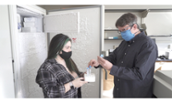
The Biotechnology major is a 4-year interdisciplinary major leading to the B.S. degree. The major is housed in the Biology Department but operates in cooperation with the Department of Integrated Science and Technology, and the Department of Chemistry.
As outlined below and in the official catalog, Biotechnology majors must complete 47-53 credit hours of science foundation courses, 17 credit hours of biotechnology transition and core courses, and 15 credit hours of elective courses. With the advice and approval of the adviser, each student selects the courses for his or her electives. Three broad areas of focus are suggested to serve a spectrum of student needs and desires:
A research focus will prepare students for graduate school or entry into a research laboratory.
An industry focus will prepare students for entry into the biotechnology industry.
A custom focus can be assembled for a specialized area of study such as bioinformatics, genomics or agricultural biotechnology.
Course Checklist for Major in Biotechnology ![]()
Faculty |
||
|
Name |
Department |
Research Interests |
|
Marta Bechtel PRogram Director |
Biology |
Molecular mechanisms associated with wound healing and tissue repair |
|
Biology |
Mechanisms of cell death in development and disease |
|
|
Biology |
Production and characterization of recombinant proteins |
|
|
Biology |
Biochemistry and Molecular Biology of glucose transport |
|
|
ISAT |
Virology, viral pathogenesis, and vaccine design |
|
|
Biology |
Genetics and molecular biology of cell development |
|
|
Biology |
Transfer of bacterial antibiotic resistance and virulence genes |
|
|
Biology |
Parasitology and immunology |
|
|
Chemistry |
Biochemistry of nucleotide binding proteins |
|
|
ISAT |
Genetic engineering, recombinant protein production |
|
|
Chemistry |
Biochemistry of DNA and protein structure |
|
|
Biology |
Biochemistry and molecular biology of plant beta-amylases |
|
|
Biology |
Molecular biology of nitric oxide synthase |
|
|
Biology |
Molecular biology of surface antigens of Group B Streptococci |
|
|
Biology |
Genetics and molecular biology of anti-oxidant genes in yeast |
|
|
ISAT |
Genetic and molecular host-bacterial interactions |
|
|
ISAT |
Microbial pathogenesis, genomics |
|
|
Chemistry |
Protein structure/function relationships |
|
Major Curriculum |
||
|
Foundation courses
|
Biology core courses (BIO 114, 124, 214 and 224) |
16 |
|
General Chemistry (CHEM 131, 131L, 132, 132L) |
8 |
|
|
Organic Chemistry (CHEM 341, 342, 346L) |
8 |
|
|
Physics (PHY 125, 126 or 140, 140L, 150, 150L) |
8 |
|
|
Calculus (MATH 231 and 232, or 235) |
4-8 |
|
|
Statistics (Math 220 or 285) |
3-4 |
|
|
Transition courses
|
Biotechnology seminar (BIOT 260) |
1 |
|
Biotechnology Lab (ISAT 305) |
1 |
|
|
Biochemistry (CHEM /BIO 361, 366L) |
5 |
|
|
Molecular Biology (BIO 480) |
4 |
|
|
Biotechnology in Industry and Agriculture (ISAT 451) |
3 |
|
|
Ethical, Legal and Social Implications of Biotechnology (ISAT 456) |
3 |
|
|
Elective courses |
See your advisor |
15 |
|
Capstone experience |
Independent research or Honors thesis (ISAT 493, BIO 497 or BIO/ISAT 499) is highly recommended. |
|