1) Self-Determination
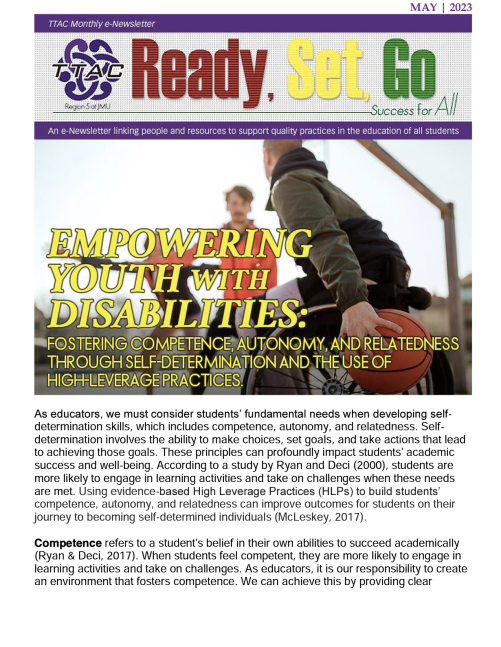
I'm Determined, a project developed and sponsored by the Virginia Department of Education's Training and Technical Assistance Centers, focuses on providing direct instruction, models, and opportunities to practice skills associated with self-determined behavior beginning at the elementary level and continuing through the student's educational career. The empowered student knows how to set and achieve goals and has a greater understanding of personal strengths and how to get support for areas of need.
Learn more at http://www.imdetermined.org
2) Secondary Data Collection
Collects, analyzes, and disseminates data on indicators #13 and #14 addressing transition and post-secondary outcomes for VA’s State Performance Report.
4) Transition Matrix/College Guide
Develops and maintains information that maps transition resources for students, families, and service providers with information about searching for, attending, and being successful in college. Includes links to VA colleges and universities.
Adults are welcome to return for the high school and college panel from 2:00 – 3:00 p.m.
Pre-registration is required. A registration form will be available at a later date. For more information, contact Sally Chappel at 540.568.8095 or chappesl@jmu.edu.
VDOE Region 5 T/TAC has teamed with three colleges and universities to offer a program for students with disabilities to experience and learn about the college setting. This half day visit pairs high school students with college students who are registered with the Office of Disability Services. The high school students are welcomed with an icebreaker activity, attend a mock college class taught by a college professor, eat lunch with college students, and are provided the opportunity to ask questions and hear from the college students and others about college life.
Some of the high school students report that the best thing was “being in a college class to understand what happens in class,” “talking with college students,” “eating on campus,” and “learning about college life.”
During the 2009-2010 school year, VDOE Region 5 T/TAC will partner with James Madison University, Piedmont Virginia Community College, and Lynchburg College to provide this program to area high school students. For information click on Discovering College Brochure.


The Jump Into Vocational Exploration (JIVE) program is a collaborative effort between James Madison University (JMU), Rockingham County Public Schools (RCPS), Harrisonburg City Public Schools (HCPS) and VDOE Region 5 T/TAC as a result of Rockingham County and Harrisonburg City Public Schools’ desire to find community short-term assessment sites for students with disabilities, JMU Special Education Program’s desire to place teachers in training as job coaches in real work situations, and T/TAC’s willingness to provide the needed technical assistance.
The purpose of the JIVE Program is to create a secondary transition education program where RCPS and HCPS students with disabilities are provided with a variety of situational assessments enhancing their ability to make choices, and develop independence, educational, career, and interpersonal skills. JIVE also provides an authentic learning and teaching environment for JMU graduate students preparing to work in the field of special education and related services as they assess RCPS and HCPS students on the JMU campus. In addition, this program helps the JMU community better understand and appreciate persons with disabilities.
Goals of the JIVE program are to: enhance JMU/RCPS/HCPS/VDOE TTAC partnership, create a collaborative program between a four-year institution and a public school that provides situational assessment sites for high school students with disabilities, provide a vocational/transition experience for JMU pre-service teachers, provide community-based work assessment experiences for high school students with disabilities who have completed school-based work-study programs, and provide high school students with disabilities opportunities for short-term situational job assessment.
Benefits for JIVE students are to: receive job assessment and work place exposure beneficial to decision making about future employment in a community environment, enhance social and interpersonal skills through interaction with college students, and increase abilities to function independently in work, community, and social environments.
Benefits for JIVE job coaches are to: provide JMU students enrolled in special education related courses experiences regarding mentoring, supervising, assessing, and job coaching individuals with disabilities, provides experience working in field of interest, and provide on-campus practicum experiences.
Benefits for Rockingham County and Harrisonburg City Public Schools are to: provide situational assessments for high school students with disabilities, provide a scope and sequence for gaining multiple vocational experiences in preparation for competitive employment, and provide an unbiased assessment from external evaluators.
Benefits for James Madison University are to: provide the JMU community with positive exposure and appreciation for individuals with disabilities, provide on-campus practicum experiences for students enrolled in related fields, and expose JMU employers to potential employees.
Central Virginia Transition Council Lynchburg, Bedford, Amherst, Campbell 2nd Wednesday every month 10:30 a.m. - Merritt Hall, Central Virginia Community College, Lynchburg Contact: Dottie Narodny, dnarodny@autismva.org, 540.588.4796 or 800.649.8481
Jefferson Area Transition Council (JATC) Albemarle, Charlottesville, Greene, Fluvanna, Nelson, Louisa 2nd Monday every month Contact: Ms. Billie Campbell, bcampbell@tjpdc.org, 434.979.7310, ext. 230
Rockbridge Area Transition Council (RATC) Buena Vista, Lexington, Rockbridge 2nd Thursday every other month Contact: Mr. Mike Gieske-Smith, Giesekesmith@racsb.org, 540.261.7781
Transition Advisory Council Augusta, Staunton, Waynesboro, Bath, Highland 2nd Monday every other month Contact: Ms. Sharon Falls, sharonfalls@hotmail.com, 540.245.5002
Life After High School www.LifeAfterHS.org Successfully making the transition to adulthood is hard work, particularly for students with disabilities. You will need to gather information, talk to others, ask for their help, and think about what you really want. You will need to use resources at school and in the community to create a plan that will work for you.
The Youthhood http://www.youthhood.org/ Hello! Hey, we're glad you made it. This site is a place for you, your friends, and other teens. It's a welcoming community for all youth and a place where all youth belong. We want you to be here. This is your place, your space. Here you can start thinking about what you want to do with the rest of your life. This Web site was built to help you plan for the future. What will you do after high school? Will you work? Go to college? Live in a place of your own? By using this Web site, you can plan for your future right now!
National Collaborative on Workforce and Disability for Youth http://www.ncwd-youth.info/ NCWD/Youth is your source for information about employment and youth with disabilities. Our partners — experts in disability, education, employment, and workforce development — strive to ensure you will be provided with the highest quality, most relevant information available.
College Guide for Students with Disabilities www.pen.k12.va.us/VDOE/sped/transition/cpr.shtml
Know How Virginia www.knowhowvirginia.org/ Know how Virginia.org is the place to discover your career.
Virginia Career View http://www.vaview.org/ Welcome to Virginia Career VIEW; your main source for career and education information within the state of Virginia . DREAM IT, PLAN IT, DO IT™
Post-ITT http://www.postitt.org/about.shtml Post-ITT is an acronym for Postsecondary Innovative Transition Technology. Post-ITT uses the Internet to provide information and resources to high school students with disabilities considering college and to those who support them. The Web site offers a collection of resources and activities to help students, parents, and educators plan for transition from secondary to postsecondary schools. Permission is granted to download and reproduce Post-ITT materials for non-commercial educational purposes.
Creating High Expectations (CHE) is an innovative project designed to light a spark in middle and high school students with disabilities by engaging the student in thoughts about a career & post-secondary education, making the most of the student's attendance at a transition event, and informing the student about how s/he can be an active participant in his or her own transition planning. Visit http://www.create.org.vt.edu/ to find a series of lesson that are offered as modules in three critical areas: Assistive Technology, Career, and Leadership. In addition, resources are provided for students, educators, and families.
The Career Assessment Manual, designed in collaboration with Virginia Department of Education and Virginia Department of Rehabilitative Services, is available from the T/TAC library, and was developed as a resource for those serving students and consumers with disabilities who are preparing to transition to or within the adult world. School and vocational rehabilitation counselors often look for free or inexpensive assessments to use to help support the decisions made in the transition process. The tools in this manual can be used to help with transition planning by facilitating transition discussions or by assisting students and consumers with making decisions about their future. The instruments are not designed to be used exclusive of other assessment means, but are to be used as one of many assessments to help with making decisions. They are only a sampling of assessments that are available for purchase; they are neither endorsed nor promoted by the managers of this manual. The manual also includes a section relating to free or low-cost career planning and interest assessments that are available on-line.
The links below provide information related to the each of the assessments that are in the manual. In order to view the actual assessment one would need to request the manual from the T/TAC library.

VDOE T/TAC
Contact:
Sally Chappel
chappesl@jmu.edu
Statewide Self-determination Coordinator:
John McNaught
mcnaugjt@jmu.edu