
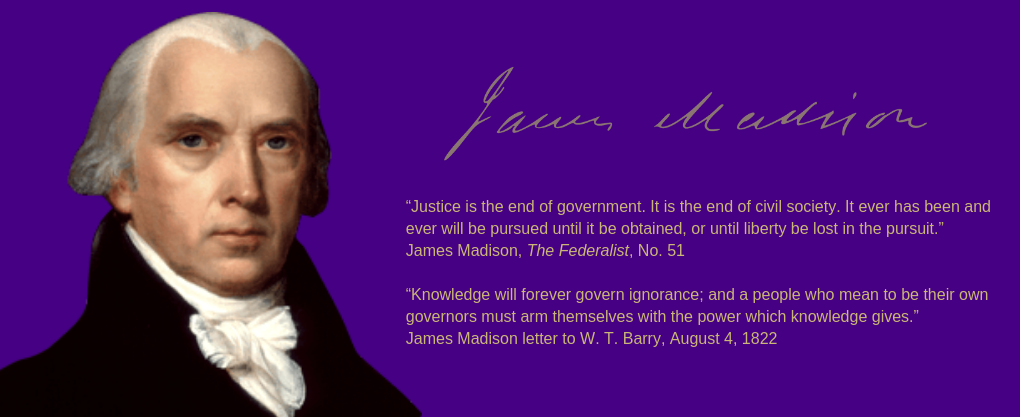
Report of the Committee to whom were referred
the Communications of various States, relative to the Resolutions
of the last General Assembly of this State, concerning the Alien
and Sedition Laws.
Whatever room might be found in the proceedings
of some of the states, who have disapproved of the resolutions
of the General Assembly of this commonwealth, passed on the 21st
day of December, 1798, for painful remarks on the spirit and manner
of those proceedings, it appears to the committee most consistent
with the duty, as well as dignity, of the General Assembly, to
hasten an oblivion of every circumstance which might be construed
into a diminution of mutual respect, confidence, and affection,
among the members of the Union.
The committee have deemed it a more useful task
to revise, with a critical eye, the resolutions which have met
with their disapprobation; to examine fully the several objections
and arguments which have appeared against them; and to inquire
whether there can be any errors of fact, of principle, or of reasoning,
which the candor of the General Assembly ought to acknowledge
and correct.
The first of the resolutions is in the words
following—
"Resolved, That the General Assembly of
Virginia doth unequivocally express a firm resolution to maintain
and defend the Constitution of the United States, and the Constitution
of this state, against every aggression, either foreign or domestic;
and that theft will support the government of the United States
in all measures warranted by the former."
No unfavorable comment can have been made on
the sentiments here expressed. To maintain and defend the Constitution
of the United States, and of their own state, against every aggression,
both foreign and domestic, and to support the government of the
United States in all measures warranted by their Constitution,
are duties which the General Assembly ought always to feel, and
to which, on such an occasion, it was evidently proper to express
their sincere and firm adherence.
In their next resolution—
"That General Assembly most solemnly declares
a warm attachment to the union of the states, to maintain which
it pledges all its powers; and that, for this end, it is their
duty to watch over and oppose every infraction of those principles
which constitute the only basis of that Union, because a faithful
observance of them can alone secure its existence and the public
happiness."
The observation just made is equally applicable
to this solemn declaration of warm attachment to the Union, and
this solemn pledge to maintain it; nor can any question arise
among enlightened friends of the Union, as to the duty of watching
over and opposing every infraction of those principles which constitute
its basis, and a faithful observance of which can alone secure
its existence, and the public happiness thereon depending.
The third resolution is in the words following—
"That this Assembly doth explicitly and
peremptorily declare, that it views the powers of the federal
government, as resulting from the compact to which the states
are parties, as limited by the plain sense and intention of
the instrument constituting that compact—as no further
valid than they are authorized by the grants enumerated in that
compact; and that, in case of a deliberate, palpable, and dangerous
exercise of other powers, not granted by the said compact, the
states who are parties thereto have the right, and are in duty
bound, to interpose, for arresting the progress of the evil,
and for maintaining, within their respective limits, the authorities,
rights, and liberties, appertaining to them."
On this resolution the committee have bestowed
all the attention which its importance merits. They have scanned
it not, merely with a strict, but with a severe eye; and they
feel confidence in pronouncing that, in its just and fair construction,
it is unexceptionably true in its several positions, as well as
constitutional and conclusive in its inferences.
The resolution declares, first, that "it
views the powers of the federal government as resulting froth
the compact to which the states are parties;" in other words,
that the federal powers are derived from the Constitution; and
that the Constitution is a compact to which the states are parties.
Clear as the position must seem, that the federal
powers are derived from the Constitution, and from that alone,
the committee are not unapprized of a late doctrine which opens
another source of federal powers, not less extensive and important
than it is new and unexpected. The examination of this doctrine
will be most conveniently connected with a review of a succeeding
resolution. The committee satisfy themselves here with briefly
remarking that, in all the contemporary discussions and comments
which the Constitution underwent, it was constantly justified
and recommended on the ground that the powers not given to the
government were withheld from it; and that, if any doubt could
have existed on this subject, under the original text of the Constitution,
it is removed, as far as words could remove it, by the 12th amendment,
now a part of the Constitution, which expressly declares, "that
the powers not delegated to the United States by the Constitution,
nor prohibited by it to the states, are reserved to the states
respectively, or to the people."
The other position involved in this branch of
the resolution, namely, "that the states are parties to the
Constitution," or compact, is, in the judgment of the committee,
equally free from objection. It is indeed true that the term "states"
is sometimes used in a vague sense, and sometimes in different
senses, according to the subject to which it is applied. Thus
it sometimes means the separate sections of territory occupied
by the political societies within each; sometimes the particular
governments established by those societies; sometimes those societies
as organized into those particular governments; and lastly, it
means the people composing those political societies, in their
highest sovereign Capacity. Although it might be wished that the
perfection of language admitted less diversity in the signification
of the same words, yet little inconvenience is produced by it,
where the true sense can be collected with certainty from the
different applications. In the present instance, whatever different
construction of the term "states," in the resolution,
may have been entertained, all will at least concur in that last
mentioned; because in that sense the Constitution was submitted
to the "states;" in that sense the "states"
ratified it; and in that sense of the term states, they are consequently,
parties to the compact from which the powers of the federal government
result.
The next position is, that the General Assembly
views the powers of the federal government "as limited by
the plain sense and intention of the instrument constituting that
compact," and "as no further valid than they are authorized
by the grants therein enumerated." It does not seem possible
that any just objection can lie against either of these clauses.
The first amounts merely to a declaration that
the compact ought to have the interpretation plainly intended
by the parties to it; the other, to a declaration that it ought
to have the execution and effect intended by them. If the powers
granted be valid, it is solely because they are grant, granted;
and if the granted powers are valid because granted, all other
powers not granted must not be valid.
The resolution, having taken this view of the
federal compact, proceeds to infer, "That, in case of a deliberate,
palpable, and dangerous exercise of other powers, not granted
by the said compact, the states, who are parties thereto, have
the right, and are in duty bound, to interpose for arresting the
progress of the evil, and for maintaining, within their respective
limits, the authorities, rights, and liberties, appertaining to
them."
It appears to your committee to be a plain principle,
founded in common sense, illustrated by common practice, and essential
to the nature compacts, that, where resort can be had to no tribunal
superior to the authority of the parties, the parties themselves
must be the rightful judges, in the last resort, whether the bargain
made has been pursued or violated. The Constitution of the United
States was formed by the sanction of the states, given by each
in its sovereign capacity. It adds to the stability and dignity,
as well as to the authority, of the Constitution, that it rests
on this legitimate and solid foundation. The states, then, being
the parties to the constitutional compact, and in their sovereign
capacity, it follows of necessity that there can be no tribunal,
above their authority, to decide, in the last resort, whether
the compact made by them be violated; and consequently, that,
as the parties to it, they must themselves decide, in the last
resort, such questions as may be of sufficient magnitude to require
their interposition.
It does not follow, however, because the states,
as sovereign parties to their constitutional compact, must ultimately
decide whether it has been violated, that such a decision ought
to be interposed either in a hasty manner or on doubtful and inferior
occasions. Even in the case of ordinary conventions between different
nations, where, by the strict rule of interpretation, a breach
of a part may be deemed a breach of the whole,—every part
being deemed a condition of every other part, and of the whole,—it
is always laid down that the breach must be both wilful and material,
to justify an application of the rule. But in the case of an intimate
and constitutional union, like that of the United States, it is
evident that the interposition of the parties, in their sovereign
capacity, can be called for by occasions only deeply and essentially
affecting the vital principles of their political system.
The resolution has, accordingly, guarded against
any misapprehension of its object, by expressly requiring, for
such an interposition, "the ease of a deliberate, palpable,
and dangerous breach of the Constitution, by the exercise of powers
not granted by it." It must be a case not of a light and
transient nature, but of a nature dangerous to the great purposes
for which the Constitution was established. It must be a case,
moreover, not obscure or doubtful in its construction, but plain
and palpable. Lastly, it must be a case not resulting from a partial
consideration or hasty determination, but a case stamped with
a final consideration and deliberate adherence. It is not necessary,
because the resolution does not require, that the question should
be discussed, how far the exercise of any particular power, ungranted
by the Constitution, would justify the interposition of the parties
to it. As cases might easily be stated, which none would contend
ought to fall within that description,—cases, on the other
hand, might, with equal ease, be stated, so flagrant and so fatal
as to unite every opinion in placing them within the description.
But the resolution has done more than guard against
misconstruction, by expressly referring to cases of a deliberate,
palpable, and dangerous nature. It specifies the object of the
interposition, which it contemplates, to be solely that of arresting
the progress of the evil of usurpation, and of maintaining the
authorities, rights, and liberties, appertaining to the states,
as parties to the Constitution.
From this view of the resolution, it would seem
inconceivable that it can incur any just disapprobation from those
who, laying aside all momentary impressions, and recollecting
the genuine source and object of the Federal Constitution, shall
candidly and accurately interpret the meaning of the General Assembly.
If the deliberate exercise of dangerous powers, palpably Withheld
by the Constitution, could not justify the parties to it in interposing
even so far as to arrest the progress of the evil, and thereby
to preserve the Constitution itself, as well as to provide for
the safety of the parties to it, there would be an end to all
relief from usurped power, and a direct subversion of the rights
specified or recognized under all the state constitutions, as
well as a plain denial of the fundamental principle on Which our
independence itself was declared.
But it is objected, that the judicial authority
is to he regarded as the sole expositor of the Constitution in
the last resort; and it may be asked for what reason the declaration
by the General Assembly, supposing it to be theoretically true,
could be required at the present day, and in so solemn a manner.
On this objection it might he observed, first,
that there may be instances of usurped power, which the forms
of the Constitution would never draw within the control of the
judicial department; secondly, that, if the decision of the judiciary
be raised above the authority of the sovereign parties to the
Constitution, the decisions of the other departments, not carried
by the forms of the Constitution before the judiciary, must he
equally authoritative and final with the decisions of that department.
But the proper answer to the objection is, that the resolution
of the General Assembly relates to those great and extraordinary
cases, in which all the forms of the Constitution may prove ineffectual
against infractions dangerous to the essential rights of the parties
to it. The resolution supposes that dangerous powers, not delegated,
may not only be usurped and executed by the other departments,
but that the judicial department, also, may exercise or sanction
dangerous powers beyond the grant of the Constitution; and, consequently,
that the ultimate right of the parties to the Constitution, to
judge whether the compact has been dangerously violated, must
extend to violations by one delegated authority as well as by
another—by the judiciary as well as by the executive, or
the legislature.
However true, therefore, it may be, that the
judicial department is, in all questions submitted to it by the
forms of the Constitution, to decide in the last resort, this
resort must necessarily be deemed the last in relation to the
authorities of the other departments of the government; not in
relation to the rights of the parties to the constitutional compact,
from which the judicial, as well as the other departments, hold
their delegated trusts. On any other hypothesis, the delegation
of judicial power would annul the authority delegating it; and
the concurrence of this department with the others in usurped
powers, might subvert forever, and beyond the possible reach of
any rightful remedy, the very Constitution which all were instituted
to preserve.
The truth declared in the resolution being established,
the expediency of making the declaration at the present day may
safely be left to the temperate consideration and candid judgment
of the American public. It will be remembered, that a frequent
recurrence to fundamental principles is solemnly enjoined by most
of the state constitutions, and particularly by our own, as a
necessary safeguard against the danger of degeneracy, to which
republics are liable, as well as other governments, though in
a less degree than others. And a fair comparison of the political
doctrines not unfrequent at the present day, with those which
characterized the epoch of our revolution, and which form the
basis of our republican constitutions, will best determine whether
the declaratory recurrence here made to those principles ought
to be viewed as unseasonable and improper, or as a vigilant discharge
of an important duty. The authority of constitutions over governments,
and of the sovereignty of the people over constitutions, are truths
which are at all times necessary to be kept in mind; and at no
time, perhaps, more necessary than at present.
The fourth resolution stands as follows:—
"That the General Assembly doth also express
its deep regret, that a spirit has, in sundry instances, been
manifested by the federal government, to enlarge its powers
by forced constructions of the constitutional charter which
defines them; and that indications have appeared eta design
to expound certain general phrases (which having been copied
from the very limited grant of powers in the former Articles
of Confederation, were the less liable to be misconstrued) So
as to destroy the meaning and effect of the particular enumeration
which necessarily explains and limits the general phrases, and
so as to consolidate the states, by degrees, into one sovereignty,
the obvious tendency and inevitable result of which would be
to transform the present republican system of the United States
into an absolute, or at best a mixed monarchy."
The first question here to be considered is,
whether a spirit has, in sundry instances, been manifested by
the federal government to enlarge its powers by forced constructions
of the constitutional charter.
The General Assembly having declared their opinion,
merely, by regretting, in general terms, that forced constructions
for enlarging the federal powers have taken place, it does not
appear to the committee necessary to go into a specification of
every instance to which the resolution may allude. The Alien and
Sedition Acts being particularly named in a succeeding resolution,
are of course to be understood as included in the allusion. omitting
others which have less occupied public attention, or been less
extensively regarded as Unconstitutional, the resolution may be
presumed to refer particularly to the bank law, which, from the
circumstances of its passage, as well as the latitude of construction
on which it is founded, strikes the attention with singular force,
and the carriage tax, distinguished also by circumstances in its
history having a similar tendency. Those instances alone, if resulting
from forced construction, and calculated to enlarge the powers
of the federal government,—as the committee cannot but conceive
to be the case,—sufficiently warrant this part of the resolution.
The committee have not thought it incumbent on them to extend
their attention to laws which have been objected to rather as
varying the Constitutional distribution of powers in the federal
government, than as an absolute enlargement of them; because instances
of this sort, however important in their principles and tendencies,
do not appear to fall strictly within the text under view.
The other questions presenting themselves are,
1. Whether indications have appeared of a design to expound certain
general phrases, copied from the "Articles of Confederation,"
so as to destroy the effect of the particular enumeration explaining
and limiting their meaning; 2. Whether this exposition would,
by degrees, consolidate the states into one sovereignty; 3. Whether
the tendency and result of this consolidation would be to transform
the republican system of the United States into a monarchy.
1. The general phrases here meant must be those
"of providing for the common defence and general welfare."
In the "Articles of Confederation,"
the phrases are used as follows, in Art. VIII.: "All charges
of war, and all other expenses that shall be incurred for the
common defence and general welfare, and allowed by the United
States in Congress assembled, shall be defrayed out of a common
treasury, which shall be supplied by the several states, in proportion
to the value of all land within each state, granted to or surveyed
for any person, as such land, and the buildings and improvements
thereon, shall be estimated, according to such mode as the United
States in Congress assembled shall, from time to time, direct
and appoint."
In the existing Constitution, they make the following
part of sect. 8: "The Congress shall have power to lay and
collect taxes, duties, imposts, and excises; to pay the debts,
and provide for the common defence and general welfare, of the
United States."
This similarity in the use of these phrases,
in the two great federal charters, might well be considered as
rendering their meaning less liable to be misconstrued in the
latter; because it will scarcely be said, that in the former they
were ever understood to be either a general grant of power, or
to authorize the requisition or application of money, by the old
Congress, to the common defence and general welfare, except in
cases afterwards enumerated, which explained and limited their
meaning; and if such was the limited meaning attached to these
phrases in the very instrument revised and remodeled by the present
Constitution, it can never be supposed that, when copied into
this Constitution, a different meaning ought to be attached to
them.
That, notwithstanding this remarkable security
against misconstruction, a design has been indicated to expound
these phrases, in the Constitution, so as to destroy the effect
of the particular enumeration of powers by which it explains and
limits them, must have fallen under the observation of those who
have attended to the course of public transactions. Not to multiply
proofs on this subject, it will suffice to refer to the debates
of the federal legislature, in which arguments have, on different
occasions, been drawn, with apparent effect, from these phrases,
in their indefinite meaning.
To these indications might be added, without
looking farther, the official report on manufactures by the late
secretary of the treasury, made on the 5th of December, 1791,
and the report of a committee of Congress, in January, 1797, on
the promotion of agriculture. In the first of these it is expressly
contended to belong "to the discretion of the national legislature
to pronounce upon the objects which concern the general welfare,
and for which, under that description, an appropriation of money
is requisite and proper. And there seems to be no room for a doubt,
that whatever concerns the general interests of learning, of agriculture,
of manufactures, and of commerce, is within the sphere of national
councils as far as regards an application of money." The
latter report assumes the same latitude of power in the national
councils, and applies it to the encouragement of agriculture,
by means of a society to be established at the seat of government
Although neither of these reports may have received the sanction
of a law carrying it into effect, yet, on the other hand, the
extraordinary doctrine contained in both has passed without the
Slightest positive mark of disapprobation from the authority to
which it was addressed.
Now, whether the phrases in question be construed
to authorize every measure relating to the common defence and
general welfare, as contended by some, or every measure only in
which there might be an application of money, as suggested by
the caution of others,—the effect must substantially be
the same, in destroying the import and force of the particular
enumeration of powers which follows these general phrases in the
Constitution; for it is evident that there is not a single power
whatever which may not have some reference to the common defence
or the general welfare; nor a power of any magnitude which, in
its exercise, does not involve, or admit, an application of money.
The government, therefore, which possesses power in either one
or other of these extents, is a government without the limitations
formed by a particular enumeration of powers; and, consequently,
the meaning and effect of this particular enumeration is destroyed
by the exposition given to these general phrases.
This conclusion will not be affected by an attempt
to qualify the power over the "general welfare," by
referring it to cases where the general welfare is beyond the
reach of the separate provisions by the individual states, and
leaving to these their jurisdiction in cases to which their separate
provisions may be competent; for, as the authority of the individual
states must in all cases be incompetent to general regulations
operating through the whole, the authority of the United States
would be extended to every object relating to the general welfare,
which might, by any possibility, be provided for by the general
authority. This qualifying construction, therefore, would have
little, if any, tendency to circumscribe the power claimed under
the latitude of the term "general welfare."
The true and fair construction of this expression,
both in the original and existing federal compacts, appears to
the committee too obvious to be mistaken. In both, the Congress
is authorized to provide money for the common defence and general
welfare. In both is subjoined to this authority an enumeration
of the eases to which their powers shall extend. Money cannot
be applied to the general welfare, otherwise than by an application
of it to some particular measure, conducive to the general welfare.
Whenever, therefore, money has been raised by the general authority,
and is to be applied to a particular measure, a question arises
whether the particular measure be within the enumerated authorities
vested in Congress. If it be, the money requisite for it may be
applied to it. If it be not, no such application can be made.
This fair and obvious interpretation coincides with, and is enforced
by, the clause in the Constitution which declares that "no
money shall be drawn from the treasury but inconsequence of appropriations
made by law." An appropriation of money to the general welfare
would be deemed rather a mockery than an observance of this constitutional
injunction.
2. Whether the exposition of the general phrases
here combated would not, by degrees, consolidate the states into
one sovereignty, is a question concerning which the committee
can perceive little room for difference of opinion. To consolidate
the states into one sovereignty, nothing more can be wanted than
to supersede their respective sovereignties, in the cases reserved
to them, by extending the sovereignty of the United States to
all cases of the "general welfare"—-that is to
say, to all cases whatever.
3. That the obvious tendency, and inevitable
result, of a consolidation of the states into one sovereignty,
would be to transform the republican system of the United States
into a monarchy, is a point which seems to have been sufficiently
decided by the general sentiment of America. In almost every instance
of discussion relating to the consolidation in question, its certain
tendency to pave the way to monarchy seems not to have been contested.
The prospect of such a consolidation has formed the only topic
of controversy. It would be unnecessary, therefore, for the committee
to dwell long on the reasons which support the position of the
General Assembly. It may not be improper, however, to remark two
consequences, evidently flowing from an extension of the federal
power to every subject falling within the idea of the "general
welfare."
One consequence must be, to enlarge the sphere
of discretion allotted to the executive magistrate. Even within
the legislative limits properly defined by the Constitution, the
difficulty of accommodating legal regulations to a country so
great in extent, and so various in its circumstances, had been
much felt, and has led to occasional investments of power in the
executive, which involve perhaps as large a portion of discretion
as can be deemed consistent with the nature of the executive trust.
In proportion as the objects of legislative care might be multiplied,
would the time allowed for each be diminished, and the difficulty
of providing uniform and particular regulations for all be increased.
From these sources would necessarily ensue a greater latitude
to the agency of that department which is always in existence,
and which could best mould regulations of a general nature, so
as to suit them to the diversity of particular situations. And
it is in this latitude, as a supplement to the deficiency of the
laws, that the degree of executive prerogative materially consists.
The other consequence would be, that of an excessive
augmentation of the offices, honors, and emoluments, depending
on the executive will. Add to the present legitimate stock all
those, of every description, which a consolidation of the states
would take from them, and turn over to the federal government,
and the patronage of the executive would necessarily be as much
swelled, in this case, as its prerogative would be in the other.
This disproportionate increase of prerogative
and patronage must evidently either enable the chief magistrate
of the Union, by quiet means, to secure his reelection from time
to time, and finally to regulate the succession as he might please;
or, by giving so transcendent an importance to the office, would
render the election to it so violent and corrupt, that the public
voice itself might call for an hereditary in place of an elective
succession. Whichever of these events might follow, the transformation
of the republican system of the United States into a monarchy,
anticipated by the General Assembly from a consolidation of the
states into one sovereignty, would be equally accomplished; and
whether it would be into a mixed or an absolute monarchy, might
depend on too many contingencies to admit of any certain foresight.
The resolution next in order is contained in
the following terms—
"That the General Assembly doth particularly
protest against the palpable and alarming infractions of the
Constitution, in the two late cases et the 'Alien and Sedition
Acts,' passed at the last session of Congress; the first of
which exercises a power nowhere delegated to the federal government;
and which, by uniting legislative and judicial powers to those
of the executive, subverts the general principles of free government,
as well as the particular organization and positive provisions
of the Federal Constitution; and the other of which acts exercises,
in like manner, a power not delegated by the Constitution, but,
on the contrary, expressly and positively forbidden by one of
the amendments thereto—a power which, more than any other,
ought to produce universal alarm, because it is leveled against
the right of freely examining public characters and measures,
and of free communication among the people thereon, which has
ever been justly deemed the only effectual guardian of every
other right."
The subject of this resolution having, it is
presumed, more particularly led the General Assembly into the
proceedings which they communicated to the other states, and being
in itself of peculiar importance, it deserves the most critical
and faithful investigation; for the length of which no apology
will be necessary.
The subject divides itself into,—
First, the "Alien Act."
Secondly, the "Sedition Act."
Of the "Alien Act," it is affirmed
by the resolution—
1. That it exercises a power nowhere delegated
to the federal government; 2. That it unites legislative and judicial
powers to those of the executive; 3. That this union of powers
subverts the general principles of free government; 4. That it
subverts the particular organization and positive provisions of
the Federal Constitution.
In order to clear the way for a correct view
of the first position, several observations will be premised.
In the first place, it is to be borne in mind,
that, it being a characteristic feature of the Federal Constitution,
as it was originally ratified, and an amendment thereto having
precisely declared. "that the powers not delegated to the
United States by the Constitution, nor prohibited by it to the
states, are reserved to the states respectively, or to the people."
it is incumbent in this, as in every other exercise of power by
the federal government, to prove, from the Constitution, that
it grants the particular power exercised.
The next observation to be made is, that much
confusion and fallacy have been thrown into the question, by blending
the two cases of aliens, members of a hostile nation; and aliens,
members of friendly nations. These two cases are so obviously
and so essentially distinct, that it occasions no little surprise
that the distinction should have been disregarded; and the surprise
is so much the greater, as it appears that the two cases are actually
distinguished by two separate acts of Congress, passed at the
same session, and comprised in the same publication; the one providing
for the case of "alien enemies;" the other "concerning
aliens" indiscriminately, and consequently extending to aliens
of every nation in peace and amity with the United States. With
respect to alien enemies, no doubt has been intimated as to the
federal authority over them; the Constitution having expressly
delegated to Congress the power to declare war against any nation,
and of course to treat it and all its members as enemies. With
respect to aliens who are not enemies, but members of nations
in peace and amity with the United States, the power assumed by
the act of Congress is denied to be constitutional; and it is
accordingly against this act that the protest of the General Assembly
is expressly and exclusively directed.
A third observation is that, were it admitted,
as is contended, that the "act concerning aliens" has
for its object, not a penal, but a preventive justice, it would
still remain to be proved that it comes within the constitutional
power of the federal legislature; and, if Within its power, that
the legislature has exercised it in a constitutional manner.
In the administration of preventive justice,
the following principles have been held sacred: that some probable
ground of suspicion be exhibited before some judicial authority;
that it he supported by oath or affirmation; that the party may
avoid being thrown into confinement, by finding pledges or sureties
for his legal conduct sufficient in the judgment of some judicial
authority; that he may have the benefit of a writ of habeas corpus,
and thus obtain his release if wrongfully confined; and that he
may at anytime be discharged from his recognizance, or his confinement,
and restored to his former liberty and rights, on the order of
the proper judicial authority, if it shall see sufficient cause.
All these principles of the only preventive justice
known to American jurisprudence are violated b the Alien Act.
The round of suspicion is to be judged of, not by any judicial
authority, but by the executive magistrate alone. No oath or affirmation
is required. If the suspicion be held reasonable by the President,
he may order the suspected alien to depart from the territory
of the United States, without the opportunity of avoiding the
sentence by finding pledges for his future good conduct. As the
President may limit the time of departure as he pleases, the benefit
of the writ of habeas corpus may be suspended with respect to
the party, although the Constitution ordains that it shall not
be suspended unless when the public safety may require it, in
case of rebellion or invasion,—neither of which existed
at the passage of the act; and the party being, under the sentence
of the President, either removed from the United States, or being
punished by imprisonment, or disqualification ever to become a
citizen, on conviction of not obeying the order of removal, he
cannot be discharged from the proceedings against him, and restored
to the benefits of his former situation, although the highest
judicial authority should see the most sufficient cause for it.
But, in the last place, it can never be admitted
that the removal of aliens, authorized by the act, is to be considered,
not as punishment for an offence, but as a measure of precaution
and prevention. If the banishment of an alien from a country into
which he has been invited as the asylum most auspicious to his
happiness,—a country where he may have formed the most tender
connections; where he may have invested his entire property, and
acquired property of the real and permanent, as well as the movable
and temporary kind; where he enjoys, under the laws, a greater
share of the blessings of personal security, and personal liberty,
than he can elsewhere hope for; and where he may have nearly completed
his probationary title to citizenship; if, moreover, in the execution
of the sentence against him, he is to be exposed, not only to
the ordinary dangers of the sea, but to the peculiar casualties
incident to a crisis of war and of unusual licentiousness on that
element and possibly to vindictive purposes, which his emigration
itself may have provoked;—if a banishment of this sort be
not a punishment, and among the severest of punishments, it will
be difficult to imagine a doom to which the name can be applied.
And if it be a punishment, it will remain to be inquired, whether
it can be constitutionally inflicted, on mere suspicion, by the
single will of the executive magistrate, on persons convicted
of no personal offence against the laws of the land, nor involved
in any offence against the law of nations, charged on the foreign
state of which they are members.
One argument offered in justification of this
power exercised over aliens is, that, the admission of them into
the country being of favor, not of right, the favor is at all
times revocable.
To this argument it might be answered, that,
allowing the truth of the inference, it would be no proof of what
is required. A question would still occur, whether the Constitution
had vested the discretionary power of admitting aliens in the
federal government or in the state governments.
But it cannot be a true inference, that, because
the admission of an alien is a favor, the favor may be revoked
at pleasure. A grant of land to an individual may be of favor,
not of right; but the moment the grant is made, the favor becomes
a right, and must be forfeited before it can be taken away. To
pardon a malefactor may be a favor, but the pardon is not, on
that account, the less irrevocable. To admit an alien to naturalization,
is as much a favor as to admit him to reside in the country; yet
it cannot be pretended that a person naturalized can be deprived
of the benefits, any more than a native citizen can be disfranchised.
Again, it is said that, aliens not being parties
to the Constitution, the rights and privileges which it secures
cannot be at all claimed by them
To this reasoning, also, it might be answered
that, although aliens are not parties to the Constitution, it
does not follow that the Constitution has vested in Congress an
absolute power over them. The parties to the Constitution may
have granted, or retained, or modified, the power over aliens,
without regard to that particular consideration.
But a more direct reply is, that it does not
follow, because aliens are not parties to the Constitution, as
citizens are parties to it, that, whilst they actually conform
to it, they have no right to its protection. Aliens are not more
parties to the laws than they are parties to the Constitution;
yet it will not be disputed that, as they owe, on one hand, a
temporary obedience, they are entitled, in return, to their protection
and advantage.
If aliens had no rights under the Constitution,
they might not only be banished, but even capitally punished,
without a jury or the other incidents to a fair trial. But so
far has a contrary principle been carried, in every part of the
United States, that, except on charges of treason, an alien has,
besides all the common privileges, the special one of being tried
by a jury, of which one half may be also aliens.
It is said, further, that, by the law and practice
of nations, aliens may be removed, at discretion, for offences
against the law of nations; that Congress are authorized to define
and punish such offences; and that to be dangerous to the peace
of society is, in aliens, one of those offences.
The distinction between alien enemies and alien
friends is a clear and conclusive answer to this argument. Alien
enemies are under the law of nations, and liable to be punished
for offences against it. Alien friends, except in the single case
of public ministers, are under the municipal law, and must be
tried and punished according to that law only.
This argument also, by referring the alien act
to the power of Congress to define and punish offences against
the law of nations, yields the point that the act is of a penal,
not merely of a preventive operation. It must, in truth, be so
considered. And if it be a penal act, the punishment it inflicts
must be justified by some offence that deserves it.
Offences for Which aliens, within the jurisdiction
of a country, are punishable, are—first, offences committed
by the nation of which they make a part, and in whose offences
they are involved; secondly, offences committed by themselves
alone, without any charge against the nation to which they belong.
The first is the case of alien enemies; the second, the case of
alien friends. In the first case, the offending nation can no
otherwise be punished than by war, one of the laws of which authorizes
the expulsion of such of its members as may be found within the
country against which the offence has been committed. In the second
case,—the offence being committed by the individual, not
by his nation, and against the municipal law, not against the
law of nations,—the individual only, and not the nation,
is punishable; and the punishment must be conducted according
to the municipal law, not according to the law of nations. Under
this view of the subject, the act of Congress for the removal
of alien enemies, being conformable to the law of nations, is
justified by the Constitution; and the "act" for the
removal of alien friends, being repugnant to the constitutional
principles of municipal law, is unjustifiable.
Nor is the act of Congress for the removal of
alien friends more agreeable to the general practice of nations
than it is within the purview of the law of nations. The general
practice of nations distinguishes between alien friends and alien
enemies. The latter it has proceeded against, according to the
law of nations, by expelling them as enemies. The former it has
considered as under a local and temporary allegiance, and entitled
to a correspondent protection. If contrary instances are to be
found in barbarous countries, under undefined prerogatives, or
amid revolutionary dangers, they will not be deemed fit precedents
for the government of the United States, even if not beyond its
constitutional authority.
It is said that Congress may grant letters of
marque and reprisal; that reprisals may be made on persons as
well as property; and that the removal of aliens may be considered
as the exercise, in an inferior degree, of the general power of
reprisal on persons.
Without entering minutely into a question that
does not seem to require it, it may be remarked that reprisal
is a seizure of foreign persons or property, with a view to obtain
that justice for injuries done by one state, or its members, to
another state, or its members, for which a refusal of the aggressors
requires such a resort to force, under the law of nations. It
must be considered as an abuse of words, to call the removal of
persons from a country a seizure, or a reprisal on them; nor is
the distinction to be overlooked between reprisals on persons
within the country, and under the faith of its laws, and on persons
out of the country. But, laying aside these considerations, it
is evidently impossible to bring the alien act within the power
of granting reprisals; since it does not allege or imply any injury
received from any particular nation, for which this proceeding
against its members was intended as a reparation.
The proceeding is authorized against aliens of
every nation: of nations charged neither with any similar proceedings
against American citizens, nor with any injuries for which justice
might be sought, in the mode prescribed by the act. Were it true,
therefore, that good causes existed for reprisals against one
or more foreign nations, and that neither the persons nor property
Of its members, under the faith of our laws, could plead an exemption,
the operation of the act ought to have been limited to the aliens
among us belonging to such nations. To license reprisals against
all nations, for aggressions charged on one only, would be a measure
s contrary to every principle of justice and public law, as to
a wise policy, and the universal practice of nations.
It is said that the right of removing aliens
is an incident to the power of war, vested in Congress by the
Constitution.
This is a former argument in a new shape only,
and is answered by repeating, that the removal of alien enemies
is an incident to the power of war; that the removal of alien
friends is not an incident to the power of war.
It is said that Congress are, by the Constitution,
to protect each state against invasion; and that the means of
preventing invasion are included in the power of protection against
it.
The power of war, in general, having been before
granted by the Constitution, this clause must either be a mere
specification for greater caution and certainty, of which there
are other examples in the instrument, or be the injunction of
a duty, superadded to a grant of the power. Under either explanation,
it cannot enlarge the powers of Congress on the subject. The power
and the duty to protect each state against an invading enemy would
be the same under the general power, if this regard to the greater
caution had been omitted.
Invasion is an operation of war. To protect against
invasion is an exercise of the power of war. A power, therefore,
not incident to war, cannot be incident to a particular modification
of war; and as the removal of alien friends has appeared to be
no incident to a general state of war, it cannot be incident to
a partial state, or a particular modification of war.
Nor can it ever be granted, that a power to act
on a case, when it actually occurs, includes a power over all
the means that may tend to prevent the occurrence of the case.
Such a latitude of construction would render unavailing every
practical definition of particular and limited powers. Under the
idea of preventing war in general, as well as invasion in particular,
not only an indiscriminate removal of all aliens might be enforced,
but a thousand other things, still more remote from the operations
and precautions appurtenant to war, might take place. A bigoted
or tyrannical nation might threaten us with war, unless certain
religious or political regulations were adopted by us; yet it
never could be inferred, if the regulations which would prevent
war were such as Congress had otherwise no power to make, that
the power to make them would grow out of the purpose they were
to answer. Congress have power to suppress insurrections; yet
it would not be allowed to follow, that they might employ all
the means tending to prevent them; of which a system of moral
instruction for the ignorant, and of provident support for the
poor, might be regarded as among the most efficacious.
One argument for the power of the general government
to remove aliens would have been passed in silence, if it had
appeared under any authority inferior to that of a report made,
during the last session of Congress, to the House of Representatives,
by a committee, and approved by the house. The doctrine on Which
this argument is founded is of so new and so extraordinary a character,
and strikes so radically at the political system of America, that
it is proper to state it in the very words of the report.
"The act (concerning aliens) is said to
be unconstitutional, because to remove aliens is a direct breach
of the Constitution, which provides, by the 9th section of the
1st article, that the migration or importation of such persons
as any of the states shall think proper to admit, shall not
be prohibited by the Congress prior to the year 1808."
Among the answers given to this objection to
the constitutionality of the act, the following very remarkable
one is extracted—
"Thirdly, That, as the Constitution has
given to the states no power to remove aliens, during the period
of the limitation under consideration, in the mean time, on
the construction assumed, there would be no authority in the
country empowered to send away dangerous aliens; which cannot
be admitted."
The reasoning here used would not, in any view,
be conclusive; because there are powers exercised by most other
governments, which, in the United States, are withheld by the
people both from the general government and from the state governments.
Of this sort are many of the powers prohibited by the declarations
of rights prefixed to the constitutions, or by the clauses, in
the constitutions, in the nature of such declarations. Nay, so
far is the political system of the United States distinguishable
from that of other countries, by the caution with which powers
are delegated and defined, that, in one very important case, even
of commercial regulation and revenue, the power is absolutely
locked up against the hands of both governments. A tax on exports
can be laid by no constitutional authority whatever. Under a system
thus peculiarly guarded, there could surely be no absurdity in
supposing that alien friends—who, if guilty of treasonable
machinations, may be punished, or, if suspected on probable grounds,
may be secured by pledges or imprisonment, in like manner with
permanent citizens—were never meant to be subjected to banishment
by an arbitrary and unusual process, either under the one government
or the other.
But it is not the inconclusiveness of the general
reasoning, in this passage, which chiefly calls the attention
to it. It is the principle assumed by it, that the powers held
by the states are given to them by the Constitution of the United
States; and the inference from this principle, that the powers
supposed to be necessary, which are not so given to the state
governments, must reside in this government of the United States.
The respect which is felt for every portion of
the constituted authorities forbids some of the reflections which
this singular paragraph might excite; and they are the more readily
suppressed, as it may be presumed, with justice perhaps as well
as candor, that inadvertence may have had its share in the error.
It would be unjustifiable delicacy, nevertheless, to pass by so
portentous a claim, proceeding from so high an authority, without
a monitory notice of the fatal tendencies with which it would
be pregnant.
Lastly, it is said that a law on the same subject
with the alien act, passed by this state originally in 1785, and
reenacted in 1792, is a proof that a summary removal of suspected
aliens was not heretofore regarded, by the Virginia legislature,
as liable to the objections now urged against such a measure.
This charge against Virginia vanishes before
the simple remark, that the law of Virginia relates to "suspicious
persons, being the subjects of any foreign power or state who
shall have made a declaration of war, or actually commenced hostilities,
or from whom the President shall apprehend hostile designs;"
whereas the act of Congress relates to aliens, being the subjects
of foreign powers and states, who have neither declared war, nor
commenced hostilities, nor from whom hostile dangers are apprehend.
2. It is next affirmed of the Alien Act, that
it unites legislative, judicial, and executive powers, in the
hands of the President.
However difficult it maybe to mark, in every
case, with clearness and certainty, the line which divides legislative
power from the other departments of power, all will agree that
the powers referred to these departments may be so general and
undefined, as to be of a legislative, not of an executive or judicial
nature, and may for that reason be unconstitutional. Details,
to a certain degree, are essential to the nature and character
of law; and on criminal subjects, it is proper that details should
leave as little as possible to the discretion of those who are
to apply and execute the law. If nothing more were required, in
exercising a legislative trust, than a general conveyance of authority—without
laying down any precise rules by which the authority conveyed
should be carried into effect—it would follow that the whole
power of legislation might be transferred by the legislature from
itself, and proclamations might become substitutes for taw. A
delegation of power in this latitude would not be denied to be
a union of the different powers.
To determine, then, whether the appropriate powers
of the distinct departments are united by the act authorizing
the executive to remove aliens, it must be inquired whether it
contains such details, definitions, and rules, as appertain to
the true character of a law; especially a law by which personal
liberty is invaded, property deprived of its value to the owner,
and life itself indirectly exposed to danger.
The Alien Act declares "that it shall be
lawful for the President to order all such aliens as he shall
judge dangerous to the peace and safety of the United States,
or shall have reasonable ground to suspect are concerned in any
treasonable or secret machinations against the government thereof,
to depart," &c.
Could a power be well given in terms less definite,
less particular, and less precise? To be dangerous to the public
safety—to be suspected of secret machination against the
government; these can never be mistaken for legal rules or certain
definitions. They leave every thing to the President. His will
is the law.
But it is not a legislative power only that is
given to the President. He is to stand in the place of the judiciary
also. His suspicion is the only evidence which is to convict;
his order, the only judgment which is to be executed.
Thus it is the President whose will is to designate
the offensive conduct; it is his will that is to ascertain the
individuals on whom it is charged; and it is his will that is
to cause the sentence to be executed. It is rightly affirmed.
therefore, that the act unites legislative and judicial powers
to those of the executive.
3. It is affirmed that this union of power subverts
the general principle of free government.
It has become an axiom in the science of government,
that a separation of the legislative, executive, and judicial
departments is necessary to the preservation of public liberty.
Nowhere has this axiom been better understood in theory, or more
carefully pursued in practice, than in the United States.
4. It is affirmed that such a union of power
subverts the particular organization and positive provision of
the Federal Constitution.
According to the particular organization of the
Constitution, its legislative powers are vested in the Congress,
its executive powers in the President, and its judicial powers
in a supreme and inferior tribunals. The union of any of these
powers, and still more of all three, in any one of these departments,
as has been shown to be done by the Alien Act, must, consequently,
subvert the constitutional organization of them.
That positive provisions, in the Constitution,
securing to individuals the benefits of fair trial, are also violated
by the union of powers in the Alien Act, necessarily results from
the two facts, that the act relates to alien friends, and that
alien friends, being under the municipal law only, are entitled
to its protection.
The second object, against which the resolution
protests, is the Sedition Act.
Of this act it is affirmed—
1. That it exercises, in like manner, a power
not delegated by the Constitution; 2. That the power, on the contrary,
is expressly and positively forbidden by one of the amendments
to the Constitution; 3. That this is a power which, more than
any other, ought to produce universal alarm, because it is levelled
against that right of freely examining public characters and measures,
and of free communication thereon, which has ever been justly
deemed the only effectual guardian of every other right.
1. That it exercises a power not delegated by
the Constitution.
Here, again, it will be proper to recollect that,
the federal government being composed of powers specifically granted,
with reservation of all others to the states or to the people,
the positive authority under which the Sedition Act could be passed
must be produced by those who assert its constitutionality. In
what part of the Constitution, then, is this authority to be found?
Several attempts have been made to answer this
question, which will be examined in their order. The committee
will begin with one which has filled them with equal astonishment
and apprehension; and which, they cannot but persuade themselves,
must have the same effect on all who will consider it with coolness
and impartiality, and with a reverence for our Constitution, in
the true character in which it issued from the sovereign authority
of the people. The committee refer to the doctrine lately advanced,
as a sanction to the Sedition Act, "that the common or unwritten
law" — a law of vast extent and complexity, and embracing
almost every possible subject of legislation, both civil and criminal
— makes a part of the law of these states, in their united
and national capacity.
The novelty, and, in the judgment of the committee,
the extravagance of this pretension, would have consigned it to
the silence in which they have passed by other arguments which
an extraordinary zeal for the act has drawn into the discussion;
but the auspices under which this innovation presents itself have
constrained the committee to bestow on it an attention which other
considerations might have forbidden.
In executing the task, it may be of use to look
back to the colonial state of this country prior to the revolution;
to trace the effect of the revolution which converted the colonies
into independent states to inquire into the import of the Articles
of Confederation, the first instrument by which the union of the
states was regularly established; and, finally, to consult the
Constitution of 1787, which is the oracle that must decide the
important question.
In the state prior to the revolution, it is certain
that the common law, under different limitations, made a part
of the colonial codes. But, whether it be understood that the
original colonist brought the law with them, or made it their
law by adoption, it is equally certain that it was the separate
law of each colony within its respective limits, and was unknown
to them as a law pervading and operating through the whole, as
one society.
It could not possibly be otherwise. The common
law was not the same in any two of the colonies; in some, the
modifications were materially and extensively different. There
was no common legislature, by which a common will could be expressed
in the form of a law; nor any common magistracy, by which such
a law could be carried into practice. The Will of each colony,
alone and separately, had its organs for these purposes.
This stage of our political history furnishes
no foothold for the patrons of this new doctrine.
Did, then, the principle or operation of the
great event which made the colonies independent states, imply
or introduce the common law, as a law of the Union?
The fundamental principle of the revolution was,
that the colonies were coordinate members with each other, and
with Great Britain, of an empire united by a common executive
sovereign, but not united by any common legislative sovereign.
The legislative power was maintained to be as complete in each
American Parliament, as in the British Parliament. And the royal
prerogative was in force, in each colony, by virtue of its acknowledging
the king for its executive magistrate, as it was in Great Britain,
by virtue of a like acknowledgment there. A denial of these principles
by Great Britain, and the assertion of them by America, produced
the revolution.
There was a time, indeed, when an exception to
the legislative separation of the several component and coequal
parts of the empire obtained a degree of acquiescence. The British
Parliament was allowed to regulate the trade with foreign nations,
and between the different parts of the empire. This was, however,
mere practice without right, and contrary to the true theory of
the Constitution. The convenience of some regulations, in both
cases, was apparent; and, as there was no legislature with power
over the whole, nor any constitutional preeminence among the legislatures
of the several parts, it was natural for the legislature of that
particular part which was the eldest and the largest, to assume
this function, and for the others to acquiesce in it. This tacit
arrangement was the less criticized, as the regulations established
by the British Parliament operated in favor of that part of the
empire which seemed to bear the principal share of the public
burdens, and were regarded as an indemnification of its advances
for the other parts. As long as this regulating power was confined
to the two objects of conveniency and equity, it was not complained
of, nor much inquired into. But no sooner was it perverted to
the selfish views of the party assuming it, than the injured parties
began to feet and to reflect; and the moment the claim to a direct
and indefinite power was ingrafted on the precedent of the regulating
power, the whole charm was dissolved, and every eye opened to
the usurpation. The assertion by Great Britain of a power to make
laws for the other members of the empire, in all cases whatsoever,
ended in the discovery that she had a right to make laws for them
in no cases whatsoever.
Such being the ground of our revolution, no support
or color can be drawn from it for the doctrine that the common
law is binding on these states as one society. The doctrine, on
the contrary, is evidently repugnant to the fundamental principle
of the revolution.
The Articles of Confederation are the next source
of information on this subject.
In the interval between the commencement of the
revolution and the final ratification of these Articles, the nature
and extent of the Union was determined by the circumstances of
the crisis, rather than by any accurate delineation of the general
authority. It will not be alleged that the "common law"
could have any legitimate birth, as a law of the United States,
during that state of things. If it came, as such, into existence
at all, the charter of confederation must have been its parent.
Here, again, however, its pretensions are absolutely
destitute of foundation. This instrument does not contain a sentence
or a syllable that can be tortured into a countenance of the idea
that the parties to it were, with respect to the objects of the
common law, to form one community. No such law is named, or implied,
or alluded to, as being in force, or as brought into force by
that compact. No provision is made by which such a law could be
carried into operation; whilst, on the other hand, every such
inference or pretext is absolutely precluded by art. 2, which
declares "that each state retains its sovereignty, freedom,
and independence, and every power, jurisdiction, and right, which
is not by this Confederation expressly delegated to the United
States in Congress assembled."
Thus far it appears that not a vestige of this
extraordinary doctrine can be found in the origin or progress
of American institutions. The evidence against it has, on the
contrary, grown stronger at every step, till it has amounted to
a formal and positive exclusion, by written articles of compact
among the parties concerned.
Is this exclusion revoked, and the common law
introduced as national law, by the present Constitution of the
United States? This is the final question to be examined.
It is readily admitted that particular parts
of the common law may have a sanction from the Constitution, so
far as they are necessarily comprehended in the technical phrases
which express the powers delegated to the government; and so far,
also, as such other parts may be adopted by Congress, as necessary
and proper for carrying into execution the powers expressly delegated.
But the question does not relate to either of these portions of
the common law. It relates to the common law beyond these limitations.
The only part of the Constitution which seems
to have been relied on in this case, is the 2d section of art.
3—
"The judicial power shall extend to all
cases, in law and equity, arising under this Constitution, the
laws of the United States, and treaties made, or which shall
be made, under their authority."
It has been asked what cases, distinct from those
arising under the laws and treaties of the United States, can
arise under the Constitution, other than those arising under the
common law; and it is inferred that the common law is, accordingly,
adopted or recognized by the Constitution.
Never, perhaps, was so broad a construction applied
to a text so clearly unsusceptible of it. If any color for the
inference could be found, it must be in the impossibility of finding
any other cases, in law and equity, within the provisions of the
Constitution, to satisfy the expression; and rather than resort
to a construction affecting so essentially the whole character
of the government, it would perhaps be more rational to consider
the expression as a mere pleonasm or inadvertence. But it is not
necessary to decide on such a dilemma. The expression is fully
satisfied, and its accuracy justified, by two descriptions of
cases, to which the judicial authority is extended, and neither
of which implies that the common law is the law of the United
States. one of these descriptions comprehends the cases growing
out of the restrictions on the legislative power of the states.
For example, it is provided that "no state shall emit bills
of credit," or "make any thing but gold and silver coin
a tender for the payment of debts," Should this prohibition
be violated, and a suit between citizens of the same state be
the consequence, this would be a case arising under the Constitution
before the judicial power of the United States. A second description
comprehends suits between citizens and foreigners, of citizens
of different states, to be decided according to the state or foreign
laws, but submitted by the Constitution to the judicial power
of the United States; the judicial power being, in several instances,
extended beyond the legislative power of the United States.
To this explanation of the text, the following
observations may be added—
The expression "cases in law and equity"
is manifestly confined to cases of a civil nature, and would exclude
cases of criminal jurisdiction. Criminal cases in law and equity
would be a language unknown to the law.
The succeeding paragraph in the same section
is in harmony with this construction. It is in these words: "In
all cases affecting ambassadors, or other public ministers, and
consuls, and those in which a state shall be a party, the Supreme
Court shall have original jurisdiction. In all the other cases,
[including cases of law and equity arising under the Constitution,]
the Supreme Court shall have appellate jurisdiction, both as to
law and fact, with such exceptions, and under such regulations,
as Congress shall make."
This paragraph, by expressly giving an appellate
jurisdiction, in cases of law and equity arising under the Constitution,
to fact, as well as to law, clearly excludes criminal cases, where
the trial by jury is secured — because the fact, in such
cases, is not a subject of appeal; and, although the appeal is
liable to such exceptions and regulations as Congress may adopt,
yet it is not to be supposed that an exception of all criminal
cases could be contemplated, as well because a discretion in Congress
to make or omit the exception would be improper, as because it
would have been unnecessary. The exception could as easily have
been made by the Constitution itself, as referred to the Congress.
Once more: The amendment last added to the Constitution
deserves attention as throwing light on this subject. "The
judicial power of the United States shall not be construed to
extend to any suit in law or equity, commenced or prosecuted against
one of the United States, by citizens of another state, or by
citizens or subjects of any foreign power." As it will not
be pretended that any criminal proceeding could take place against
a state, the terms law or equity must be understood as appropriate
to civil, in exclusion of criminal cases.
From these considerations, it is evident that
this part of the Constitution, even if it could be applied at
all to the purpose for which it has been cited, would not include
any eases whatever of a criminal nature, and consequently would
not authorize the inference from it, that the judicial authority
extends to offences against the common law, as offences arising
under the Constitution.
It is further to be considered that, even if
this part of the Constitution could be strained into an application
to every common-law case, criminal as well as civil, it could
have no effect in justifying the Sedition Act, which his an act
of legislative, and not of judicial power: and it is the judicial
power only of which the extent is defined in this part of the
Constitution.
There are two passages in the Constitution, in
which a description of the law of the United States is found.
The first is contained in art. 3, sect. 3, in the words following:
"This Constitution, the laws of the United States, and treaties
made, or which shalt be made, under this authority." The
second is contained in the second paragraph of art. 6, as follows:
"This Constitution, and the laws of the United States which
shall be made in pursuance thereof, and all treaties made, or
which shall be made, under the authority of the United States,
shall be the supreme law of the land." The first of these
descriptions was meant as a guide to the judges of the United
States; the second, as a guide to the judges of the several states.
Both of them consist of an enumeration, which was evidently meant
to be precise and complete. If the common law had been understood
to be a law of the United States, it is not possible to assign
a satisfactory reason why it was not expressed in the enumeration.
In aid of these objections, the difficulties
and confusion inseparable from a constructive introduction of
the common law would afford powerful reasons against it.
Is it to be the common law with or without the
British statutes?
If without the statutory amendments, the vices
of the code would be insupportable.
If with these amendments, what period is to be
fixed for limiting the British authority over our laws?
Is it to be the date of the eldest, or the youngest,
of the colonies?
Or are the dates to be thrown together, and a
medium deduced?
Or is our independence to be taken for the date?
Is, again, regard to be had to the various changes
in the commons law made by the local codes of America?
Is regard to be had to such changes subsequent
as well as prior to the establishment of the Constitution?
Is regard to be had to future as well as past
changes?
Is the law to be different in every state, as
differently modified by its code; or are the modifications of
any particular state to be applied to all?
And on the latter supposition, which among the
state codes forms the standard?
Questions of this sort might be multiplied with
as much ease as there would be difficulty in answering them.
These consequences, flowing from the proposed
construction, furnish other objections equally conclusive; unless
the text were peremptory in its meaning, and consistent with other
parts of the instrument.
These consequences may be in relation to the
legislative authority of the United States; to the executive authority;
to the judicial authority; and to the governments of the several
states.
If it be understood that the common law is established
by the Constitution, it follows that no part of the law can be
altered by the legislature. Such of the statutes already passed
as may be repugnant thereto, would be nullified; particularly
the Sedition Act itself, which boasts of being a melioration of
the common law; and the whole code, with all it incongruities,
barbarisms, and bloody maxims, would be inviolably saddled on
the good people of the United States.
Should this consequence be rejected, and the
common law be held, like other laws, liable to revision and alteration
by the authority of Congress, it then follows that the authority
of Congress is coextensive with the objects of common law; that
is to say, with every object of legislation; for to every such
object does some branch or other of the common law extend. The
authority of Congress would, therefore, be no longer under the
limitations marked out in the Constitution. They would be authorized
to legislate in all cases whatsoever
In the next place, as the President possesses
the executive powers of the Constitution, and is to see that the
laws be faithfully executed, his authority also must be coextensive
with every branch of the common law. The additions which this
would make to his power, though not readily to be estimated, claim
the most serious attention.
This is not all: it will merit the most profound
consideration, how far an indefinite admission of the common law,
with a latitude in construing it equal to the construction by
which it is deduced from the Constitution, might draw after it
the various prerogatives, making part of the unwritten law of
England. The English constitution itself is nothing more than
composition of unwritten laws and maxims.
In the third place, whether the common law be
admitted as of legal or of constitutional obligation, it would
confer on the judicial department a discretion little short of
a legislative power.
On the supposition of its having a constitutional
obligation, this power in the judges would be permanent and irremediable
by the legislature. On the other supposition, the power would
not expire until the legislature should have introduced a full
system of statutory provisions. Let it be observed, too, that,
besides all the uncertainties above enumerated, and which present
an immense field for judicial discretion, it would remain with
the same department to decide what parts of the common law would,
and what would not, be properly applicable to the circumstances
of the United States.
A discretion of this sort has always been lamented
as incongruous and dangerous, even in the colonial and state courts,
although so much narrowed by positive provisions in the local
codes on all the principal subjects embraced by the common law.
Under the United States, where so few laws exist on those subjects,
and where so great a lapse of time must happen before the vast
chasm could be supplied, it is manifest that the power of the
judges over the law would, in fact, erect them into legislators,
and that, for a long time, it would be impossible for the citizens
to conjecture either what was, or would be, law.
In the last place, the consequence of admitting
the common law as the law of the United States, on the authority
of the individual states, is as obvious as it would be fatal.
As this law relates to every subject of legislation, and would
be paramount to the constitutions and laws of the states, the
admission of it would overwhelm the residuary sovereignty of the
states, and, by one constructive operation, new-model the whole
political fabric of the country.
From the review thus taken of the situation of
the American colonies prior to their independence; of the effect
of this event on their situation; of the nature and import of
the Articles of Confederation; of the true meaning of the passage
in the existing Constitution from which the common law has been
deduced; of the difficulties and uncertainties incident to the
doctrine; and of its vast consequences in extending the powers
of the federal government, and in superseding the authorities
of the state governments,—the committee feel the utmost
confidence in concluding that the common law never was, nor by
any fair construction ever call be, deemed a law for the American
people as one community; and they indulge the strongest expectation
that the same conclusion will be finally drawn by all candid and
accurate inquirers into the subject. It is, indeed, distressing
to reflect that it ever should have been made a question, whether
the Constitution, on the whole face of which is seen so much labor
to enumerate and define the several objects of federal power,
could intend to introduce in the lump, in an indirect manner,
and by a forced construction of a few phrases, the vast and multifarious
jurisdiction involved in the common law—a law filling so
many ample volumes; a law overspreading the entire field of legislation;
and a law that would sap the foundation of the Constitution as
a system of limited and specified powers. A severer reproach could
not, in the opinion of the committee, be thrown on the Constitution,
on those who framed, or on those who established it, than such
a supposition would throw on them.
The argument, then, drawn from the common law,
on the ground of its being adopted or recognized by the Constitution,
being inapplicable to the Sedition Act, the committee will proceed
to examine the other arguments which have been founded on the
Constitution.
They will waste but little time on the attempt
to cover the act by the preamble to the Constitution, it being
contrary to every acknowledged rule of construction to set up
this part of an instrument in opposition to the plain meaning
expressed in the body of the instrument. A preamble usually contains
the general motives or reason for the particular regulations or
measures which follow it, and is always understood to be explained
and limited by them, In the present instance, a contrary interpretation
would have the inadmissible effect of rendering nugatory or improper
every part of the Constitution which succeeds the preamble.
The paragraph in art. 1, sect. 8, which contains
the power to lay and collect taxes, duties, imposts, and excises,
to pay the debts, and provide for the common defence and general
welfare, having been already examined, will also require no particular
attention in this place. It will have been seen that, in its fair
and consistent meaning, it cannot enlarge the enumerated powers
vested in Congress.
The part of the Constitution which seems most
to be recurred to, in defence of the Sedition Act, is the last
clause of the above section, empowering Congress to make all laws
which shall be necessary and proper for carrying into execution
the foregoing powers, dud all other powers vested by this Constitution
in the government of the united States, or in any department or
officer thereof.
The plain import of this clause is, that Congress
shall have all the incidental or instrumental powers necessary
and proper for carrying into execution all the express powers,
whether they be vested in the government of the United States,
more collectively, or in the several departments or officers thereof.
It is not a grant of new powers to Congress,
but merely a declaration, for the removal of all uncertainty,
that the means of carrying into execution those otherwise granted
are included in the grant.
Whenever, therefore, a question arises concerning
the constitutionality of a particular power, the first question
is, whether the power be expressed in the Constitution. If it
be, the question is decided. If it be not expressed, the next
inquiry must be, whether it is properly an incident to an express
power, and necessary to its execution. If it be, it may be exercised
by Congress. If it be not, Congress cannot exercise it.
Let the question be asked, then, whether the
power over the press, exercised in the Sedition Act, be found
among the powers expressly vested in Congress. This is not pretended.
Is there any express power, for executing which
it is a necessary and proper power?
The power which has been selected, as least remote,
in answer to this question, is that "of suppressing insurrections;"
which is said to imply a power to prevent insurrections, by punishing
whatever may lead or tend to them. But it surely cannot, with
the least plausibility, be said, that the regulation of the press,
and punishment of libels, are exercises of a power to suppress
insurrections. The most that could be said would be, that the
punishment of libels, if it had the tendency ascribed to it, might
prevent the occasion of passing or executing laws necessary and
proper for the suppression of insurrections.
Has the federal government no power, then, to
prevent as well as to punish resistance to the laws?
They have the power, which the Constitution deemed
most proper, in their hands for the purpose. The Congress has
power, before it happens, to pass laws for punishing it; and the
executive and judiciary have power to enforce those laws when
it does happen.
It must be recollected by many, and could be
shown to the satisfaction of all that the construction here put
on the terms "necessary and proper" is precisely the
construction which prevailed during the discussions and ratifications
of the Constitution. It may be added, and cannot too often be
repeated, that it is a construction absolutely necessary to maintain
their consistency with the peculiar character of the government,
as possessed of particular and definite powers only, not of the
general and indefinite powers vested in ordinary governments;
for, if the power to suppress insurrections includes the power
to punish libels, or if the power to punish includes a power to
prevent, by all the means that may have that tendency, such is
the relation and influence among the most remote subjects of legislation,
that a power over a very few would carry with it a power over
all. And it must be wholly immaterial whether unlimited powers
be exercised under the name of unlimited powers, or be exercised
under the name of unlimited means of carrying into execution limited
powers.
This branch of the subject will be closed with
a reflection which must have weight with all, but more especially
with those who place peculiar reliance on the judicial exposition
of the Constitution, as the bulwark provided against an undue
extension of the legislative power. If it be understood that the
powers implied in the specified powers have an immediate and appropriate
relation to them, as means necessary and proper for carrying them
into execution, questions on constitutionality of laws passed
for this purpose will be of a nature sufficiently precise and
determinate for judicial cognizance and control. If, on the other
hand, Congress are not limited, in the choice of means, by any
such appropriate relation of them to the specified powers, but
may employ all such means as they may deem fitted to prevent,
as well as to punish, crimes subjected to their authority, (such
as may haves tendency only to promote an object for which they
are authorized to provide,) every one must perceive that questions
relating to means of this sort must be questions for mere policy
and expediency; on which legislative discretion alone can decide,
and from which the judicial interposition and control are completely
excluded.
2. The next point which the resolution requires
to be proved is, that the power over the press, exercised by the
Sedition Act, is positively forbidden by one of the amendments
to the Constitution.
The amendment stands in these words: "Congress
shall make no law respecting an establishment of religion, or
prohibiting the free exercise thereof, or abridging the freedom
of speech, or of the press, or of the right of the people peaceably
to assemble, and to petition the government for a redress of grievances."
In the attempts to vindicate the Sedition Act,
it has been contended, 1. That the "freedom of the press"
is to be determined by the meaning of these terms in the common
law; 2. That the article supposes the power over the press to
be in Congress, and prohibits them only from abridging the freedom
allowed to it by the common law.
Although it will be shown, on examining the second
of these positions, that the amendment is a denial to Congress
of all power over the press, it may not be useless to make the
following observations on the first of them—
It is deemed to be a sound opinion that the Sedition
Act, in its definition of some of the crimes created, is an abridgment
of the freedom of publication, recognized by principles of the
common law in England.
The freedom of the press, under the common law,
is, in the defences of the Sedition Act, made to consist in an
exemption from all previous restraint on printed publications,
by persons authorized to inspect or prohibit them. It appears
to the committee that this idea of the freedom of the press can
never be admitted to be the American idea of it; since a law inflicting
penalties on printed publications would have a similar effect
with a law authorizing a previous restraint on them. It would
seem a mockery to say that no laws should be passed preventing
publications from being made, but that laws might be passed for
punishing them in case they should be made.
The essential difference between the British
government and the American constitutions will place this subject
in the clearest light.
In the British government, the danger of encroachments
on the rights of the people is understood to be confined to the
executive magistrate. The representatives of the people in the
legislature are not only exempt themselves from distrust, but
are considered as sufficient guardians of the rights of their
Constituents against the danger from the executive. Hence it is
a principle, that the Parliament is unlimited in its power; or,
in their own language, is omnipotent. Hence, too, all the ramparts
for protecting the rights Of the people,—such as their Magna
Charta, their bill of rights, &c.,—are not reared against
the Parliament, but against the royal prerogative. They are merely
legislative precautions against executive usurpation. Under such
a government as this, an exemption of the press from previous
restraint by licensers appointed by the king, is all the freedom
that can be secured to it.
In the United States, the ease is altogether
different. The people, not the government, possess the absolute
sovereignty. The legislature, no less than the executive, is under
limitations of power. Encroachments are regarded as possible from
the one as well as from the other. Hence, in the United States,
the great and essential rights of the people are secured against
legislative as well as executive ambition. They are secured, not
by laws paramount to prerogative, but by constitutions paramount
to laws. This security of the freedom of the press requires that
it should be exempt, not only from previous restraint of the executive,
as in Great Britain, but from legislative restraint also; and
this exemption, to be effectual, must be an exemption, not only
from the previous inspection of licensers, but from the Subsequent
penalty of laws.
The state of the press, therefore, under the
common law, cannot, in this point of view, be the standard of
its freedom in the United States.
But there is another view under which it may
be necessary to consider this subject. It may be alleged that,
although the security for the freedom of the press be different
in Great Britain and in this country,—being a legal security
only in the former, and a constitutional security in the latter,—and
although there may be a further difference, in an extension of
the freedom of the press, here, beyond an exemption from previous
restraint, to an exemption from subsequent penalties also,—yet
the actual legal freedom of the press, under the common law, must
determine the degree of freedom which is meant by the terms, and
which is constitutionally secured against both previous and subsequent
restraints.
The committee are not unaware of the difficulty
of all general questions, which may turn on the proper boundary
between the liberty and licentiousness of the press. They will
leave it, therefore, for consideration only, how far the difference
between the nature of the British government, and the nature of
the American government, and the practice under the latter, may
show the degree of rigor in the former to be inapplicable to,
and not obligatory in, the latter.
The nature of governments elective, limited,
and responsible, in all their branches, may well be supposed to
require a greater freedom of animadversion, than might be tolerated
by the genius of such a government as that of Great Britain. In
the latter, it is a maxim, that the king—an hereditary,
not a responsible magistrate—can do no wrong; and that the
legislature, which, in two thirds of its composition, is also
hereditary, not responsible, can do what it pleases. In the United
States, the executive magistrates are not held to be infallible,
nor the legislatures to be omnipotent; and both, being elective,
are both responsible. Is it not natural and necessary, under such
different circumstances, that a different degree of freedom in
the use of the press should be contemplated?
Is not such an inference favored by what is observable
in Great Britain itself? Notwithstanding the general doctrine
of the common law, on the subject of the press, and the occasional
punishment of those who use it with a freedom offensive to the
government, it is well known that, with respect to the responsible
measures of the government, where the reasons operating here become
applicable there, the freedom exercised by the press, and protected
by public opinion, far exceeds the limits prescribed by the ordinary
rules of law. The ministry, who are responsible to impeachment,
are at all times a animadverted on, by the press, with peculiar
freedom; and during the elections for the House of Commons, the
other responsible part of the government, the press is employed
with as little reserve towards the candidates.
The practice in America must be entitled to much
more respect. In every state, probably, in the Union, the press
has exerted a freedom in canvassing the merits and measures of
public men, of every description, which has not been Confined
to the strict limits of the common law. On this footing the freedom
of the press has stood; on this foundation it yet stands; and
it wilt not be a breach, either of truth or of candor, to say
that no persons or presses are in the habit of more unrestrained
animadversions on the proceedings and functionaries of the state
governments, than the persons and presses most zealous in vindicating
the act of Congress for punishing similar animadversions on the
government of the United States.
The last remark will not be understood as claiming
for the state governments an immunity greater than they have heretofore
enjoyed. Some degree of abuse is inseparable from the proper use
of every thing; and in no instance is this more true than in that
of the press. It has accordingly been decided, by the practice
of the states, that it is better to leave a few of its noxious
branches to their luxuriant gro