



Madison Script
James Madison University

Welcome

   - Purpose, Nature, Scope
   - Mission, Aspiration, Values

People

Programs & Activities

The King Library

Publications Program

Humanitarian Award

Gandhi Statue at JMU

Academic Society

Student Club

Gifts

Support Our Work

Contact Us

Search the Center's website


Gandhi Center logo

The Gandhi Center logo includes a spiral form. The spiral is one of the most basic shapes found in nature and one of the most ancient symbols of growth, change, and transformation. For the Gandhi Center it evokes the processes that lead outward, onward, and upward from conflict toward creativity and harmony.

Purpose, Nature, Scope


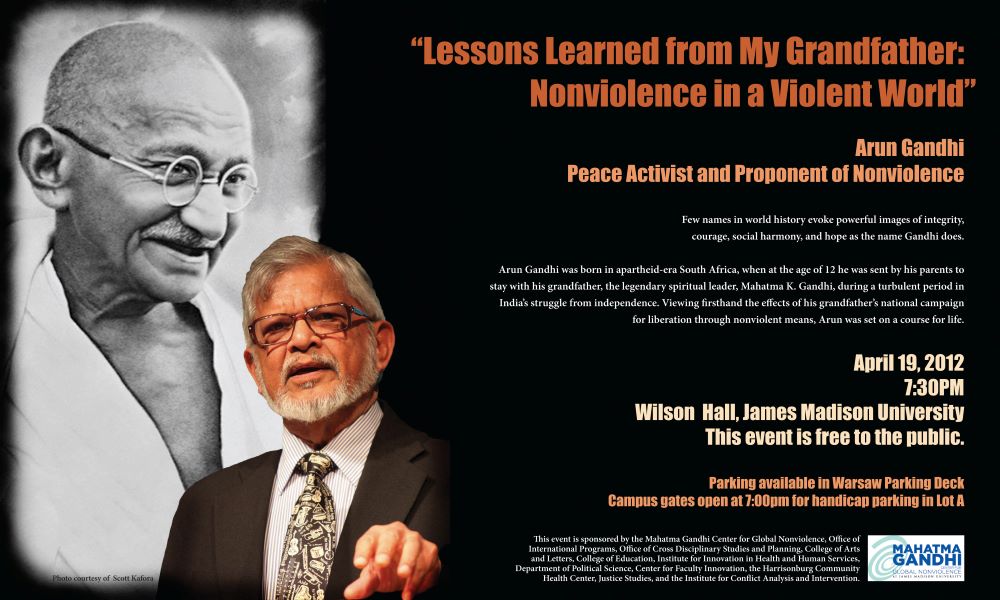
At the Mahatma Gandhi Center for Global Nonviolence, we are exploring the significance for the contemporary world of the great task Mahatma Gandhi set for himself and for all of us as an experiment and an actual experience. "My mission," he said, "is to convert…the world to non-violence for regulating mutual relations, whether political, economic, social, or religious." Our work is based on distinctively Gandhian insights, methods, and strategies. It addresses a set of problems that are uniquely urgent, and it represents a uniquely promising potential to make a positive difference on a global scale.


Uniqueness however is both an ancient vice and a quintessentially modern virtue. The ancients knew that there is "nothing new under the sun," as a wise yet depressed sage observed in the Hebrew Bible, and that anything claiming to be "new" was unlikely to be worthwhile. Moderns reverse the traditional scale of values and are ever seeking something that claims to be new and different. Mahatma Gandhi was both an heir to ancient values and the singularly influential "nonviolent revolutionary" of the twentieth century who reworked inherited wisdom into a plan of action suited to an age of technologically fueled empires and global access to communication.


Gandhian nonviolence brings hope for the future of humanity. For Mahatma Gandhi the opposite of war is not peace but ahimsa. He never used the word "santi," which is an equivalent for the English word "peace" in the sense of ultimate union of the soul with the Divine. The peace for which we usually pray and ask others to pray would be translated by the word "sandhi," meaning truce, suspension of war. What Gandhi taught is ahimsa, which consists in total avoidance of harm to another, in thought, in speech, in action. For him this is neither a doctrine nor a dogma: it is an action, an act of every moment. In contrast, more typical appeals to "Peace!" are what Hamlet would qualify as "Words, Words, Words!" in answer to Polonius' query.


Mahatma Gandhi did not preach nonviolence. He did not ask others to pray for it. He acted out his ahimsa. He never swerved from the belief that a pure, noble end must be sought and attained by the execution of pure, noble means. He vigorously eschewed the argument that some evil means can be condoned if the end happens to be satisfactory. Nor could he advocate the choice of a lesser evil as a necessity to avoid being coerced into adopting a bigger evil, for the choice of the lesser evil is always evil.


Education is a key to preparing people to appreciate the value of nonviolence, the potential of nonviolent action to address conflicts, the value of social responsibility, the interconnected nature of all human experience, and the planet's natural environment.


The Center is a non-partisan and non-sectarian enterprise that welcomes both secular and faith-based participants in its programs as well as secular non-governmental organizations.


The Center was established on March 4, 2005.

James Madison University logo PUBLISHER: Gandhi Center at JMU, MSC 2604, Harrisonburg, VA 22807 - PHONE: (540) 568-6394 - FAX: (540) 568-7251
FOR INFORMATION CONTACT: Webmaster - Privacy Statement
Last Modified: 5/8/2008